Leaving Langar
On my second morning in the Wakhan we got ready to leave Langar, and Megi's language skills came in handy once again. It turned out that one of Yodgor's relatives would be heading down the valley later in the morning, so we arranged to have him pick us up from the side of the road as we started ahead of him.It was only while we were leaving that we discussed money with Yodgor, and when we asked him how much we owed him, he suggested 30 somoni per night–including breakfast and dinner–but said that if we thought this was too much we should say so. This is a screaming deal compared to prevailing rates at tourist-board-affiliated homestays—which are around $10 (45 somoni at the time) for a place to sleep, with meals adding another $5-$7 per day—so I was perfectly happy with his prices... and happy to recommend him to anyone staying in Langar. Of course the facilities are a bit more basic than at more tourist-oriented homestays (expect breakfast to be the shir choi that is a staple of local diet—bits of old, hard bread mixed with back tea, milk, and butter), but Yodgor is friendly and honest.
 |
| Panorama of the Wakhan valley to the west of Langar. |
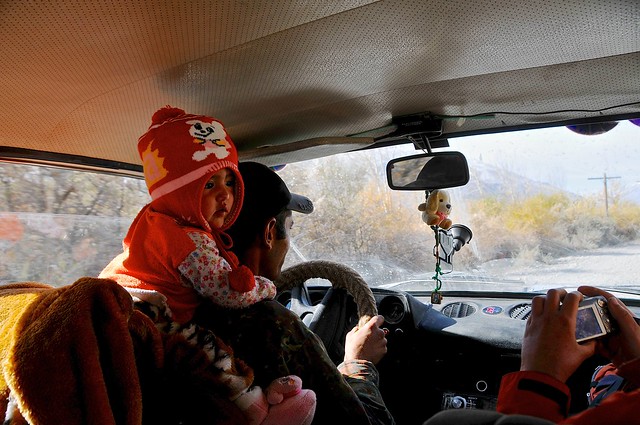 |
| Tajik car seat. Rather like a 1970's western car seat, except the kid is way cuter. The car was a Lada Niva, which is like a 4-wheel-drive version of a 1970s VW Golf/Rabbit—a model which has been in continuous production since 1977. Just about every old car is equipped with an mp3 player that accept tiny micro-SD cards, and it can be comical to be bumping along horrific roads in an ancient vehicle driven by a rough and tough local who starts fumbling with a tiny little memory card between his fat, callused fingers when he decides to switch up the music. |
We were dropped off in the village of Vrang, which is notable mainly for a five-level stepped pyramid which is usually described as a Buddhist stupa, but which some think may originally have been a Zoroastrian fire-worship platform—it definitely doesn't look like any other Buddhist stupa you're likely to see. Regardless of its original purpose, the structure was used for Buddhist purposes at some point in its history, and their are monks' caves built into the stupa's foundation—and apparently there are more caves on the other side of the Pyanj in Afghanistan, where a monastery was also located.
 |
| We were dropped on the main road through Vrang, from which it is a short walk through the fields to the Buddhist or Zoroastrian stupa/pyramid on a salt-dome above the village. |
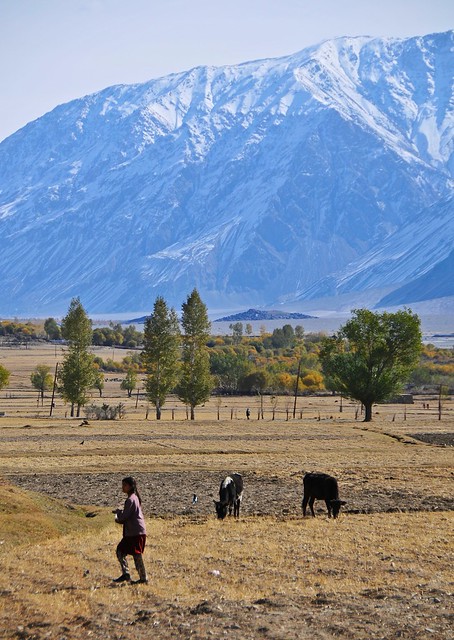 |
| A Pamiri girl in the fields. |
As we walked through the village towards the pyramid which towers over the village, Megi and I were approached by a girl of perhaps twelve who offered to show us the way and guide us around the village. This sort of thing is very common in Southeast Asian countries like Cambodia and Burma, where there are kids at local temples and caves who will tag along and show you the path or point things out with their flashlights, all in the hope of getting a tip at the end. I didn't know if this was the same sort of setup, but I suspected it might be, especially since the Lonely Planet section on Langar indicated people would expect to be paid for guiding you to the petroglyphs there. That being the case, I largely left Megi and the girl to walk together and chat, which was relatively easy to do since could talk pretty easily in Tajik.
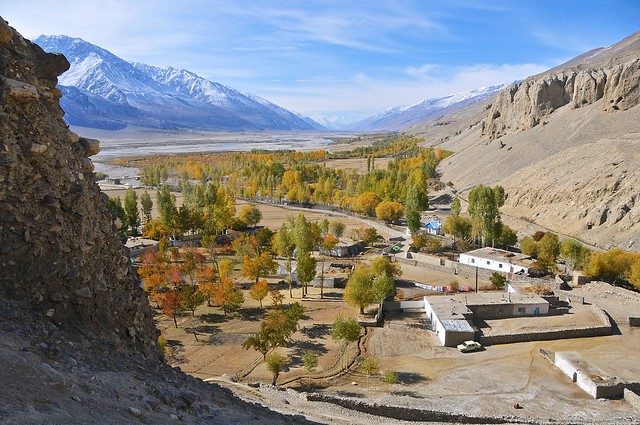 |
| The best way to the pyramid is to curve around the base and enter from the side. This approach lets you take a look at the (inaccessible) Buddhist caves built into the pyramid's foundation, which you can see on the left. |
 |
| Panorama from above the pyramid, with the ruins of an old fort above the pyramid. |
