Showing posts with label homestay. Show all posts

Saturday, 27 October 2012

Back in Khorog, via the border town of Ishkashim

In the morning we had breakfast and then settled up for our room and board. Aydar asked 50 somoni but was open to negotiation. Meggy thought this was a bit much, but given that official homestays cost that much for a bed and breakfast alone, I thought his price was quite fair, especially given that we each had our own room and there was a western toilet... and especially since it had been a rough year for tourism with the region closed for tourists for most of the peak season.
We ended up paying 50, and Aydar helped us find a ride into Ishkashim. There's a fort near Ishkashim, on a hill between the road and the Pyanj river, which many tourists stop at and which is somewhat known for being frequently occupied by Tajik border guards who don't take kindly to unannounced visitors, but since we weren't in a private car we didn't stop. Most of the excitement involved in stopping at this fort seems to center on interacting with the border guards, anyway, so I don't think it was any big loss.

Once we alighted in Ishkashim we first headed west of town to the location of the cross-border Saturday market to confirm it wasn't being held, then came back into town and explored the regular, daily market. The market was pretty basic, but we picked up some fruit and snacks. Ishkashim seemed like a pretty basic town, and in 2012 there were somewhat surprisingly no real places to stay there, even though it was the jumping-off place for exploring the Afghan Wakhan. And even though not a lot of tourists explore the Afghan side, there are plenty of traders and local who do cross over into Afghanistan (or vice-versa), so the lack of options is somewhat surprising.
_DSC3730
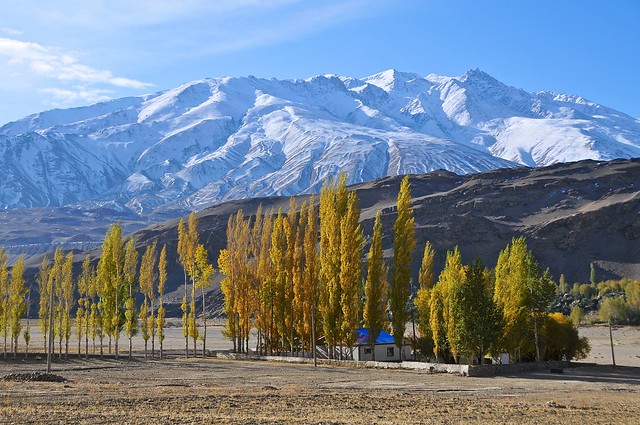
West of Ishkashim, near the Saturday market, looking towards Afghanistan.

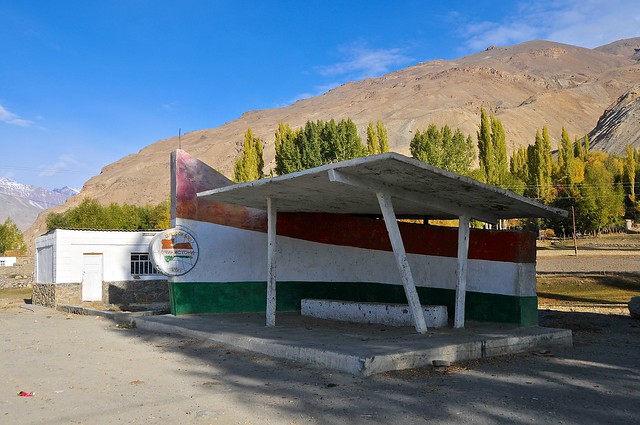
_DSC3728
Cool bus stop. Does this mean they had proper bus services in the Soviet era?

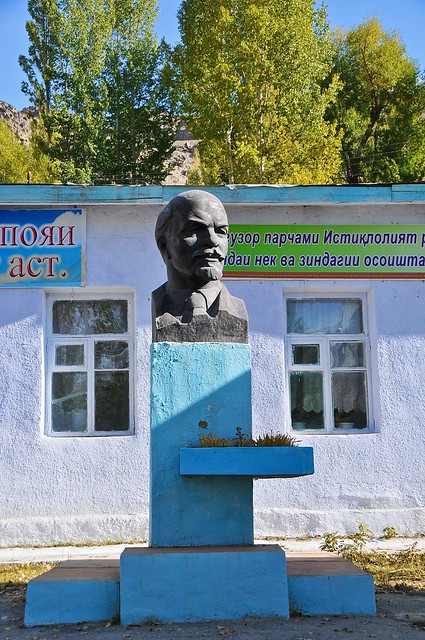
_DSC3731
More Lenin, with some of Rahmon's words of wisdom on the walls behind.

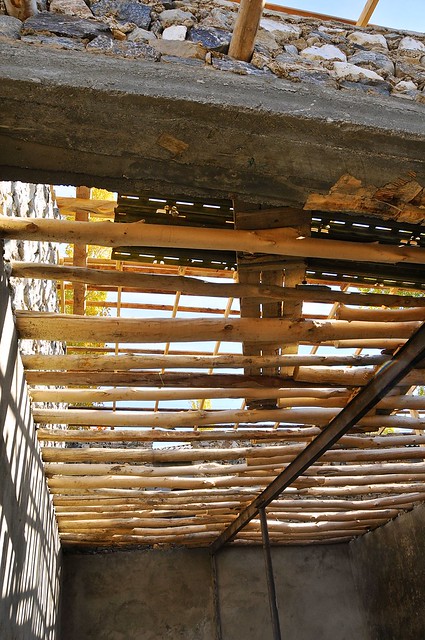
_DSC3732
Interesting construction techniques: concrete supports on the lower level, stone walls, and rough wooden logs as floor and ceiling supports.

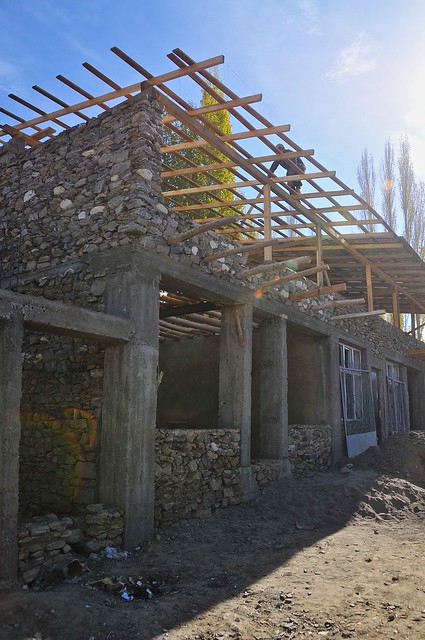
_DSC3733
Building new shops in Ishkashim's market area.

Strange happenings on the ride from Ishkashim to Khorog

We managed to find a car heading back to Khorog without too much difficulty. All of the other people in the SUV were young guys in their twenties, and out bags were stuffed in the back.

As we left town, we made a brief stop at a farmhouse just outside Ishkashim. These kinds of stops to pick up passengers and cargo are pretty normal, but this was a bit different, as we stopped about 100 meters from the house and they didn't want us to get out. The driver and his friend headed inside, then a couple of minutes later they came running back to the car, jumped in, and we immediately sped out of there. This is all very strange, as you never see anyone running, and usually no one is in a rush to get into a car (even if the driving is often quite manic). The concern was amplified when one of the guys in the rear seat started stuffing things into someone's bag—we couldn't see what he had r where he was putting it, but something was going on. 

Meggy and I exchanged slightly concerned glances, and we were both a little apprehensive when we reached the checkpoint between Ishkashim and Khorog, as we were both thinking that possibly these guys had picked up (or stolen) some drugs or other contraband and put them in our bags to help smuggle them through security. It turned out we had no problems at the checkpoint and there was certainly nothing removed from our bags before we left, so while the circumstances around that little stop remained a mystery, it was likely much more innocuous than we imagined. Or maybe not. 

Anyway, during the post-checkpoint ride to Khorog, we talked a bit with some of the guys, and it turns out that a couple of them were Afghanis from Afghanistan's Ishkashim who were studying and living in Khorog. I was a little surprised to hear this, as I kind of figured that Tajikistan would make things difficult for foreigners (from poorer countries) who wanted to live and study in Tajikistan, but apparently it isn't that uncommon in the region.

Back in Khorog

In Khorog we were dropped off at the taxi lot, and then decided to head over to the botanical gardens for the afternoon. Meggy was going to stay with the family she had stayed with the last time she was in Khorog (she had met a woman on her car ride from Dushanbe, and the woman had invited her to stay with her), so she went there while I headed back to Lalmo's. We met a half hour later, and took a marshrutka to the botanical garden, which is on the east side of town on a bluff south of the river overlooking the town.

I'm not quite sure what your typical botanical garden looks like, and October probably isn't prime viewing season, but this garden seemed to be mostly trees, with a path winding through it and a few picnic areas. On the south edge of the garden, overlooking the valley below, there is a large and impressive European-style house (currently undergoing renovation)—this building doesn't really have anything to do with the garden, but is one of the President's residences.

Behind the President's house is an orchard full of regularly planted apple trees, which were full of fruit when we were there. There was some fruit on the ground, and many apples which could easily be knocked loose by shaking the tree or throwing sticks up at branches.
_DSC3736
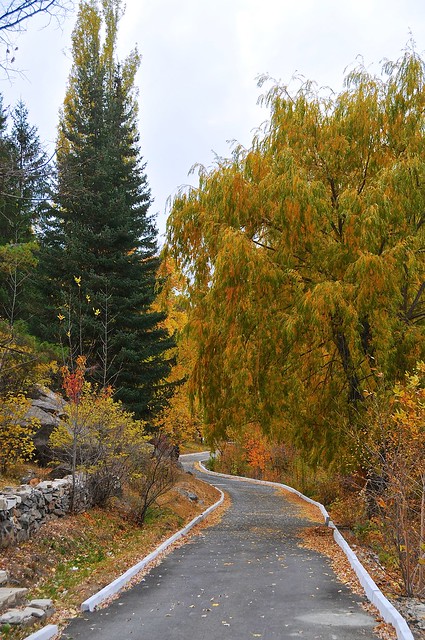
Khorog's botanical garden on the east edge of town. It's meant to be the second or third highest botanical garden in the world. It was pretty abandoned when we were there, but they had lots of trees full of ripe apples which we stocked up on.

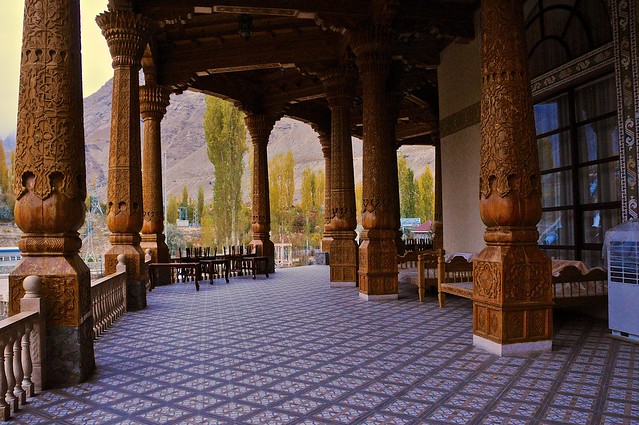
After filling our pockets with apples, we returned to the President's house and headed down the grassy slope to the valley below, where we had spotted an interesting building near the river. It turned out to be a fancy chaikhana that was surrounded by a chain-link fence and locked up. I think it was used mainly during big events like Presidential visits and weddings. The guard came out to the entrance gate and after chatting with Meggy he let us in and gave us a brief tour of the exterior. It was impressive overkill: the sort of ostentatious but useless buildings you see being built in Dushanbe by people like Rahmon, and not the sort of functional infrastructure built in the Pamirs by the Aga Khan.
_DSC3739
The ornate and little-used chaikhana.

The weather in Khorog was disappointingly grey and cool, which only served to remind us how lucky we had been with the brilliantly sunny and warm weather we had enjoyed for the last few days. When I got back to Lalmo's she said that she had forgot to ask me if I wanted to eat there that evening, and when I said I did (it was dark and I didn't want to head down into town to find the Delhi Darbar Indian restaurant, which is pretty much the default option for travelers in Khorog) she was kind of pressured to whip something up on short notice. Reminder: always let her know in advance if you want dinner, as if she has notice she can make pretty great stuff.

Speaking of food, while walking to Lalmo's, I had encountered a young boy who offered me some food. I declined, and in doing so I think I committed a serious faux pas. As I said earlier, the Afghan market and the borders with Afghanistan were closed at this time for Eid al-Adha, which commemorates the willingness of Ibrahim/Abraham to sacrifice his son for God/Allah. Today, Muslims who can afford to do so commemorate Ibrahim's sacrifice by sacrificing their best animal, which they then divide into three portions for themselves, their neighbours, and the needy—and that distribution of food is what the boy was doing when I turned him down. This sort of community spirit is something I love about Islam: their religious holidays are still very much about the community and the less fortunate, and taking care of them. Ramadan is all about depriving yourself of food so you can understand how the hungry feel every day, and breaking the fast is about inviting the community to share in your food. Now think of the largest Christian holidays and what they mean (or don't). It's because I found the philosophy behind Ramadan so appealing that I started to observe Ramadan in my early twenties: it's a holiday that makes sense, unlike my equally secular historical observation of Christmas.

Budget

October 27, from Yamg to Khorog: 157 somoni
  • Taxi from Yamg to Ishkashim: 25 somoni
  • Taxi from Ishkashim to Khorog: 60 somoni
  • Room and dinner at Lalmo's: 72 somoni ($15)

Friday, 26 October 2012

Another day in paradise: Yamg, Vrang, Yamchun Fort, and Bibi Fatima hotsprings

Leaving Langar

On my second morning in the Wakhan we got ready to leave Langar, and Megi's language skills came in handy once again. It turned out that one of Yodgor's relatives would be heading down the valley later in the morning, so we arranged to have him pick us up from the side of the road as we started ahead of him.

It was only while we were leaving that we discussed money with Yodgor, and when we asked him how much we owed him, he suggested 30 somoni per night–including breakfast and dinner–but said that if we thought this was too much we should say so. This is a screaming deal compared to prevailing rates at tourist-board-affiliated homestays—which are around $10 (45 somoni at the time) for a place to sleep, with meals adding another $5-$7 per day—so I was perfectly happy with his prices... and happy to recommend him to anyone staying in Langar. Of course the facilities are a bit more basic than at more tourist-oriented homestays (expect breakfast to be the shir choi that is a staple of local diet—bits of old, hard bread mixed with back tea, milk, and butter), but Yodgor is friendly and honest.

_DSC3542 - _DSC3555 2
Panorama of the Wakhan valley to the west of Langar.

_DSC3556
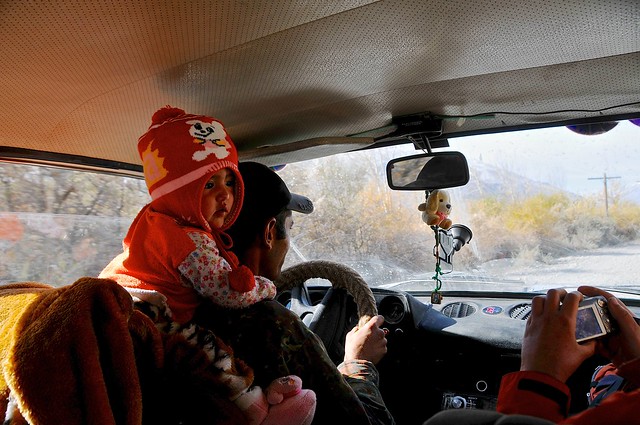
Tajik car seat. Rather like a 1970's western car seat, except the kid is way cuter. The car was a Lada Niva, which is like a 4-wheel-drive version of a 1970s VW Golf/Rabbit—a model which has been in continuous production since 1977. Just about every old car is equipped with an mp3 player that accept tiny micro-SD cards, and it can be comical to be bumping along horrific roads in an ancient vehicle driven by a rough and tough local who starts fumbling with a tiny little memory card between his fat, callused fingers when he decides to switch up the music.

We were dropped off in the village of Vrang, which is notable mainly for a five-level stepped pyramid which is usually described as a Buddhist stupa, but which some think may originally have been a Zoroastrian fire-worship platform—it definitely doesn't look like any other Buddhist stupa you're likely to see. Regardless of its original purpose, the structure was used for Buddhist purposes at some point in its history, and their are monks' caves built into the stupa's foundation—and apparently there are more caves on the other side of the Pyanj in Afghanistan, where a monastery was also located.

_DSC3557 - _DSC3562
We were dropped on the main road through Vrang, from which it is a short walk through the fields to the Buddhist or Zoroastrian stupa/pyramid on a salt-dome above the village.

_DSC3563
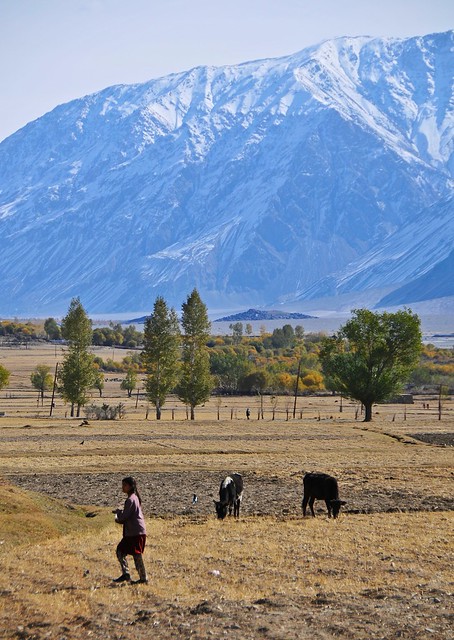
A Pamiri girl in the fields.

As we walked through the village towards the pyramid which towers over the village, Megi and I were approached by a girl of perhaps twelve who offered to show us the way and guide us around the village. This sort of thing is very common in Southeast Asian countries like Cambodia and Burma, where there are kids at local temples and caves who will tag along and show you the path or point things out with their flashlights, all in the hope of getting a tip at the end. I didn't know if this was the same sort of setup, but I suspected it might be, especially since the Lonely Planet section on Langar indicated people would expect to be paid for guiding you to the petroglyphs there. That being the case, I largely left Megi and the girl to walk together and chat, which was relatively easy to do since could talk pretty easily in Tajik.

_DSC3564
The best way to the pyramid is to curve around the base and enter from the side. This approach lets you take a look at the (inaccessible) Buddhist caves built into the pyramid's foundation, which you can see on the left.

_DSC3565 - _DSC3570 2
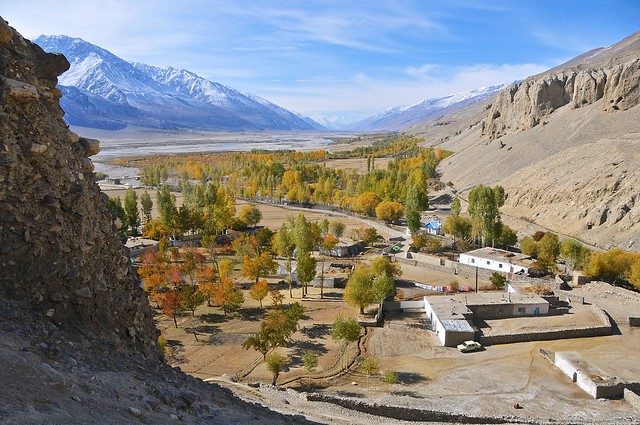
Panorama from above the pyramid, with the ruins of an old fort above the pyramid.

Thursday, 25 October 2012

Welcome to the Wakhan: two nights in Langar

The eventful ride to Langar

After getting my visa I headed over to the taxi lot for Ishkashim and Langar. Walk through one of these lots and you'll be approached by people asking where you're going, and if you're lucky they'll either be going there or point you to someone who is. Then you start negotiating price, which can be tricky for locals and foreigners alike. The general rule is that you try to get to car lots as early as possible, although when traveling from a market town to nearby rural villages most cars leave after people have had a chance to shop at the market. Ishkashim itself is probably somewhere between the two options: it's lose enough that people may drive up to Khorog in the morning for the market, but it's also big enough that it has a decent market of its own. Langar is far enough away that no one would drive to Khorog just to do shopping, however.

Despite this, and despite my not leaving until the afternoon as a result of obtaining my Afghan visa in the morning, I was able to find a vehicle going all the way to Langar, for 100 somoni.

Of course, this being rural Central Asia, things are rarely as simple as they seem. Even though the car was full, we ended up making a stop at the nearby village of Dasht, which is just above the Khorog-Ishkashim road but utterly hidden from the valley below, so that we could pick up some cargo from one of the passengers' family. We ended up staying in Dasht for fifteen minutes or so, stopping at a couple of different houses before continuing on our way. Pretty standard stuff. One of the ladies returned from one of the houses with a big bag of apples which she shared with the car.

_DSC3339
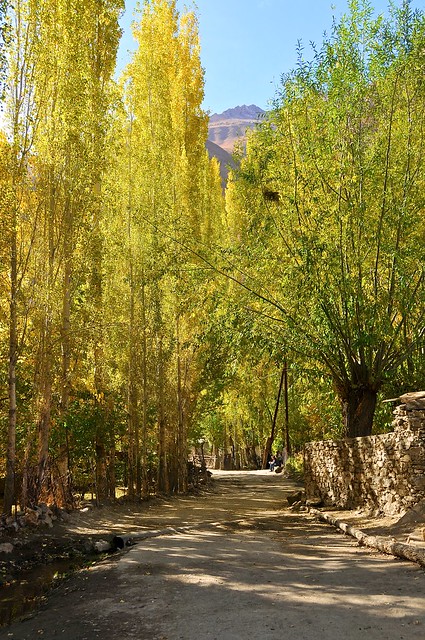
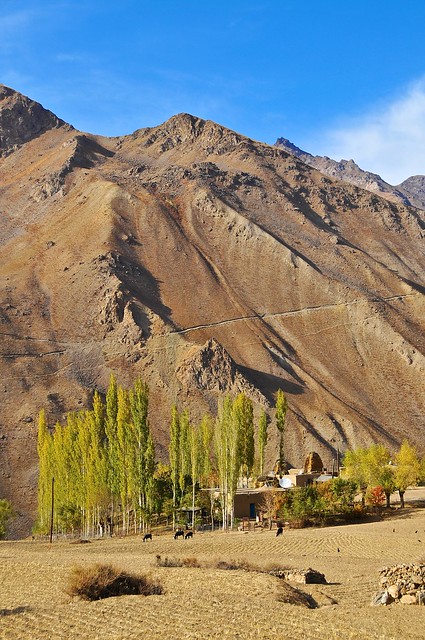
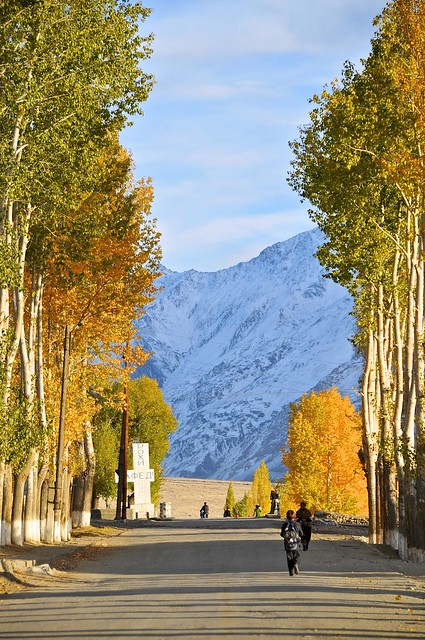
Poplar-lined road in Dasht village, above the road to Ishkashim.

_DSC3342
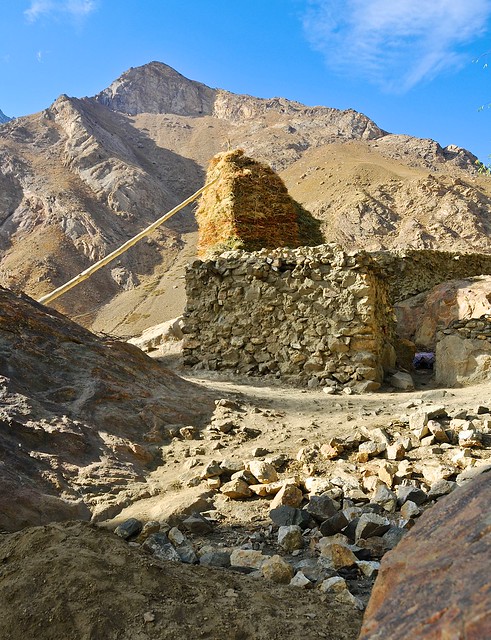
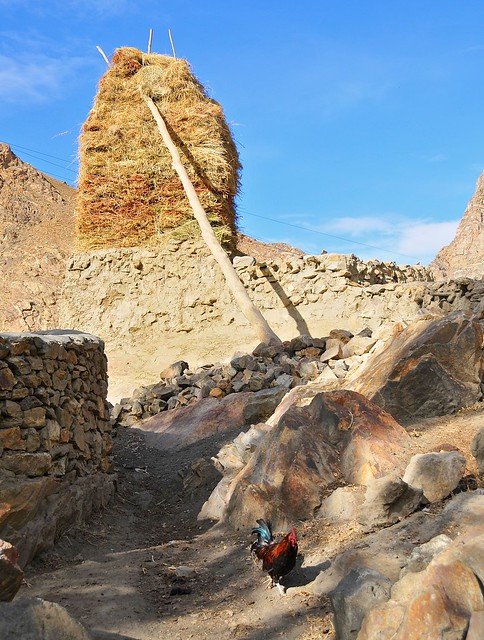
Hay stacked precariously on the roof.

_DSC3341
Rooster just wandering around the village.

_DSC3345
A Tajik farmhouse, with Afghan mountains on the other side of the Pyanj river.

_DSC3347
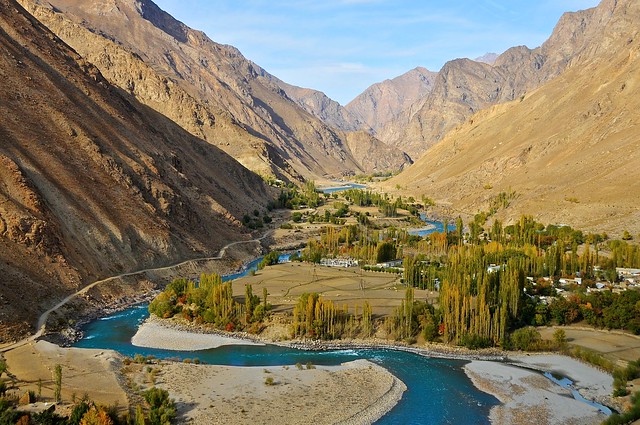
Looking north down the Pyanj towards Khorog: Afghanistan on the left, Tajikistan on the right.

_DSC3349
Looking down the main street in Ishkashim, with the Hindu Kush in the background.

Tuesday, 23 October 2012

One day in Khorog: an oasis of progressiveness


GBAO: the Gorno-Badakhshan Autonomous Oblast

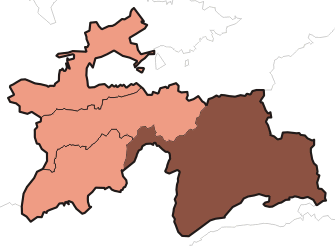
Basically all of the Pamirs and the entire southeastern knob of Tajikistan falls within the administrative region known as Gorno-Badakhshan. And if ever there was a part of the country that could be said to contain nothing but rocks and water, it would be the GBAO, which occupies 45% of Tajikistan but has only 220,000 people (about 3% of the population).


Pamiris are Ismaili Shias, while most Tajiks are Sunni

The region is not only geographically distinct, but ethnically and religiously as well. The northeastern part of the GBAO, along the Pamir Highway from the Kyrgyz border until at least Murghab, is mainly Kyrgyz, while the western GBAO and areas near Afghanistan (which are significantly lower, though still above 2,000 meters) are mainly Pamiri. Pamiris have their own languages, but like Dari and Tajik, these languages are minor variants of Farsi and seem to be mutually intelligible for the most part. The main point of distinction between Pamiris and the Tajik is religious: while lowland Tajiks are Sunni, like 90% of Muslims in the world, Pamiris are Shia—and more specifically, Ismaili (which are only 20% of Shias).

Attending university in Calgary, I knew quite a few Ismailis: we had a sizeable population of Gujarati Ismailis who worked as traders and settled in East Africa, but were then expelled from countries like Uganda after they gained independence (Indian merchants being convenient scapegoats). Many seem to have somehow made their way to Calgary. Indeed, the beloved mayor of Calgary, Naheed Nenshi, is an Ismaili Muslim of Tanzanian extraction.

So who are the Ismaili's? Well, here's an excerpt from a great piece on Ismaili Islam on Paul's Travel Blog:


The Tajik Pamirs and northern Pakistan share not only mountainous terrain and certain ethnic/cultural links but also religion: Ismaili Islam. The Ismailis are Shiite Muslims who believe that the true seventh Imam was a man named Ismail rather than his younger brother Musa, as the Twelver Shiites (such as those of Iran) believe. While during certain periods, such as the Cairo-based Fatimid Empire, Ismailis were a powerful force, today they form a small minority of Muslims, often scattered in remote mountainous terrain.

The historical distinction between Ismailis and other Shiites may seem minor, but, over time, this simple succession dispute has led to a universe of divergence, as Ismailis have become among the most progressive of the Islamic sects, in stark contrast to the Shiites of Iran. Indeed, the distinction between Ismailis and other Muslims has grown so great that one (Sunni) Kyrgyz woman in Tajikistan told us that the Tajik Pamiris were not even Muslim. Of course, despite the strong lingering of pre-Islamic beliefs and traditions the Ismaili Pamiris are in fact Muslim, as are the Ismaili Hunzas of northern Pakistan, but it is true that the Ismaili worldview of the twentieth and twenty-first centuries is clearly a world apart from some other sects of Islam, and, to this outsider, far more appealing.

Ismailis are also different from most other Muslims in that they have the Aga Khan as a living spiritual advisor, whom they see as a direct descendant of the seventh Imam, and more importantly they believe that he is able to interpret the Quran in the modern context. I suppose this might make him something like the Pope, but the Aga Khan is quite different than the Pope in that he is an extremely modern man (in this he more resembles the Dalai Lama), was born in Switzerland, and is something of a playboy. Imagine Tony Stark as the leader of a branch of Islam and you're not too far off. I mean, his parents were divorced and his father then married Rita Hayworth, which tells you a lot about his family and their values—especially given that his grandfather was the prior Aga Khan and passed on his duties to his grandson because he wanted even more modernity from the future leader.

The net effect of having a branch of Islam being led by this Swiss-born spiritual leader is that Ismailis are hugely progressive by the standards of just about any religion, and the hugely wealthy Aga Khan remains close to his followers and spend hundreds of millions of dollars per year through his Aga Khan Foundation and Aga Khan Development Network to advance the development of his people and their surrounding communities.

The impact of the Aga Khan and the magnitude of his contributions are most apparent in the GBAO—and in Khorog in particular—as so many of the things that make the town so special have been funded by the Aga Khan. From quite literally building bridges that connect communities and countries, to providing food aid during the civil war, to spending in the medical community, to providing education, to hearing people in the streets tell you that they do things (or don't do things, like drugs) because of the guidance of the Aga Khan. One area where you see a real difference is in how women are treated. Unlike in the ultra-conservative Fann Mountains, women play a real role in civil society and assume positions of leadership within families. Girls are not second-class citizens, women don't run away from even the most fleeting contact with men, and there seems to be no thought of denying them education because of their sex. It's no coincidence that the homestay I stayed at is known as Lalmo's homestay, and not Lalmo's husband's homestay: women are empowered to a startling degree.

The post-Independence Civil War

Now, in the paragraph above, I alluded to the civil war. Tajikistan is the only one of the Central Asian CIS countries that devolved into civil war following independence from the crumbling Soviet Union, and given the cultural and logistical differences between the GBAO and the rest of the country perhaps it's no surprise that Badakhshanis and the lowland Tajiks were on opposing sides... or that the lowlanders won.

The current President, Emomali Rahmon, came to power as a result of the civil war, and he has basically been the only leader that an independent Tajikistan has ever known. In the wake of the civil war it seems that Rahmon granted government positions to a number of warlords and opposition leaders in a attempt to placate them and ensure a measure of government support—something that was probably of special interest given the strategic importance of the GBAO given its long borders with China and especially Afghanistan.

Despite these concessions, there has been a long history of tensions between the Pamiris and lowland Tajiks. Part of this tensions is religious (many Tajiks think that Ismaili Islam isn't a pure or legitimate form of Islam, epsecially since it views the Quran as open to interpretation by the Aga Khan) and part of it is a resentment by the Pamiris that the government treats them unfavourably (you certainly hear people saying that there were better services during the Soviet era, and although you hear this in lots of former second-world countries, in the Pamirs I think there is the suspicion that the decline has been due to them being Pamiris and not lowland Tajiks). Virtually everyone in the GBAO will self-identify primarily as something other than Tajik, be it Kyrgyz or Pamiri.

First impressions: walking from the Airport to Lalmo's

I don't know what I was expecting from Khorog. Something high and harsh, maybe. Small and rough. And definitely running north-south along the border with Afghanistan. On pretty much all fronts I was surprised. Although Khorog is at an elevation of over 2,100 meters, the town is surprisingly green and full of trees. And for late October, it was a lot warmer than I expected, and pleasant to walk around in the sun. Heck, this would be better weather than one would expect in Calgary, and the climate also supports a greater range of trees. Looking at weather profiles for Khorog, however, it seems like a remarkably temperate city, with the average high in October of 18°C (65°F)—only in January is the average high below freezing.

And despite the harrowing road journey from Dushanbe, Khorog didn't feel as isolated as I expected. The markets were well stocked—certainly much more so than I saw in Kyrgyz Alay Valley communities like Sary Mogul, Sary Tash, and Daroot Korgon. Maybe this shouldn't be so surprising, as it actually lies on the closest road to China, which would run through the Pamir border of Qolma before running through Murghab and Khorog on the way to Dushanbe.

Among the ubiquitous Chinese goods at the market there were some distinctly Pamiri items like huge and bulky socks and knitted toques ("knit cap" in American). Perhaps the only way the town revealed its isolation was in the food situation, as there didn't seem to be many restaurants.

_DSC3267
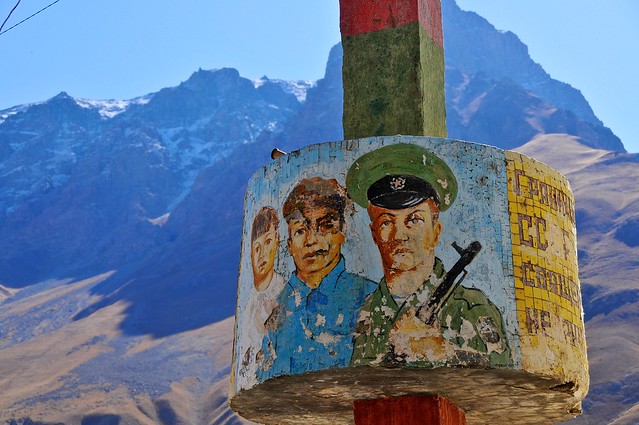
An  old Soviet-era social-realism style painting on a pole.

_DSC3268
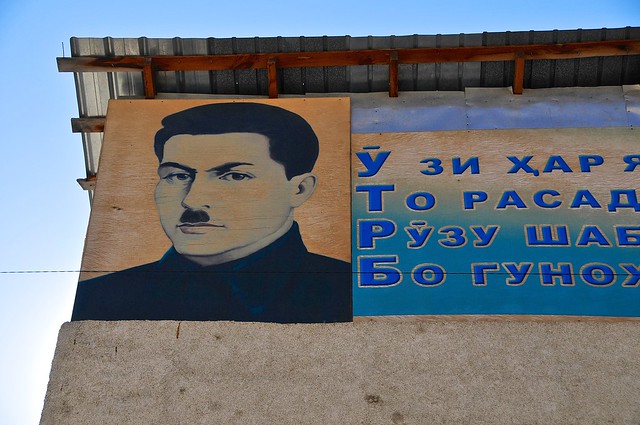
The "Hitler" look is apparently respectable in Tajikistan. Or maybe it demands respect. Or fear. Or something. Based on some things I later saw in Murghab, this guy appears to be some sort of government official.

_DSC3269
Khorog lies along the northern and southern slopes of the Gunt River, just before it joins the north-south flowing Pyanj river, which forms the border with Afghanistan.The Gunt almost seems bigger than the Pyanj.

Saturday, 8 September 2012

Arslanbob

The Marshrutka to Arslanbob drops you off in the town square, which is essentially a big gravel parking lot with a small statue in the middle. A short walk uphill along the river from the square is the CBT office, which should be your first stop.

CBT, or Community Based Tourism, is a Kyrgyzstan-wide tourist initiative that helps connect tourists with local homestays and tour guides. The basic idea is that the central CBT offices help train the homestay and service providers, while certifying their offerings (homestays are classified according to the amenities they offer) and providing centralized booking services. In return, they receive a commission of about 15%, with the remainder going to the local operators.

CBT was launched in 2000 by the Swiss NGO Helvetas, and my understanding is that they provided significant start-up funds, training, and infrastructure support. Unfortunately, CBT seems to have gone through some growing pains when Helvetas withdrew and turned over all operation to local Kygyzstanis. Some of the more popular homestays disliked paying a commission to the local CBT office, and withdrew. Some of the CBT booking offices started directing most or all tourists to favored homestays they might have connections with, meaning that only a select few providers actually benefited from the scheme. CBT offices throughout the country continue to offer varying levels of assistance, expertise, and availability, making it difficult to evaluate the CBT as a whole.

The CBT office in Arslanbob seems to be one of the best-run offices in the entire country, even if it does seem to support an unsustainably high number of homestays, at 18. They seem to provide fairly impartial allocation and travel advice/information, even trying to develop skiing in the area. They can also provide internet access through a cell-phone based modem, but this is pretty pricey.

Anyway, I opted for an English-speaking host, and homestay #13 was suggested to me. This was located a kilometer or so west of the square, near the access road leading up to the plateau that sits to the southwest of the village. The homestay was really quite nice, with all of the guest rooms located in a separate building with about three bedrooms and a common room that could collectively sleep about a dozen people. The houses feel quite Russian, with stucco walls, pastel colours, and lots of lace and floral prints.

As with most places outside of the major cities, there is no real plumbing and no sewer, which means long-drop outhouses. In practice, this typically entails a separate outbuilding with a cement floor with a narrow slot in it: a squat toilet. Even though it's an outhouse, you don't throw your used toilet paper down the hole, but in a bin next to the toilet (outside of Japan, it has been the norm to put used paper—which you've typically supplied yourself—in a bin and not down the toilet). Depending on how well the toilet and pit has been maintained, it might not even be that unpleasant an experience.

Even places with long-drop toilets typically have hot showers, as it really doesn't require much more than a hot water heater and gravity. They'll be placed in another area, sometimes even in places with dirt floors, and while gravity alone doesn't lead to very good water pressure, they get the job done... just be sure to wear your flip-flops.

The host of our homestay was a schoolteacher who had been mayor of the village in the past (one of his prouder achievements as mayor was to eliminate hard alcohol from Arslanbob), and he—like over 90% of the village—was Uzbek. It's a little surprising to find so many Uzbek (the population of Arslanbob seems to be almost 10,000) in the mountains, but there is a surprising amount of farming in the village. Like most Uzbek families, this one was large, as I believe he had something like seven children, and would have been happy with 10 (it's a nice round number, and why wouldn't you want 10?).

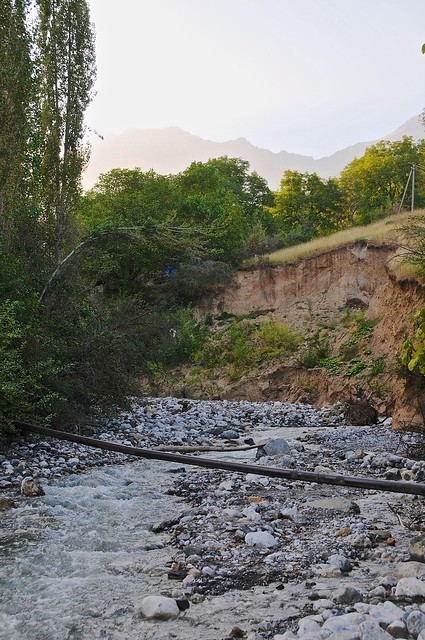
_DSC9859
This stream runs in front of the homestay I stayed at. Even at the end of summer there was still abundant water flow from high-elevation snows and glaciers, and these streams (which run everywhere) are the source of water in Arslanbob, which otherwise has no central plumbing system and certainly no sewer: this was one of the only pipes I saw, as most water was sourced directly from streams.

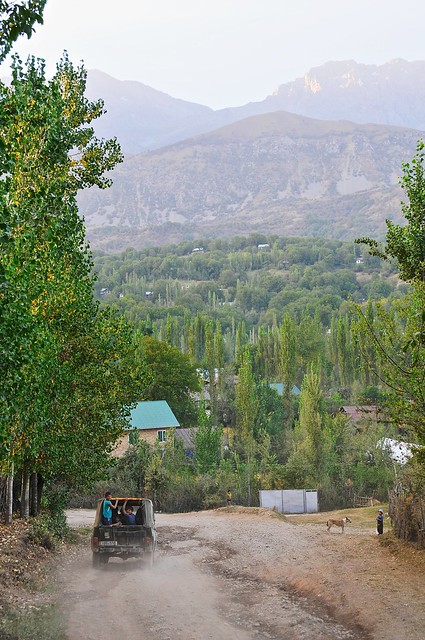
_DSC9861
Looking down the road up to the plateau. Everyone was coming down from a day working the fields up there, by ancient jeep, truck, donkey, and foot.

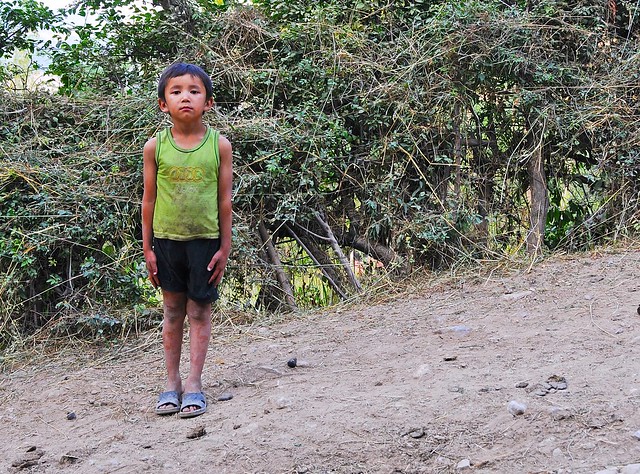
_DSC9865
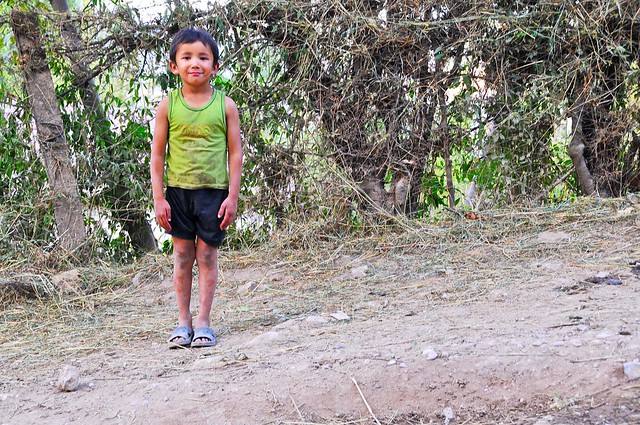
Apparently kids in Kyrgyzstan pose like soldiers at attention.

_DSC9868
At ease.

_DSC9869
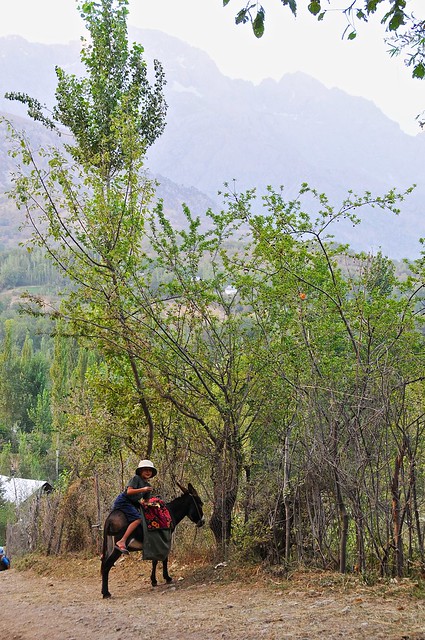
Donkeys are a common form of transport, mainly for young kids and old men.