Hotel Poytaht is a Dushanbe landmark. It's a huge Soviet-style hotel near the train station, and it's actually a reasonably attractive low-slung building that is four or five stories tall with two long wings angling off the central reception area. It's supposed to have reasonable rooms on the top floor that are charged on a per-person basis (and may or may not involve sharing), but they didn't want to sell me this sort of room, and said the lowest room was something like $30 or $40. The difference was academic to me, as either total was more than I wanted to spend.
I headed to a small supermarket nearby to get something to drink, and to plot out my next plan of attack. I figured out I would try the Farhang hotel, which is supposed to be cheap even if it's not exactly central. I hopped a bus headed in that direction, and found the hotel without too much difficulty (being behind the UFO-shaped circus, which itself was just off the major road the bus traversed, made this pretty easy). Whereas the Poytaht was well-maintained and a clean version of Soviet "hospitality," the Farhang had the dilapidated and scruffy feeling more familiar from Kyrgyzstan. For such a large hotel, I had to wait in the lobby until an attendant showed up, but the rooms were a bargain (for Dushanbe) at 60 somoni.
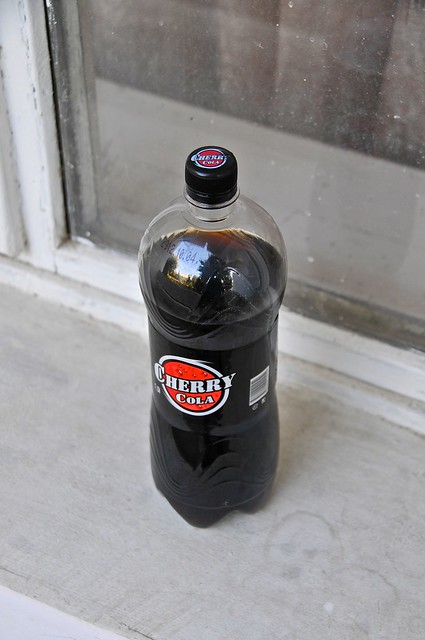 |
| I love Cherry Coke. This is no Cherry Coke. |
While Kyrgyzstani supermarkets were surprisingly Russian/Western, most of the things they sold were fairly local, or possibly from Turkey. In Dushanbe, a lot more things were imported from Europe, and a lot of things that would have been locally-produced in Kyrgyzstan were imported. Maybe the best example is Coke and Pepsi. Thomas Friedman's
McDonalds theory of war says that no two nations with McDonalds outlets have ever gone to war (which was true until the Russia-Georgia conflict), and to a certain extent I think this really says something about the stability of nations with McDonalds. I think that the existence of foreign brands in a country says a lot about the investment climate and political stability and predictability in that country, and in this context it's interesting to note that Tajikistan is the only country in Central Asia that
does not have a domestic Coke or Pepsi bottling facility: these products are officially imported from Kyrgyzstan, and unofficially imported from Afghanistan. The locally-bottled brand is RC Cola, which is more or less extinct in most corners of the world.
This lack of locally-produced goods inevitably means that things tend to be more expensive in Tajikistan than in Kyrgyzstan, which is unfortunate given that Tajikistan is even poorer than Kyrgyzstan. If your only exposure to the country was Dushanbe, however, it certainly wouldn't feel very poor—even if your only basis of comparison was with Kyrgyzstan's most prosperous city, Bishkek. Now, it's no surprise that large, capital cities feel more prosperous than other parts of the country, especially when the capital cities are orders of magnitude larger than any other city in the country. But even given this, it's pretty clear that a
disproportionate amount of public funds have been spent beautifying the capital, and that a disproportionate amount of money resides in the capital. The old, Soviet-era public buildings in Dushanbe are better maintained and more attractive than they are in Bishkek. As mentioned earlier, the stores stock more imported goods, at higher prices. You see a lot more late-model luxury cars and European imports in Dushanbe than Kyrgyzstan (although I believe that many of them are stolen), with models like BMW X6 models being not hugely unusual.
What really sets Dushanbe apart from Bishkek, however, is that in Dushanbe you can see new construction and new monuments being built by the government and
President Rahmon (who has ruled since 1992). Sure, Nazarbayev is doing the same thing in Astana, but the key difference is that Kazakhstan is riding a wave of resource-based prosperity, while Tajikistan remains dirt poor. Despite this, in Tajikistan the villages remain poor while Dushanbe is beautified.
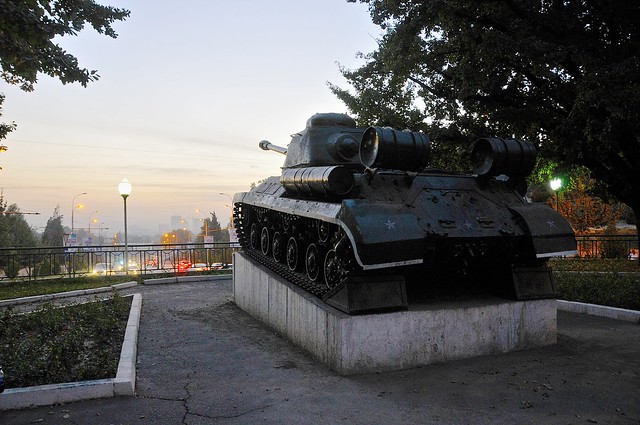 |
| Old Soviet tank in old-style park takes aim at the skyline. |
 |
| Imposing monuments (this one to Ismail Samani), empty plazas surrounded by barricades, and armed guards make these public spaces less than inviting. Pedestrians walking by skirted the plaza in front instead of taking the shortcut across, so I had to ask the guard to ask if it was possible to approach the monument and take a picture. |
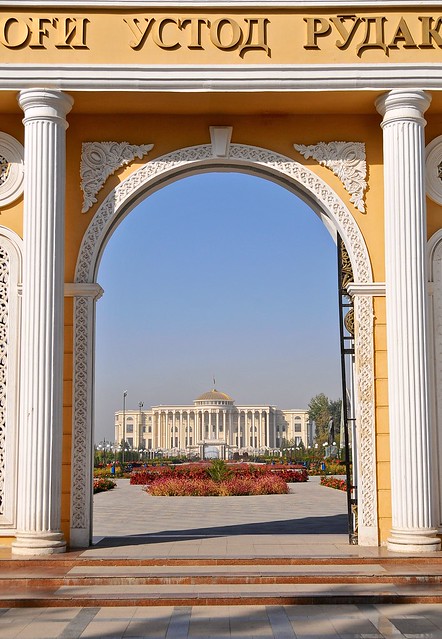 |
| The Presidential Palace. |
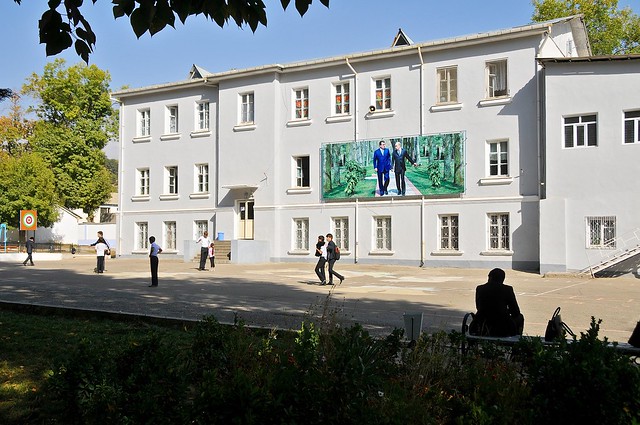 |
| Next to Turkmenistan, Tajikistan is the Central Asian country that most aggressively promotes a personality cult around its leader, Rahmon. Pictures of him heralding his accomplishments and profound statements ("Education is good!") are everywhere. Putin looks like a wimp next to him. |