Showing posts with label Dushanbe. Show all posts

Tuesday, 23 October 2012

One day in Khorog: an oasis of progressiveness


GBAO: the Gorno-Badakhshan Autonomous Oblast

Basically all of the Pamirs and the entire southeastern knob of Tajikistan falls within the administrative region known as Gorno-Badakhshan. And if ever there was a part of the country that could be said to contain nothing but rocks and water, it would be the GBAO, which occupies 45% of Tajikistan but has only 220,000 people (about 3% of the population).
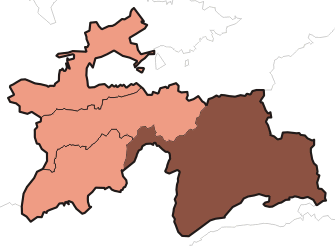

Pamiris are Ismaili Shias, while most Tajiks are Sunni

The region is not only geographically distinct, but ethnically and religiously as well. The northeastern part of the GBAO, along the Pamir Highway from the Kyrgyz border until at least Murghab, is mainly Kyrgyz, while the western GBAO and areas near Afghanistan (which are significantly lower, though still above 2,000 meters) are mainly Pamiri. Pamiris have their own languages, but like Dari and Tajik, these languages are minor variants of Farsi and seem to be mutually intelligible for the most part. The main point of distinction between Pamiris and the Tajik is religious: while lowland Tajiks are Sunni, like 90% of Muslims in the world, Pamiris are Shia—and more specifically, Ismaili (which are only 20% of Shias).

Attending university in Calgary, I knew quite a few Ismailis: we had a sizeable population of Gujarati Ismailis who worked as traders and settled in East Africa, but were then expelled from countries like Uganda after they gained independence (Indian merchants being convenient scapegoats). Many seem to have somehow made their way to Calgary. Indeed, the beloved mayor of Calgary, Naheed Nenshi, is an Ismaili Muslim of Tanzanian extraction.

So who are the Ismaili's? Well, here's an excerpt from a great piece on Ismaili Islam on Paul's Travel Blog:


The Tajik Pamirs and northern Pakistan share not only mountainous terrain and certain ethnic/cultural links but also religion: Ismaili Islam. The Ismailis are Shiite Muslims who believe that the true seventh Imam was a man named Ismail rather than his younger brother Musa, as the Twelver Shiites (such as those of Iran) believe. While during certain periods, such as the Cairo-based Fatimid Empire, Ismailis were a powerful force, today they form a small minority of Muslims, often scattered in remote mountainous terrain.

The historical distinction between Ismailis and other Shiites may seem minor, but, over time, this simple succession dispute has led to a universe of divergence, as Ismailis have become among the most progressive of the Islamic sects, in stark contrast to the Shiites of Iran. Indeed, the distinction between Ismailis and other Muslims has grown so great that one (Sunni) Kyrgyz woman in Tajikistan told us that the Tajik Pamiris were not even Muslim. Of course, despite the strong lingering of pre-Islamic beliefs and traditions the Ismaili Pamiris are in fact Muslim, as are the Ismaili Hunzas of northern Pakistan, but it is true that the Ismaili worldview of the twentieth and twenty-first centuries is clearly a world apart from some other sects of Islam, and, to this outsider, far more appealing.

Ismailis are also different from most other Muslims in that they have the Aga Khan as a living spiritual advisor, whom they see as a direct descendant of the seventh Imam, and more importantly they believe that he is able to interpret the Quran in the modern context. I suppose this might make him something like the Pope, but the Aga Khan is quite different than the Pope in that he is an extremely modern man (in this he more resembles the Dalai Lama), was born in Switzerland, and is something of a playboy. Imagine Tony Stark as the leader of a branch of Islam and you're not too far off. I mean, his parents were divorced and his father then married Rita Hayworth, which tells you a lot about his family and their values—especially given that his grandfather was the prior Aga Khan and passed on his duties to his grandson because he wanted even more modernity from the future leader.

The net effect of having a branch of Islam being led by this Swiss-born spiritual leader is that Ismailis are hugely progressive by the standards of just about any religion, and the hugely wealthy Aga Khan remains close to his followers and spend hundreds of millions of dollars per year through his Aga Khan Foundation and Aga Khan Development Network to advance the development of his people and their surrounding communities.

The impact of the Aga Khan and the magnitude of his contributions are most apparent in the GBAO—and in Khorog in particular—as so many of the things that make the town so special have been funded by the Aga Khan. From quite literally building bridges that connect communities and countries, to providing food aid during the civil war, to spending in the medical community, to providing education, to hearing people in the streets tell you that they do things (or don't do things, like drugs) because of the guidance of the Aga Khan. One area where you see a real difference is in how women are treated. Unlike in the ultra-conservative Fann Mountains, women play a real role in civil society and assume positions of leadership within families. Girls are not second-class citizens, women don't run away from even the most fleeting contact with men, and there seems to be no thought of denying them education because of their sex. It's no coincidence that the homestay I stayed at is known as Lalmo's homestay, and not Lalmo's husband's homestay: women are empowered to a startling degree.

The post-Independence Civil War

Now, in the paragraph above, I alluded to the civil war. Tajikistan is the only one of the Central Asian CIS countries that devolved into civil war following independence from the crumbling Soviet Union, and given the cultural and logistical differences between the GBAO and the rest of the country perhaps it's no surprise that Badakhshanis and the lowland Tajiks were on opposing sides... or that the lowlanders won.

The current President, Emomali Rahmon, came to power as a result of the civil war, and he has basically been the only leader that an independent Tajikistan has ever known. In the wake of the civil war it seems that Rahmon granted government positions to a number of warlords and opposition leaders in a attempt to placate them and ensure a measure of government support—something that was probably of special interest given the strategic importance of the GBAO given its long borders with China and especially Afghanistan.

Despite these concessions, there has been a long history of tensions between the Pamiris and lowland Tajiks. Part of this tensions is religious (many Tajiks think that Ismaili Islam isn't a pure or legitimate form of Islam, epsecially since it views the Quran as open to interpretation by the Aga Khan) and part of it is a resentment by the Pamiris that the government treats them unfavourably (you certainly hear people saying that there were better services during the Soviet era, and although you hear this in lots of former second-world countries, in the Pamirs I think there is the suspicion that the decline has been due to them being Pamiris and not lowland Tajiks). Virtually everyone in the GBAO will self-identify primarily as something other than Tajik, be it Kyrgyz or Pamiri.

First impressions: walking from the Airport to Lalmo's

I don't know what I was expecting from Khorog. Something high and harsh, maybe. Small and rough. And definitely running north-south along the border with Afghanistan. On pretty much all fronts I was surprised. Although Khorog is at an elevation of over 2,100 meters, the town is surprisingly green and full of trees. And for late October, it was a lot warmer than I expected, and pleasant to walk around in the sun. Heck, this would be better weather than one would expect in Calgary, and the climate also supports a greater range of trees. Looking at weather profiles for Khorog, however, it seems like a remarkably temperate city, with the average high in October of 18°C (65°F)—only in January is the average high below freezing.

And despite the harrowing road journey from Dushanbe, Khorog didn't feel as isolated as I expected. The markets were well stocked—certainly much more so than I saw in Kyrgyz Alay Valley communities like Sary Mogul, Sary Tash, and Daroot Korgon. Maybe this shouldn't be so surprising, as it actually lies on the closest road to China, which would run through the Pamir border of Qolma before running through Murghab and Khorog on the way to Dushanbe.

Among the ubiquitous Chinese goods at the market there were some distinctly Pamiri items like huge and bulky socks and knitted toques ("knit cap" in American). Perhaps the only way the town revealed its isolation was in the food situation, as there didn't seem to be many restaurants.
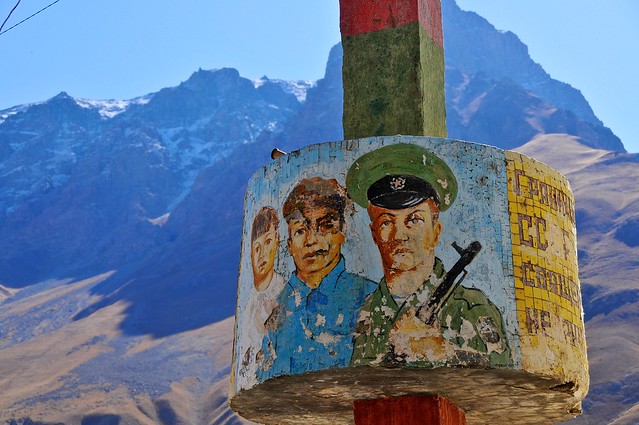
_DSC3267
An  old Soviet-era social-realism style painting on a pole.

_DSC3268
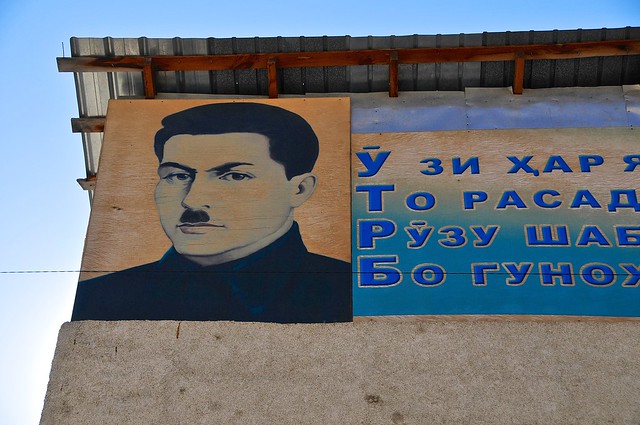
The "Hitler" look is apparently respectable in Tajikistan. Or maybe it demands respect. Or fear. Or something. Based on some things I later saw in Murghab, this guy appears to be some sort of government official.

_DSC3269
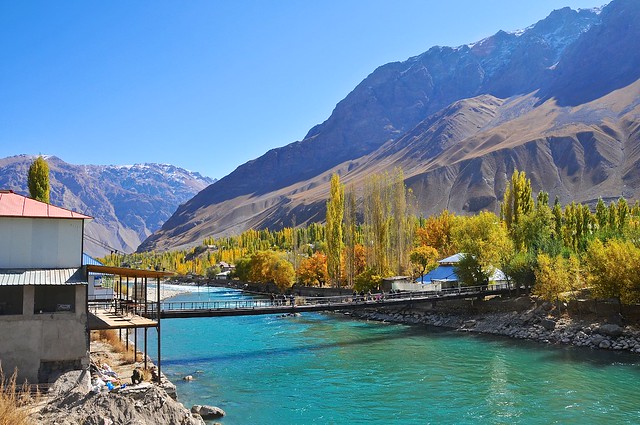
Khorog lies along the northern and southern slopes of the Gunt River, just before it joins the north-south flowing Pyanj river, which forms the border with Afghanistan.The Gunt almost seems bigger than the Pyanj.

The much-hyped, internet infamous, flight from Dushanbe to Khorog


There's a lot of hype out there about the flight between Dushanbe and Khorog, with breathless claims about how dangerous and terrifying it is, and how the plane routinely comes dangerously close to the sides of mountains as it flies between them and not above them. You'll even read about how, despite there not being any crashes involving this flight, there have been instances where the wingtips have actually brushed up against the mountains, dusting the snow off them. That the flight only runs on days when they can confirm at both ends that the weather is clear, and the mountains they fly between clearly visible, only serves to confirm the notoriety of this segment.

But first things first: I had to actually get to the airport in the morning and hope for good weather so the flight could be confirmed. The time printed on the ticket was 6:30, and I figured that it would be a good idea to show up early. You know, like people do in most airports. I thought this would be an especially good idea since I had heard that despite tickets not being sold until the evening before a flight, there were sometimes more tickets sold than seats available if earlier flights had been cancelled due to bad weather.

I took one of the first-running trolley buses from the Farhang to the airport, and made my way to the domestic terminal, which is actually just a large room off to the left of the main terminal, with a separate entrance and a few counters. The terminal was open when I arrived around 5:15, but people were just milling around and they were not waiting for the flight to Khorog. I was pretty sure of this as I didn't see my friend from the day before.

At around 5:45, once the flight those people were assembled for had left, they closed the terminal and kicked me out, making me wait outside. This wasn't that bad, as I fired up my netbook and discovered that the flagship Megafon telecom store, located in the international terminal, had an open wi-fi connection that was extremely fast (a rarity in Central Asia outside of Kazakhstan). I took the opportunity to download a bunch of movies as I waited for things to get cooking.

It wasn't until the actual indicated departure time that people began showing up, and even as they began to gather in the square outside, the terminal still didn't open up. When it did open up the entire check-in process was remarkably relaxed and surprisingly informal. They have a 10 kg weight limit on luggage, and I ended up paying an extra 10 somoni for being a kilogram over. What was more surprising was how many people who showed up who weren't taking the flight, and were also not related to any of the passengers—they were there to ask them to take things to their friends or relatives in Khorog. Obviously this would be a big no-no from a security perspective in the West, and those who buy into the idea that Badakshan is a restive area filled with potential terrorists might also balk at the idea, but my Pamiri friend said that pretty much everyone would agree to do this as it serves an important function in facilitating the transfer of important items. He himself accepted a car part that someone would be waiting for in Khorog. Given the standards of hospitality in the area, none of this should be particularly surprising.

After getting everyone checked in an passing through the rudimentary security, we went out on the tarmac to the plane. You enter at the rear through bomb-bay doors and a little ladder, and inside there are five rows of seats, with single seats on the left of the aisle and benches that seat two (or three) on the right. The seats are little fold-down benches of the sort that might have appeared in cheap post-war cars, but which are more akin to lawn furniture than modern seats. I first picked the first seat on the left, but later asked my Pamiri friend if I could switch with him when I noticed that my window was cracked and scratched and practically impossible to see out of. Since he had taken this flight a number of times, I thought he wouldn't mind, and I was able to get his window seat on the right side.

The seats don't have seat belts—not that it would matter that much—and parents kept their kids in their laps or let them sprawl over the backs of the benches. Again, similar to post-war driving culture, before we cared about things like padded dashes, seat-belts, and car seats for kids, let alone air bags and the like.

_DSC3184
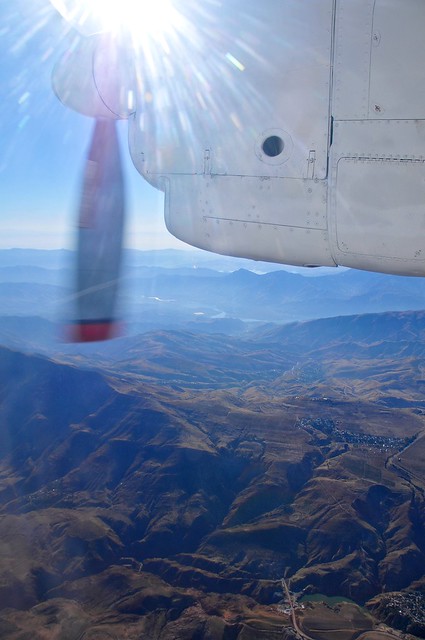
We ended up taking off at about 9:15. This flat agricultural land was just outside Dushanbe.

_DSC3185
The views on the right on the Dushanbe-Khorog leg are meant to be the best, but at this time of year you get a face full of glare from the sun, and hazy views from the smog, making views from the left side much clearer, if less spectacular. In the summer the sun would be much higher and less problematic, and in the later Khorog-Dushanbe flight it would also be less objectionable.

_DSC3187
Nurek Reservoir, formed by a 300 meter high dam—the second-highest in the world.

_DSC3191
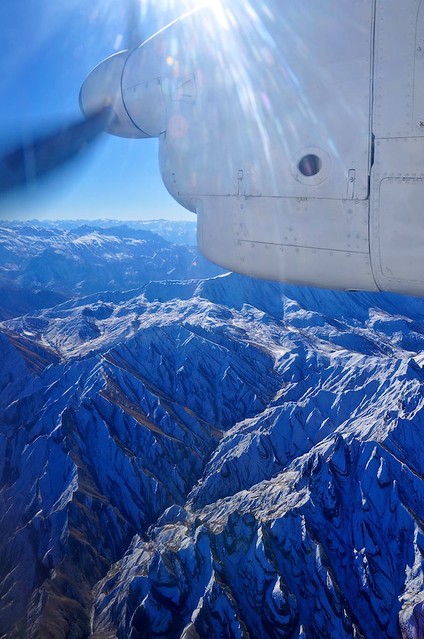
Low mountains are already covered with snow. I know they're low because the plane apparently doesn't go above 4,200 meters.

Monday, 22 October 2012

Padrud to to Dushanbe

Walking down the valley to Shing

I woke up early in the morning to be on the road by 6:00, which is supposedly when vehicles went down to Penjikent. After waiting by the main road in the darkness with Jumaboy for a while, it became fairly clear that whatever vehicles there were had already left, so I started to walk down the valley in the crisp morning air.

_DSC3075
By 6:45 the sun was up and I was on my way down the valley.

_DSC3076
Everything looks so different in the shade as opposed to the sun.

_DSC3078
Lake 3, with lake 2 behind it.

Wednesday, 17 October 2012

Penjikent, where the journey is more interesting than the destination

As I said in my previous post, share taxis to points north of Dushanbe don't actually leave from the cement factory but from a kilometer or so north of there, where the buses that run along Rudaki turn around (the map below reflects this starting point, which you can see if you zoom in). When I eventually found my way there, I was quickly able to find jeeps going to Penjikent, and negotiated a seat for 90 somoni (almost as much as a seat from Osh to Bishkek, which is about three times longer). Transportation prices in Tajikistan are fairly high, in part because the roads are pretty bad, and in part because fuel is considerably more expensive than in Kyrgyzstan. (You're also more likely to have to bribe a policeman in Tajikistan, too.)


The first stretch of highway as you head north from Dushanbe runs through an increasingly rugged valley that is the backyard for Dushanbe's rich and powerful, who maintain palatial estates along the river. The town of Varzob is possibly the epicenter of ill-gotten wealth, and includes a Presidential retreat complete with imposing fences and security. After Varzob the valley becomes more steep and there are precious few opportunities to build mansions as the road hugs the hills as it wends its way through the Fann Mountains.

_DSC2015
The M34 somewhere past Varzob but before the Anzob tunnel.

_DSC2017
Though not particularly high, the Fann Mountains are rocky and support little vegetation. Or maybe it's more accurate to say that whatever vegetation that may have existed has been long since stripped by the peoples who have lived there.

The M34 between Dushanbe and Khojand is paved from start to finish, with the curious exception of the Iranian-built Anzob tunnel, also known as the tunnel of death. Officially opened in 2006, this 5-km-long tunnel bypasses the Anzob pass to the east, allowing the M34 to remain open—and northern Tajikistan connected to thre rest of the country—all year, regardless of the amount of snow in the Anzob pass. The problem is that this tunnel really isn't finished, as the surface inside the tunnel isn't paved, and is potholed and full of water year round as a result of spring-water that leaks into the tunnel from the ceiling. And despite the notoriety of the tunnel through Kyrgyzstan's Too-Ashuu pass, this tunnel is even more poorly ventilated, as there is only one fan in the middle of the tunnel, and its ineffectual whirling does little to clear exhaust fumes from the road. Supposedly the tunnel was to be completed in 2014, but I have difficulty believing that. (Edit: as of 2018 the tunnel is in good condition, with no potholes or water, and added ventilation, though apparently it can still get pretty polluted in there.)

There are also a number of smaller avalanche sheds along the road leading up to the tunnel, but these kinds of tunnels are much simpler since they are designed simply to protect the road from avalanches by allowing snow to wash over the roof. They're usually pretty short and just cover typical avalanche zones.

_DSC2021
After leaving the Anzob tunnel the road switchbacks and hairpins down and around the side of the the mountain.

Monday, 15 October 2012

Dushanbe: a monument to President Rahmon


Hotel Poytaht is a Dushanbe landmark. It's a huge Soviet-style hotel near the train station, and it's actually a reasonably attractive low-slung building that is four or five stories tall with two long wings angling off the central reception area. It's supposed to have reasonable rooms on the top floor that are charged on a per-person basis (and may or may not involve sharing), but they didn't want to sell me this sort of room, and said the lowest room was something like $30 or $40. The difference was academic to me, as either total was more than I wanted to spend.

I headed to a small supermarket nearby to get something to drink, and to plot out my next plan of attack. I figured out I would try the Farhang hotel, which is supposed to be cheap even if it's not exactly central. I hopped a bus headed in that direction, and found the hotel without too much difficulty (being behind the UFO-shaped circus, which itself was just off the major road the bus traversed, made this pretty easy). Whereas the Poytaht was well-maintained and a clean version of Soviet "hospitality," the Farhang had the dilapidated and scruffy feeling more familiar from Kyrgyzstan. For such a large hotel, I had to wait in the lobby until an attendant showed up, but the rooms were a bargain (for Dushanbe) at 60 somoni.

_DSC1916
I love Cherry Coke. This is no Cherry Coke.

While Kyrgyzstani supermarkets were surprisingly Russian/Western, most of the things they sold were fairly local, or possibly from Turkey. In Dushanbe, a lot more things were imported from Europe, and a lot of things that would have been locally-produced in Kyrgyzstan were imported. Maybe the best example is Coke and Pepsi. Thomas Friedman's McDonalds theory of war says that no two nations with McDonalds outlets have ever gone to war (which was true until the Russia-Georgia conflict), and to a certain extent I think this really says something about the stability of nations with McDonalds. I think that the existence of foreign brands in a country says a lot about the investment climate and political stability and predictability in that country, and in this context it's interesting to note that Tajikistan is the only country in Central Asia that does not have a domestic Coke or Pepsi bottling facility: these products are officially imported from Kyrgyzstan, and unofficially imported from Afghanistan. The locally-bottled brand is RC Cola, which is more or less extinct in most corners of the world.

This lack of locally-produced goods inevitably means that things tend to be more expensive in Tajikistan than in Kyrgyzstan, which is unfortunate given that Tajikistan is even poorer than Kyrgyzstan. If your only exposure to the country was Dushanbe, however, it certainly wouldn't feel very poor—even if your only basis of comparison was with Kyrgyzstan's most prosperous city, Bishkek. Now, it's no surprise that large, capital cities feel more prosperous than other parts of the country, especially when the capital cities are orders of magnitude larger than any other city in the country. But even given this, it's pretty clear that a disproportionate amount of public funds have been spent beautifying the capital, and that a disproportionate amount of money resides in the capital. The old, Soviet-era public buildings in Dushanbe are better maintained and more attractive than they are in Bishkek. As mentioned earlier, the stores stock more imported goods, at higher prices. You see a lot more late-model luxury cars and European imports in Dushanbe than Kyrgyzstan (although I believe that many of them are stolen), with models like BMW X6 models being not hugely unusual.

What really sets Dushanbe apart from Bishkek, however, is that in Dushanbe you can see new construction and new monuments being built by the government and President Rahmon (who has ruled since 1992). Sure, Nazarbayev is doing the same thing in Astana, but the key difference is that Kazakhstan is riding a wave of resource-based prosperity, while Tajikistan remains dirt poor. Despite this, in Tajikistan the villages remain poor while Dushanbe is beautified.

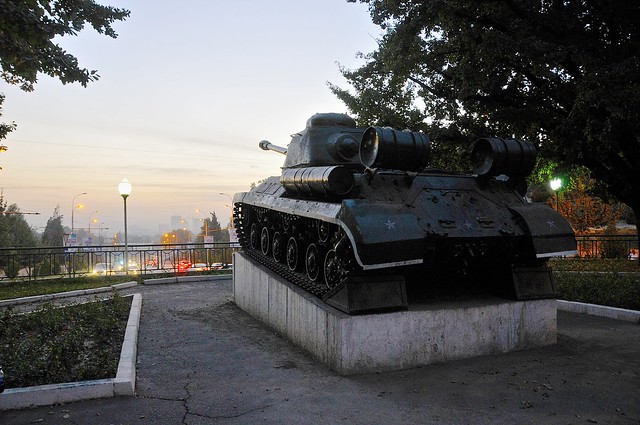
_DSC1918
Old Soviet tank in old-style park takes aim at the skyline.

_DSC1922
Imposing monuments (this one to Ismail Samani), empty plazas surrounded by barricades, and armed guards make these public spaces less than inviting. Pedestrians walking by skirted the plaza in front instead of taking the shortcut across, so I had to ask the guard to ask if it was possible to approach the monument and take a picture.

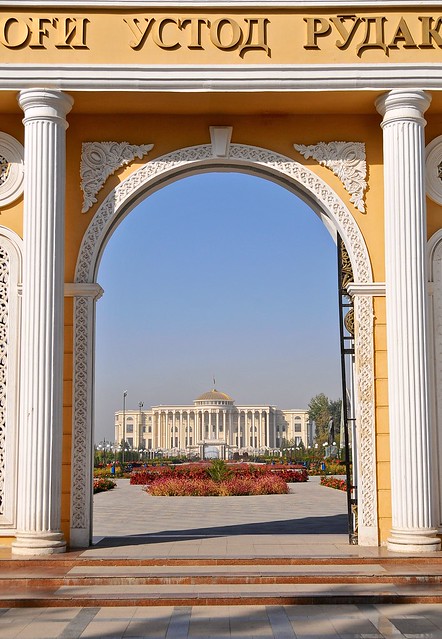
_DSC1923
The Presidential Palace.

_DSC1925
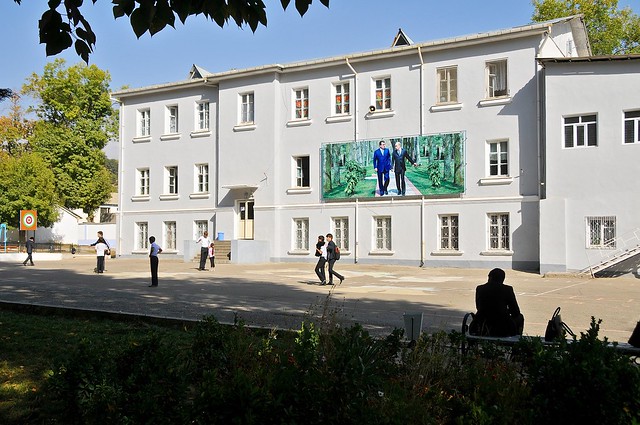
Next to Turkmenistan, Tajikistan is the Central Asian country that most aggressively promotes a personality cult around its leader, Rahmon. Pictures of him heralding his accomplishments and profound statements ("Education is good!") are everywhere. Putin looks like a wimp next to him.