Mongolia is a huge country with a small population (and the lowest population density of any country in the world), historically wedged between two competing Communist countries. After gaining independence from China in the early twentieth century, Mongolia became a Soviet satellite state—something which has had a huge effect on the country. Russian influence is seen in everything from the second language of most older Mongolians, where older Mogolians were educated, the gauge of their railways, the architecture and design of their cities, and most palpably in the huge drop in living standards that occurred when the USSR dissolved. Even more obviously, Mongolia uses the Russian Cyrillic script, in contrast to Inner Mongolia, where the traditional Mongolian script is still in official use.
Walk around Ulaanbaatar and you can see evidence that things may have been better 30 years ago; you can also see that virtually no investment, building, or upkeep has been done in the intervening timespan; and you can't miss the signs of Mongolia's
recent, mining-driven economic growth. You'll encounter some old Soviet architecture that is quite gorgeous, a lot of very institutional Soviet-style apartment blocks in varying states of disrepair, streets that were once paved but are now almost completely dirt and gravel, ramshackle houses and ger districts that have sprouted up in the last decades, as well as shiny flashes of prosperity and Western consumerism.
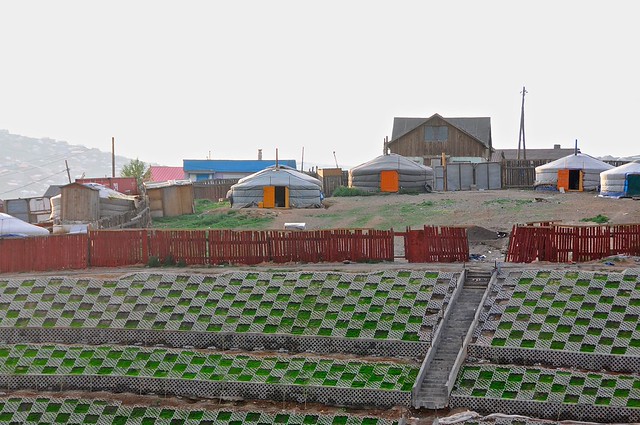 |
| A ger compound. The families living there are probably all related. Unplumbed outhouses are the norm. Ger districts are a cheap way for rural families to move to UB, and once one family member has a foothold in the city it's extremely easy for relatives to move their get to the city. When a nomadic family loses their herd in a rough winter, they move to one of these districts, and it's estimated that 700,000 of UB's residents are just these kinds of people. |
 |
| The city isn't really prepared for the sprawling development that has come with increasing urbanization. The Soviets designed the city to hold 500,000—one third of the current population. |
As a city, there's not a lot to do or see in Ulaabaatar—at least, not outside of
Naadam, the summer sporting festival that happens in Ulaanbaatar from July 11-14 (places outside of UB have their own Naadams at slightly different times). Otherwise, there are a couple of temples, a museum or two, a few other sights, but not much else. Unfortunately, UB is a place where you'll be forced to spend a fair bit of time: since UB is the only city of size, and there aren't a lot of roads, almost all travel goes through the hub of UB instead of running directly between smaller cities; and even if you are taking a private tour, you'll need to stay in UB for a while to arrange your tour unless you've spent a lot of money and booked ahead from outside Mongolia. If you're traveling independently, I suggest that you spend as little time as possible in UB when you first arrive, as you'll likely be forced to spend a few more days there later in your trip, during which time you can see what the city has to offer.
Almost all budget tours are arranged through guesthouses, which universally double as tour operators. Guesthouse tours tend to be the cheapest available, and run around $45 per day at the budget end. Most guesthouses tend to run similar itineraries, and these itineraries are pretty much exactly those listed in Lonely Planet. But the problem is that they only run when there is enough demand, so you could be waiting for a while if you want to take a specific tour. And although an all-inclusive $45 isn't terrible, on almost all tours at least a couple of those days are going to be absolutely wasted days because of the time it takes to travel to regional centers. Some tour operators will let you join a tour in the middle, for only a few days (space permitting), which can be a way to save money and limit yourself to the things you want to see (I contemplated joining a Gobi tour for a few days in Dalanzadgad, but the tour completely filled up at the last minute so they wouldn't have had space). You'll see messages in guesthouse about people looking for partners to join specific tours, and some people end up waiting for a while. Another option is to try and do things yourself: buying a motorbike and then selling it before you leave is an option, and there are lots of places near the State Department Store that sell discount outdoor gear (unlike in Nepal, it seems to be authentic gear that is a few seasons old), and lots of people buy or rent tents and sleeping bags. Given the limited bus schedules, some people try to hitchhike, but if you do this you really have to be prepared to potentially spend the night camping by the side of a road, especially if you're traveling somewhere less popular.
 |
| That van that looks like a VW bus is a virtually indestructible four-wheel drive UAZ-452 bus, first made in 1965 and still in production. Almost all guesthouse tours use them. |
Naadam
I timed my visit so that I arrived in UB on the first day of Naadam, July 11. The train arrives in the early afternoon, and by 3:30 I was at the stadium where the events, other than horse racing, occur.
Although they sell tickets to the wrestling stadium, you can get into certain sections for free. I just followed people into the entrance where there were no ticket-checkers. The stadium was fairly empty, but the area outside the stadium was much busier. There were food and drink vendors, and it was like a small-town fair.
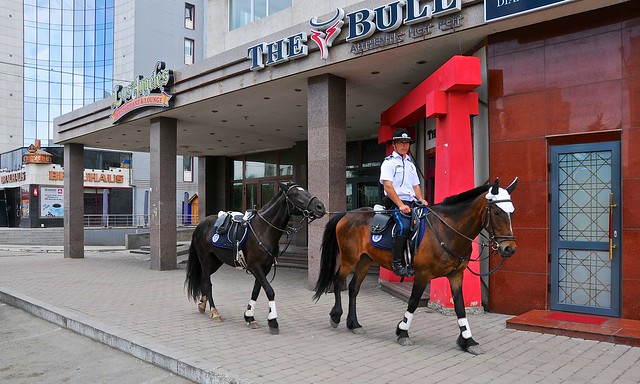 |
| I saw this in my first hour in Mongolia. It was actually pretty anomalous, even though there are horses everywhere in the countryside. |
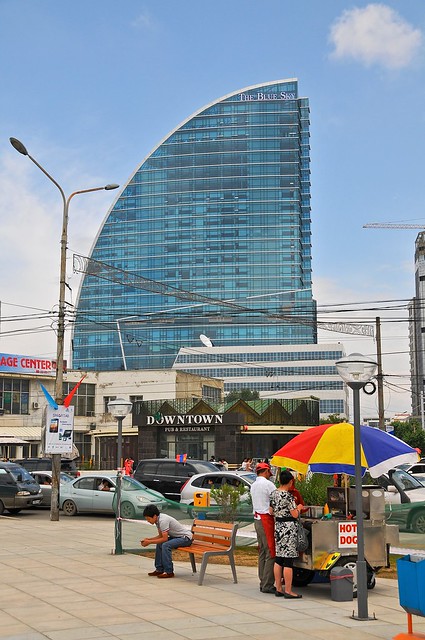 |
| The Blue Sky building behind older buildings in the downtown area, on the road south to the stadium. |
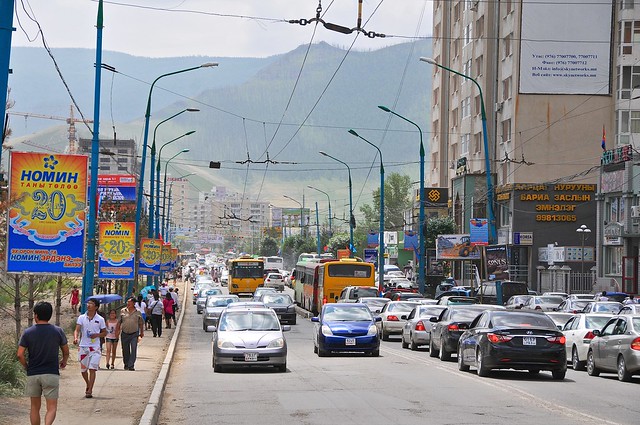 |
| Heavy traffic around the stadium. The Peace Bridge carries this street over the railway tracks and a small river, and although they were repainting some trim on the concrete railings, they were not replacing the yawning holes in the sidewalk, where square access panel for reaching the electrical cables hidden under the sidewalk were missing. Walk without paying attention—or without a flashlight at night—and you might easily end up falling down one of these holes. That's life in Mongolia. |
 |
| He's got his wrestling costume on. |
 |
| Everyone looks their best. |
Ulaanbaatar is never as interesting as it is during Naadam. The atmosphere is festive, many are in traditional dress, the streets are crowded and vibrant, and everything is very family-friendly. The actually events are something of a let down, as there's not a lot to see unless you know how to properly appreciate the events, especially since the horse racing takes place outside of town. The real attraction, however, is in watching the people, and letting the ambiance wash over you.
 |
| View from the top of the stadium. |
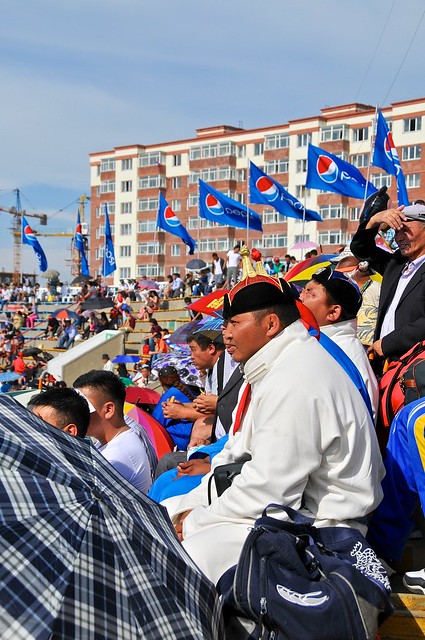 |
| Competitors sit in the stands, waiting for their time to take off their cloaks and put on their wrestling uniform. |
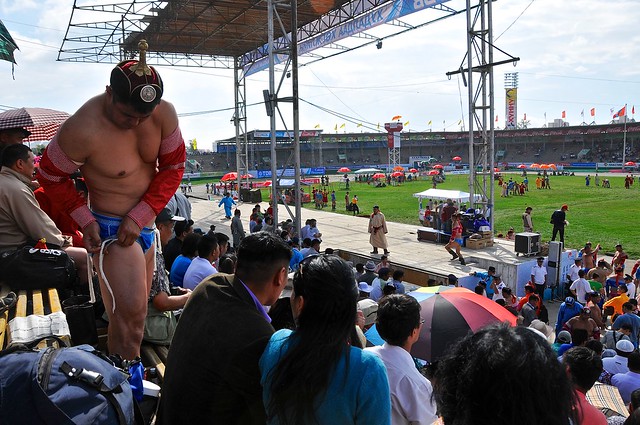 |
| Getting ready to go. |
