Marshrutkas run pretty regularly between Bishkek and Almaty, leaving Bishkek from the Western Bus Terminal. I was accompanied by a couple of German guys who had flown into Bishkek and wee looking at spending a week in the city—more time than they wanted. Although they had a now-unnecessary visa for Kyrgyzstan, they lacked one for Kazakhstan. I had read online that it was possible to enter Kazakhstan as far as Almaty under some sort of reciprocal program, so long as you had a Kyrgyz visa, so they were trying their luck at that. At the border, however, there was a long delay in processing them, so the rest of the Marshrutka passengers and I had to wait for an hour on the other side of the border while they were processed. It's a good thing that time isn't of much value in Central Asia.
When they were finally processed and allowed to enter into Kazakhstan, I found out what had happened: although the law did allow them to enter, it only allowed this if they had a double-entry Kyrgyz visa. Of course, since entry to Kyrgyzstan was now double free, this restriction didn't make much sense, so once the Kazakh officers told them that they were returned to the Kyrgyz side where the officers simply changed their visas to double-entry. That being done, they were allowed to enter Kazakhstan, on the understanding they would only visit Almaty.
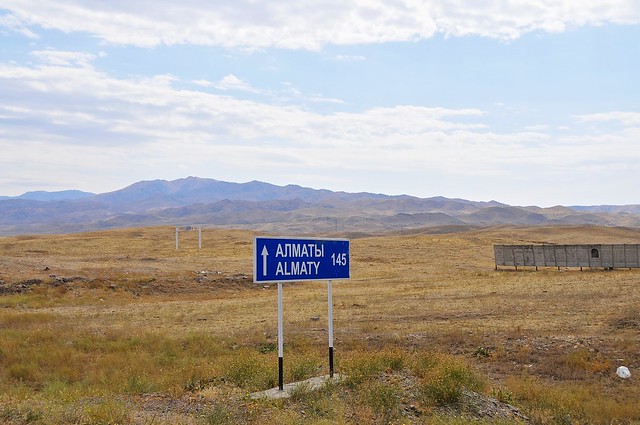 |
| On the road to Almaty. Most of the mountains in Kazakhstan are along the southern borders with Kyrgyzstan, Uzbekistan, and China. |
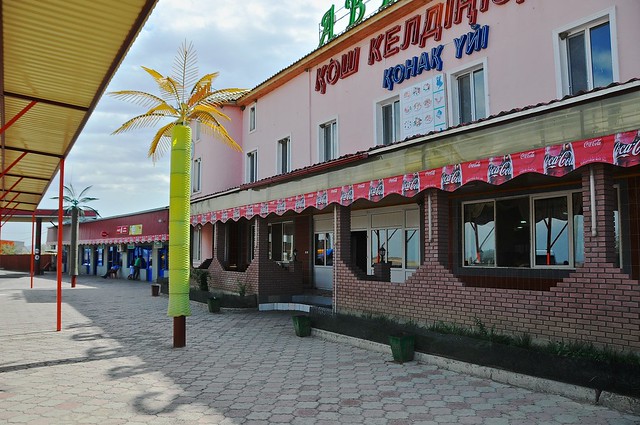 |
| We made a brief stop at this interestingly-decorated restaurant and convenience store. I probably should have bought something here or when I was waiting at the border, just to spend some som and get tenge in change, so I would have some money for bus or taxi fare to get to the hostel. |
As you enter Almaty, it becomes clear that there are real differences between Kazakhstan and Kyrgyzstan: the highway is wide and smooth, there are large and modern shopping malls with 3D movie theaters, the cars are new and undamaged, and things look like they could be from a developed nation.
The Sairan Bus Terminal, where the Marshrutka dropped us off, is well west of the center, and we didn't really have any idea how far away we were. We ended up walking to the Apple Hostel, passing a surprising number of shopping malls along the way. Thankfully, we had been given very specific instructions on how to find the hostel, as it was totally unmarked and in a complex of three apartment buildings, each of which had six separate entrances leading to unconnected stairwells (so you had to get the right entrance), each of which could only be entered by buzzing an apartment. If you didn't know exactly where to go, you'd be lost.
The appropriately named
Apple Hostel—Alma means Apple, and it was known in Russian as Alma Ata, or father of the apple, as this area is regarded as the birthplace of the apple—is basically just an apartment that a couple decided to turn into a hostel. They had their own bedroom—and a cute baby—but the other rooms were converted into dorms and smaller bedrooms. They have a full kitchen, a couple of bathrooms with showers, another without, a laundry machine free for guests to use, free and fast wi-fi (fast internet is very rare in Central Asia), and a couple of laptops you could use. Only the wife spoke English, but she was really helpful and interesting (unfortunately the girl who was there during the daytime didn't speak English) and the guests who stayed there tended to be interesting to talk to, too.
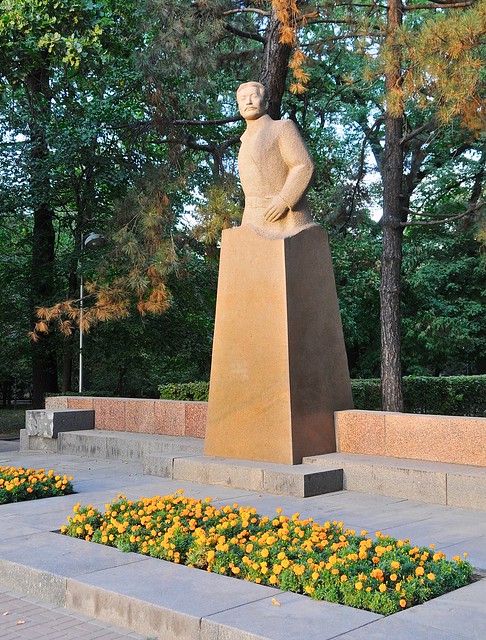 |
| He looks a bit like a Kazakh Stalin. |
On my first full day in Almaty I had a few clear objectives: to buy a train ticket to Astana; to register with the OVIR immigration office; and to visit the Almaty offices of STANtours to pay for my Uzbek letter of invitation (because of the steep bank-wire fees for transfers from North American banks to STANtours's bank, I saved myself almost $50 by making the payment in person—I later learned that
Xoom.com is a pretty cheap way to make transfers from North America.)
The STANtours office is a bit out of the way, but I was able to meet both Katya and David, both of whom are as helpful and nice in person as they are by email. It was a good chance to see what less-touristed parts of the city looked like... and actually it was pretty nice. Apple Hostel is already on the outskirts of the areas tourists are likely to go, just north of the Theater metro station, and as I walked southwest to STANtours I was impressed with the city. Confirming most of what I had seen the evening before, the quiet streets were lined with trees, and there were small shops and markets all over the place. It kind of felt like a peaceful Austrian city, but with a definite Russian flavour.
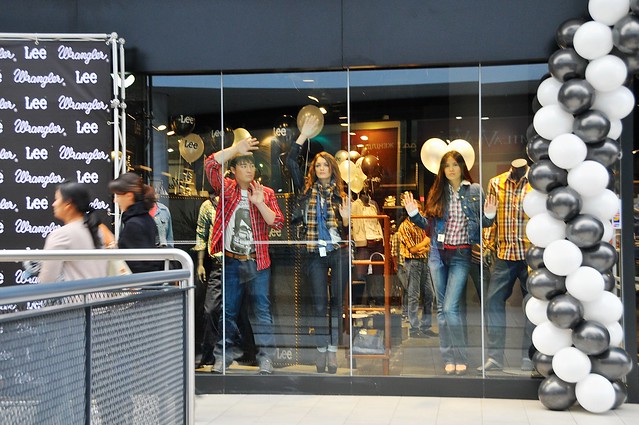
There was a large shopping mall not far from STANtours, and since I was in need of a second pair pants after my encounter with barbed wire in Ulaanbaatar, I decided to stop by. I had tried to find some between UB and here, but shops with western brands disappeared after Xian, and clothes made for the Chinese market don't fit me very well. In Kazakhstan you have lots of western brands, from Russian-oriented brands to European ones like Zara and Marks & Spencer, to American juggernauts like The Gap. Although there's rarely a day in the US where The Gap isn't on sale, pretty much everything in Kazakhstan was full priced and I didn't relish paying that much. It was still interesting to see places like Burger King in high-end boutiques in Kazakhstan, and to see how much nicer these stores tend to be in places where they are considered relatively high-end stores.
I then headed to the other end of the city, where it was pretty easy to make a train booking for the 20-hour train to Astana leaving the next day. There are a
number of trains each day, and I took one that leaved just after 1:00 in the afternoon and arrived in Astana the next morning at a little after 9:00 am.
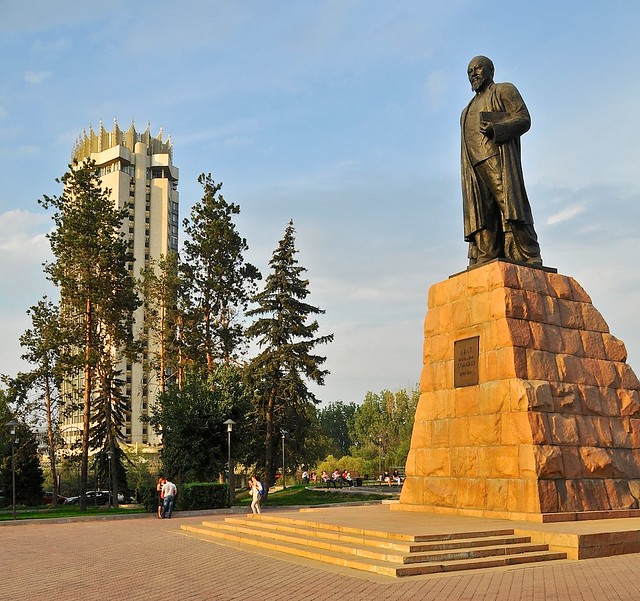 |
| Statue to Kazakh poet Abai Qunanbaiuli, with the well-kept Kazakhstan Hotel. Most Soviet-era buildings in Central Asia look their age, and are little more than peeling, crumbling shells of what they once might have been. Only in prosperous Almaty have these buildings, from the monumental to the pedestrian, been well maintained. |
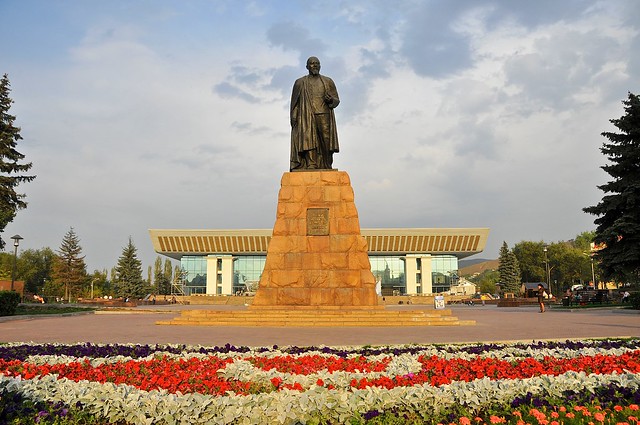 |
| The Palace of the Republic lies behind the statue. The cable-car station for the ride up to Kok Tobe is off to the right. |