Megi and I were to meet in the morning at the market, where vehicles
to Murghab leave. I arrived and wasn't able to find her, and after
waiting around and periodically wandering down the main road to other
places she might be waiting (we agreed to meet where vehicles leave, but
it isn't always clear exactly where that is), I began to fear that she
might have left before me for some reason. It turned out that she and
the family she had been staying with had spent the night at a different
house, and they had only returned relatively late in the morning. So it
was pretty late by the time we were prepared to leave, and most of the
vehicles had already left, but we found a Chinese-made minivan without
too much difficulty, and were on our way before too much time had
passed. We were stuck in the back seat with some cargo, and it was
actually fairly comfortable because you don't have to worry about
elbowing the cargo or slinging your legs over them.
Chinese
minivans are popular on this route, as the road is decent enough for
them not to be shaken apart, they hold a fair number of people, and
they're dirt cheap: I think they cost something like $6,000. One of the
other passengers in our van was a bright young girl of maybe 12 or so
who was returning to her family in Murghab, and it was really charming
to watch her talk with Megi and the other passengers, as she was
absolutely nothing like the timid, downtrodden girls you see in the Fann
mountains. She was bright and outgoing, and had no fear of challenging
and disagreeing with the adult men in the van, let alone simply talking
with them.She wasn't that happy to be returning to Murghab, however, as
there simply wasn't enough there to be appealing to her
Megi
had earlier told me about her taxi ride from Dushanbe to Khorog, where
she had been similarly surprised at just how different Pamiri women were
from the lowland Tajik women she was used to in Kulob. The women in her
car showed no fear or hesitation to dominate and chide the men, telling
her that in Pamiri families it is women who wear the pants in the
family. This is so different than most of Central Asia, and Tajikistan
in particular, but hugely refreshing, and a large part of the reason why
Pamiris are my favourite people of Central Asia.
On the road to Murghab
For the first hour or so the M41 east of
Khorog has scenery similar to the road between Khorog and Ishkashim,
which is to say that it's relatively verdant with lots of trees and
small villages. After a while, however, the valley rises and widens into
a more desolate and rocky environment of the type we might expect to
see in high-altitude mountain plains, rising to the deceptively high
Koi-Tezek pass (4,272 meters high, even though the pass is not between
close mountain but simply the crest of a long hill in the middle of a
wide valley).
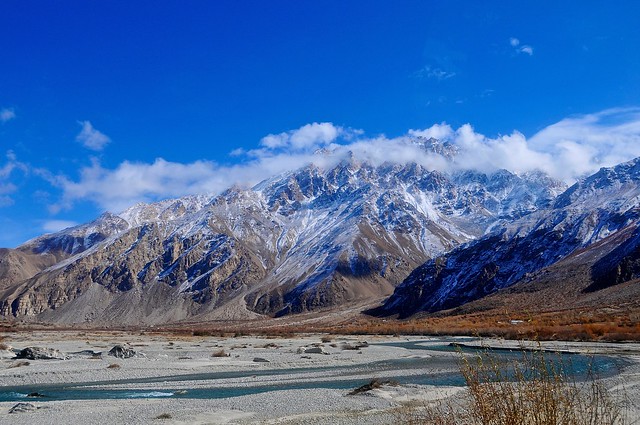 |
| Entering the high plains. |
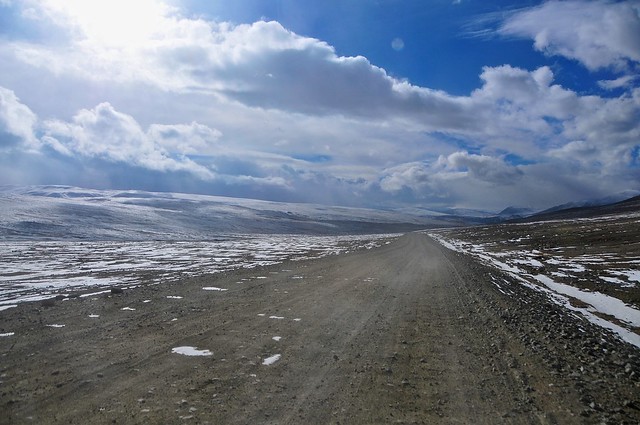 |
| Near the
Koi-Tezek pass. Despite the snow, it feels like a desert and it's
difficult to imagine that much vegetation grows in this stony valley,
even in the summer. |
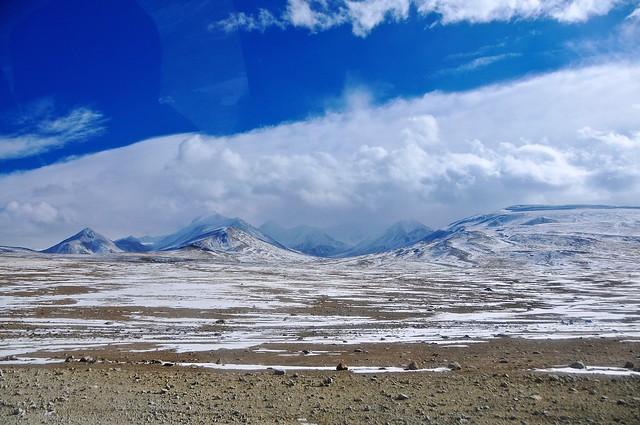 |
| Mountains to the south. |
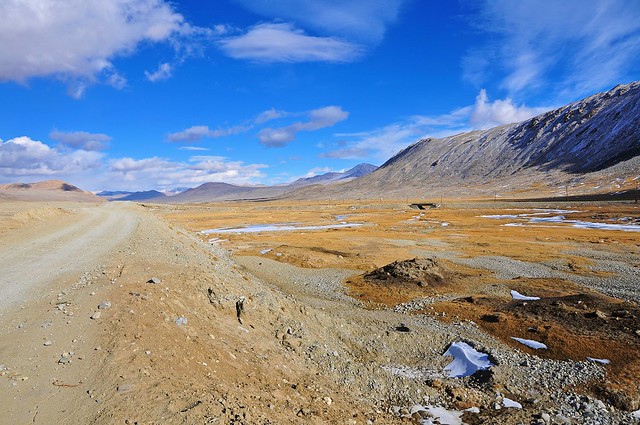 |
| We came across
a car stopped at the side of the road, and got out to stretch our legs
while the drivers talked. It turns out the other car had run out of
gas, so we gave him a ride to fetch some. |
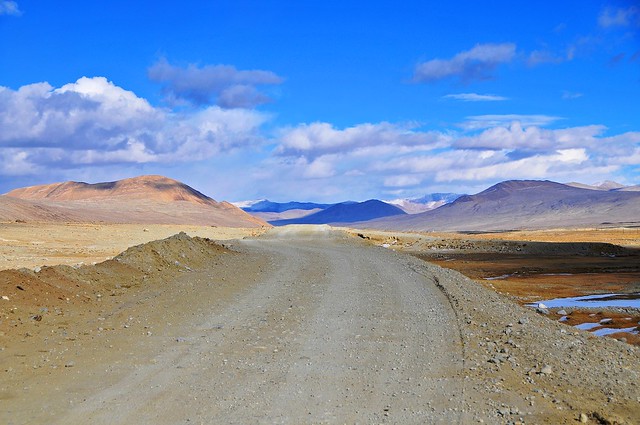 |
| The road is often washboard and bumpy, but isn't overly rocky. |
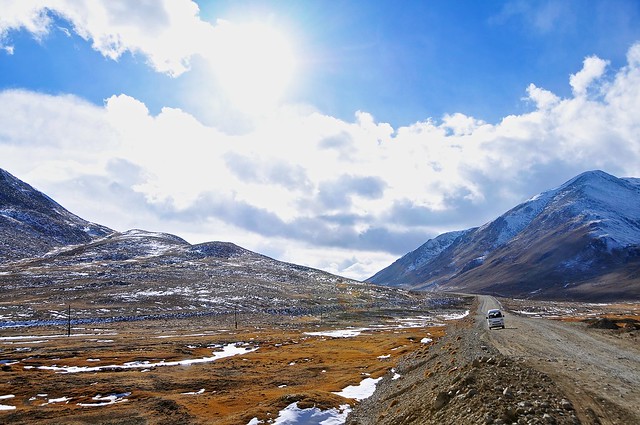 |
| Chinese minivan in need of gas. Not the best place to get stranded. |
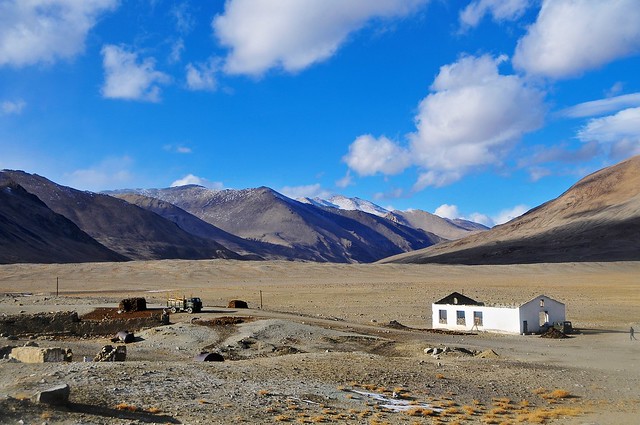 |
| We dropped the
driver here to get gas; I hope he found some. When I see a building
with a gabled roof line, I imagine that it's a Soviet-era building
constructed by the government. This may explain why it's abandoned. |
