Shanghai just sounds so exotic. But just as The Lady From Shanghai is a conventional noir film that relies on the title to add mystery and exoticism, Shanghai as a city is not terribly remarkable and relies on historical perceptions for much of its allure. Much of the foreign influence that led to Shanghai's reputation in the West has been reduced and minimized. Compared to anywhere in French Indochina, the French Concession is utterly unremarkable, and the British influence on the Bund is essentially limited to a short stretch of riverfront that isn't especially compelling when you're coming from Hong Kong. Perhaps the real story of Shanghai is the Pudong business district which has grown from nothing to an expanding thicket of skyscraper on a few short decades, but the story of rapid development and mega-cities is one repeated throughout China (and in many respects is even more impressive when applied to cities that were utterly anonymous, if not nonexistent, twenty years ago).
Because of Shanghai's modernity and cosmopolitan nature, however, it does make for a gentle introduction to China.
Once I found the Starbucks, I discovered that, besides coffee costing more than it does in the USA, in order to connect to their wi-fi you need to provide a Chinese phone number. At the time I thought this was a ridiculous requirement imposed for marketing reasons by Starbucks China, but in retrospect I suspect it is to comply with Chinese internet-monitoring regulations. I eventually found free wi-fi and was able to make a booking at a hostel in Pudong, the Hidden Garden.
That hostel was actually pretty bad, in some ways that were uniquely Chinese. The rooms would be OK if they actually had windows or ventilation. But they didn't, which meant they were dark and very damp, even though it was the middle of summer. It must be terrible in the winter. There was new hardwood laminate in the hallways, but it had been laid without padding underneath, which meant it was creeky and you could hear it anytime someone walked outside. Especially when the hostel's little dogs walked outside, with their nails clicking on the floor.
These problems could exist in any hostel in the world. The Chinese aspect was the complete lack of cleanliness in the bathrooms. They had clear signs of being somewhat new, as some of the hardware still had the protective plastic wrap stuck to it (as if they thought you're not supposed to remove it after installation). But it also looked like no one had actually cleaned the bathroom at all since it was installed. The toilet bowl was covered in brown stains. The glass shower doors had protective plastic but was also stained and moldy. It's just really strange, but is really quite characteristic of the Chinese
approach to bathroom cleanliness.
The Bund, in contrast, is British and international in origin, and consists of a number of old Western-style stone buildings that once housed major financial concerns and consulates.
Because of Shanghai's modernity and cosmopolitan nature, however, it does make for a gentle introduction to China.
Hostels, service, and cleanliness in China
I had booked a hostel online before arriving in Shanghai. But because hostelbookers.com likes to assume you want to book a week in advance, and not for the next day or so, I had inadvertently booked for the week ahead, and not when I arrived. Add in the difficulty I had in actually locating the hostel, and I was a sweaty mess when I arrived, and none too happy when I was curtly told they were full and my reservation was wrong. Of course, since I didn't have a reservation for that day, they wouldn't let me use the wi-fi so I could book another hostel, and told me I would have to go find a Starbucks, to which they gave me very general directions. Thanks, Phoenix Hostel!Once I found the Starbucks, I discovered that, besides coffee costing more than it does in the USA, in order to connect to their wi-fi you need to provide a Chinese phone number. At the time I thought this was a ridiculous requirement imposed for marketing reasons by Starbucks China, but in retrospect I suspect it is to comply with Chinese internet-monitoring regulations. I eventually found free wi-fi and was able to make a booking at a hostel in Pudong, the Hidden Garden.
That hostel was actually pretty bad, in some ways that were uniquely Chinese. The rooms would be OK if they actually had windows or ventilation. But they didn't, which meant they were dark and very damp, even though it was the middle of summer. It must be terrible in the winter. There was new hardwood laminate in the hallways, but it had been laid without padding underneath, which meant it was creeky and you could hear it anytime someone walked outside. Especially when the hostel's little dogs walked outside, with their nails clicking on the floor.
These problems could exist in any hostel in the world. The Chinese aspect was the complete lack of cleanliness in the bathrooms. They had clear signs of being somewhat new, as some of the hardware still had the protective plastic wrap stuck to it (as if they thought you're not supposed to remove it after installation). But it also looked like no one had actually cleaned the bathroom at all since it was installed. The toilet bowl was covered in brown stains. The glass shower doors had protective plastic but was also stained and moldy. It's just really strange, but is really quite characteristic of the Chinese
approach to bathroom cleanliness.
Pudong
The Pudong area of Shanghai, east of the Huangpu river and opposite the historic Bund, is where most of Shanghai's skyscrapers are located, including the iconic, futuristic, Oriental Pearl Tower, which was the first tower built in the area, in 1991. That's right, in 1990 the entire Pudong area was flat farmland.The Bund, in contrast, is British and international in origin, and consists of a number of old Western-style stone buildings that once housed major financial concerns and consulates.
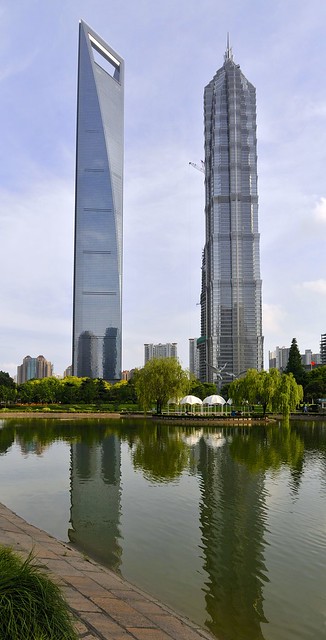 |
| The bottle-opener World Financial Center on the left, and the Jin Mao Tower on the right, as seen fro Lujiazui Park. |
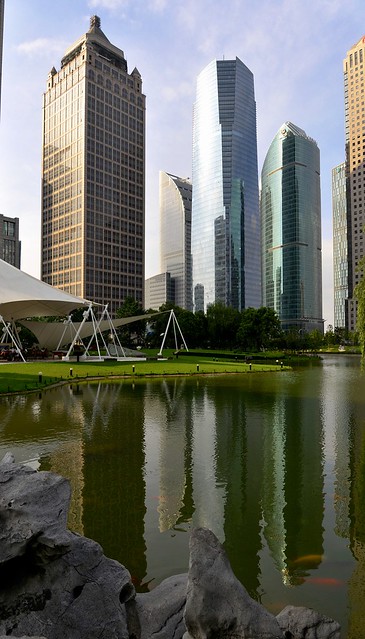 |
| Minor skyscrapers. |
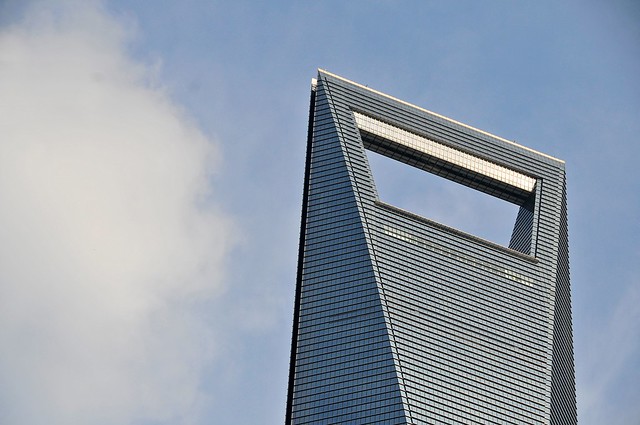 |
| The aperture was originally intended to be circular, but the shape was changed after people objected to it resembling the Japanese flag. |
