Actually, I don't love Hiroshima. That's not to say I dislike Hiroshima, because I don't. It's a pleasant Japanese city with surprisingly wide roads and a feeling of spaciousness heightened by the streetcars that (slowly) roam the streets.
Just as it forms the backdrop to
Hiroshima Mon Amour, everything about our modern conception of Hiroshima is based on their status as the first place that an atomic weapon has ever been used against humans. That's what Hiroshima is, and what it means.
Hiroshima, nuclear weapons, self-victimization, and deflection
The Japanese have a somewhat strange relationship with Hiroshima (and Nagasaki). They are both the source of stigma, but also the source of a certain sense of moral authority.
Perhaps understandably, there was considerable discrimination after the war against those who had survived the bombing. People were worried about radiation sickness, latent illnesses, and genetic deformities, which led people to attempt to conceal their backgrounds so that they could be hired or get married (two common acts that frequently involve background checks in Japan). Survivors wouldn't discuss it with their kids, and it remains a pretty taboo subject even though the fears that initially motivated the bias has been shown to be baseless.
But at the same time that Japanese society continues to victimize survivors, they use their status as the only country ever nuked as a way to play the victim and deflect criticism over their own conduct during WWII. Japan aggressively pushes their status as the only target of nuclear weapons while pushing for international pacifism and the abolition of nuclear weapons. Of course there's some hypocrisy to this, as Japan has a large military force (though because Article 9 of the Japanese Constitution—written under US occupation—prohibits Japan from having an army capable of aggression, these formidable forces are technically Self-Defense Forces), and uses nuclear power to generate a substantial portion of its energy needs. More importantly, however, is the way this Japan-as-victim-of-WWII narrative displaces any real conversation about what Japan did during the War or conceptualization of Japan as the committer of atrocities.
Ground zero for this narrative is, of course, Hiroshima, and the Hiroshima Peace Memorial Museum in particular. With powerful exhibits and artifacts illustrating the breadth and depth of the devastation incurred on August 6, 1945, the museum is compelling but occasionally devolves into the maudlin. My impression is that it has improved significantly since I first went there in 1993, with additional (though limited) discussion of Japan's role in WWII, but it also remains true that it is a powerful tool to establish and affirm the prevailing narrative that Japan as been the only victim of the uniquely horrifying instruments of indiscriminate destruction that are nuclear devices.
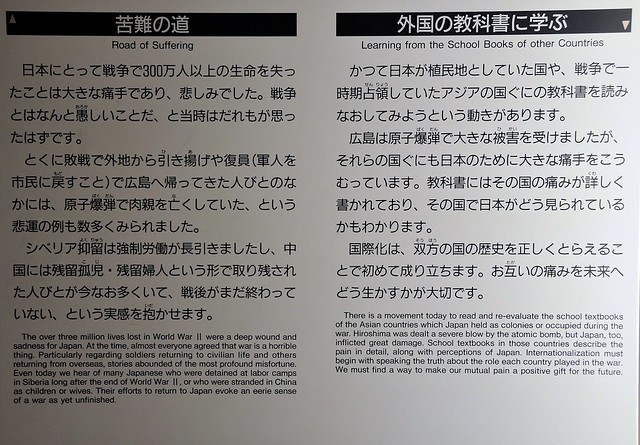 |
The text on the right actually counts as an improvement in how the Japanese address their role in WWII.
|
The Peace Park and A-bomb Dome
The iconic A-bomb dome is about 150m from the epicenter of the atomic blast, and the was one of the few buildings in the vicinity not to be totally leveled. The Peace Park is on the northern end of the island across from the A-bomb dome, and the northern tip of this island was the original targeting point of the bomb.
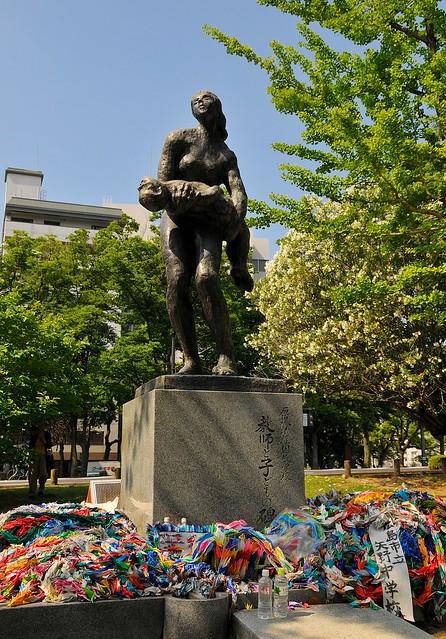 |
Monument to the A-bombed Teachers and
Students of National Elementary Schools.
|
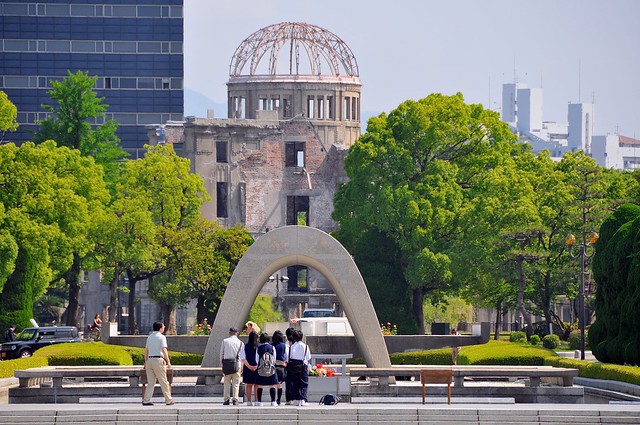 |
| Children on a school trip visit the Cenotaph for A-bomb Victims, with the A-bomb dome in the background. |
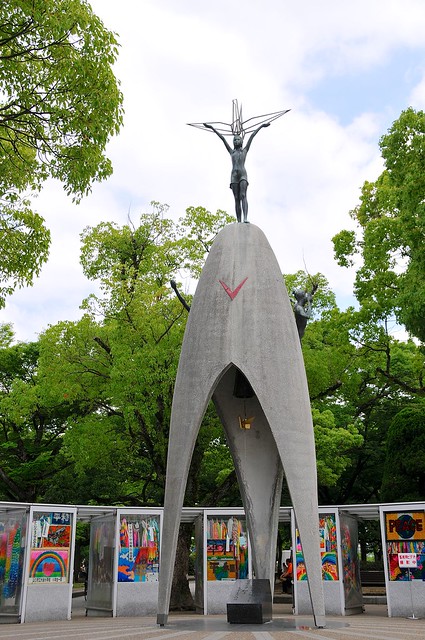 |
| Children's Peace Monument,
inspired by 12-year-old Sadako Sasaki, who died of cancer 10 years
after the bombing. She wanted to fold 1,000 cranes as part of her wish
for recovery, but was only able to make 664 before she died; schoolkids
today fold cranes for this memorial in her honor. |
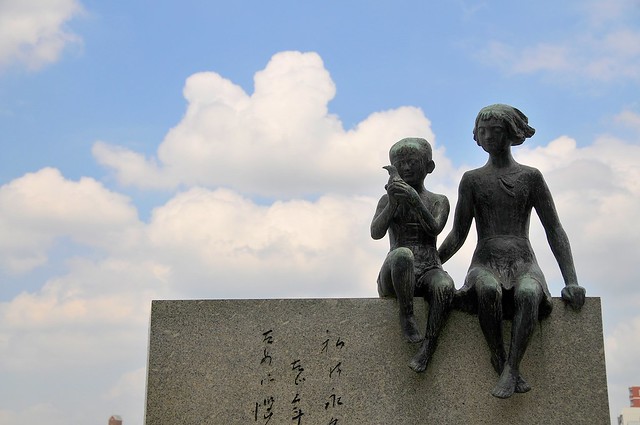 |
| Literary Monument to Miekichi Suzuki. |
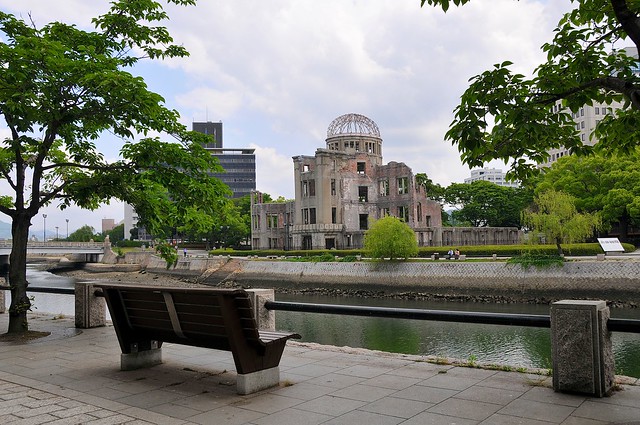 |
| A-bomb dome from the island Peace Park. |
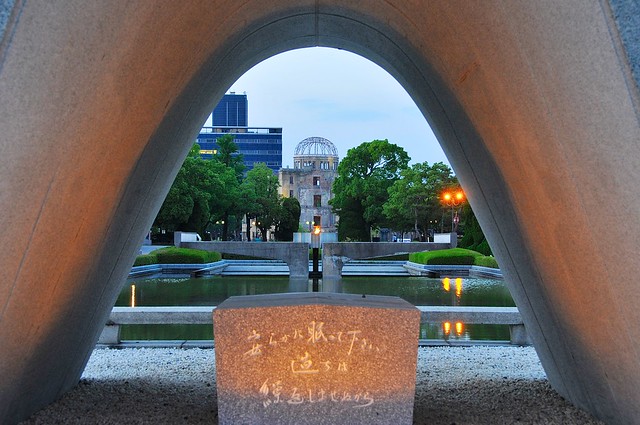 |
Cenotaph, peace flame, and A-bomb dome at dusk.
|
