Showing posts with label Iran. Show all posts

Tuesday, 20 November 2012

Bam: an ancient city, recently destroyed

I first heard of Bam back in 2003, when I read a piece in the International Herald Tribune about its destruction in an earthquake. I knew nothing of Iran, and was pretty surprised to learn that such a place as Bam—an ancient citadel with roots as far back as 500 BC, and with most of the surviving mud-brick buildings dating from the Safavid era (1501–1736). I promptly forgot about Bam, but I was reminded of it when I started to leaf through my Lonely Planet and trying to figure out what I should see in Iran. And, in truth, the memory of that news report probably gave me false expectations, as in my mind I had conflated the modern town and its casualties with the ancient town, and come away with impression that Bam had been a town where people had continued to live in ancient buildings until the quake. This false memory was reinforced by a rather vague description in Lonely Planet, which describes that the quake's destroyed the mud brick homes in which most people lived, and forced them to build steel-framed buildings to replace them, but failing to mention that these mud-brick homes were less than 50 years old.

Anyway, the reality is that most of the older buildings below the citadel were in ruined or semi-ruined condition well before the 2003 quake, and that only the citadel itself was in good repair at that time. The same is true for nearby Rayen, which was largely spared in 2003.

From Kerman to Bam

The bus station in Kerman is a bit of a mess, as it is unusually spread out, with different ticket offices in different for different companies and destinations. There are also touts outside offices trying to get people onto their buses before they leave, which can be slightly confusing. Buses to Bam run fairly frequently, but I ended up waiting for about an hour for mine to leave.

Bam isn't a major town, and almost all buses will be running through to Zahedan, so the de facto bus stop is a roundabout on the south edge of town. From there is a a few kilometers to Lonely Planet's highly-recommended place to stay, Akbar Tourist Guesthouse. Akbar's may actually be the best option in Bam, but given the dearth of options I don't think that's saying much.


Mr. Akbar's Tourist Guesthouse

I arrived at the guesthouse at about the same time as a couple of Iranians who arrived by car, but we were both stymied by no one being there, so we waited in the courtyard. It was well over an hour before anyone arrived, and the Iranian pair checked in first. I received a bit of a shock when I was told that the price the cheapest room was 300,000 rial, as the recent Lonely Planet suggested the price should be about 130,000 rial—clearly he was doing something like Vali and boosting his prices.  Of course, this was especially shocking given that the triple room in Kerman had been a total of 270,000 rial.

Akbar said he would give me a discount to 250,000 rial. If he had been there when I arrived, I probably would have walked away and returned to Kerman in the evening, but it was now late afternoon and I wouldn't be able to see the Arg before it got dark. So I ended up agreeing to stay.

In all honesty, his place was pretty rough. I know there was an earthquake, but it happened nine years earlier, in 2003. Construction was ongoing and the stairs were completely open on one side, with not even a railing for safety. The rooms were already quite dingy and dirty, with stained carpets. The shared bathrooms had inoperative toilets and showers, and were full of mosquitos. They also lacked hot water, so after I had dropped my bag Akbar let me use one of the bathrooms in a nicer room, but I had to chose if I wanted to use it in the evening or the night. As someone who showers in the morning and the evening, this sucked. In all, it was pretty unimpressive, at any price.

But whatever. I headed out to see the Arg, which was another three or four kilometers north of Akbar's. Outside of the historical areas, Iranian cities aren't especially attractive, and Bam was even uglier than most. No doubt this is a harsh assessment in light of the 2003 earthquake (but given the Iran's huge population boom—half the population is under 25—and concomitant building expansion, this isn't as unfair as you might imagine), but the area between the Arg and the highway has a very industrial feel.

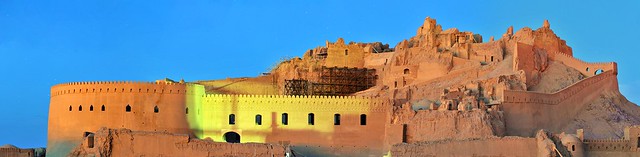
_DSC6632 - _DSC6636
The Arg at dusk. None of the area pictured here was accessible to tourists when I was there.

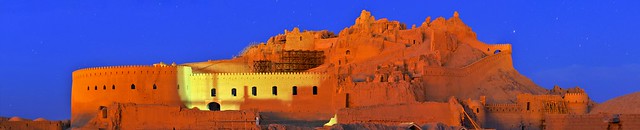
_DSC6638 - _DSC6642
A little later, a little darker. This is about as god a view as you can get of the Arg.


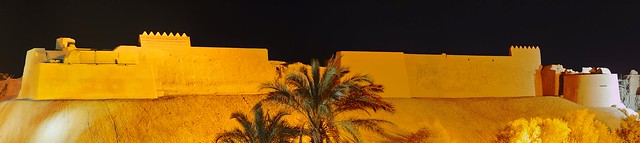
_DSC6644 - _DSC6648
View from the southwestern edge of the Arg complex. Thee walls are one of the few sections of town aside from the citadel that had been reconstructed.

The naming of the Arg is a bit confusing, as Arg (or Ark) is usually used to refer to a citadel, but in Bam the entire ancient city complex is referred to as the Arg-e-Bam. The ancient city itself contains a citadel on the northern end, which makes it a little difficult to differentiate whether you're talking about the citadel within the ancient city, or just the entire ancient city complex.

A model of Arg-e-Bam as it appeared before the earthquake. The citadel is at the northern end, on the right. Almost all of the domed structures in the bottom half were destroyed in the quake, though the two domed structures at the upper left have been somewhat reconstructed.

Sunday, 18 November 2012

Kerman

Shortly before arriving in Kerman, my conversation partner invited me to have breakfast with him. I would have agreed, but I had to find the Canadian couple I was traveling with, as they left the bus ahead of us. When I found them, I couldn't find my Iranian friend, and I felt a bit bad. But maybe the breakfast invitation was just taarof?

Anyway, we took a taxi from the bus station to one of the hotels listed in Lonely Planet. I'm not a taxi person in any culture or country, but I got sucked along with the couple I was traveling with. The small hotel we went to was nice but somewhat basic, and the Canadians were shocked by the price, as it was 270,000 rial for a triple room with a private bathroom, TV, and fridge, as well as a shared kitchen. They thought this was the per-person price, but were surprised it was the price for the room. So, basically it was half the price of Vali's, for much nicer accommodation. In reality, this was the kind of pricing that I saw in most of Iran, as the devaluation really did make most things cost less than half (in dollar terms) of what they would have been earlier in the year.

Anyway, after stowing our bags, freshening up, and making some instant coffee in the kitchen, we headed out towards the main sight in Kerman: the grand bazaar and Ganj Ali Khan complex.

We left the hotel together and walked maybe 50 meters to the main street. As soon as we reached the busy main street, however, I realized something was up. Literally everyone we came across would turn to look at the Canadian couple (both of whom were very white and had sandy-coloured hair), with most of the attention being given to the girl. The males would do a good job of not staring until the passed the couple, but their heads would swivel afterwards, while Iranian girls would openly stare without attempting to conceal it. Within the first five minutes we had been approached in English by at least three people who wanted to talk to us. But when I say we were approached, I really mean that the white guy was approached: it would be improper for these Iranian males to directly address an accompanied female, and I was basically ignored (as I would learn later, the locals probably thought I was an Iranian tour guide or friend who was accompanying them, if they even noticed me at all). It was incredibly surreal to see how different our experiences were, and how much attention was being lavished on these white folks while I passed unnoticed even though all of us identified as Canadian, that I had to laugh. But as surreal as it was to me, the Canadians were totally unfazed, as they had been in the country for a while and were undoubtedly accustomed to all the attention.

We headed down towards the grand bazaar, which was a pretty nice introduction to Iranian covered markets. Unlike in most of Central Asia, in Iran there are lots of mosques, markets, baths, and other buildings that have been in continuous use for hundreds of years. These aren't recently-(over)restored tourist pieces like you see in Uzbekistan, but living and breathing buildings that have been maintained and cared for over the years. Even in places where the Mongols destroyed buildings in the early 13th century, by the first years of the 16th century the Safavid empire overthrew the Timurids in Iran (which was no slouch in the the architecture department, as Samarkand shows), ushering in "modern" Persia and a prolonged era of stability. And as Iran has never been colonized, as most of Central Asia was by the Russians, there has never been a move away from these traditional buildings.

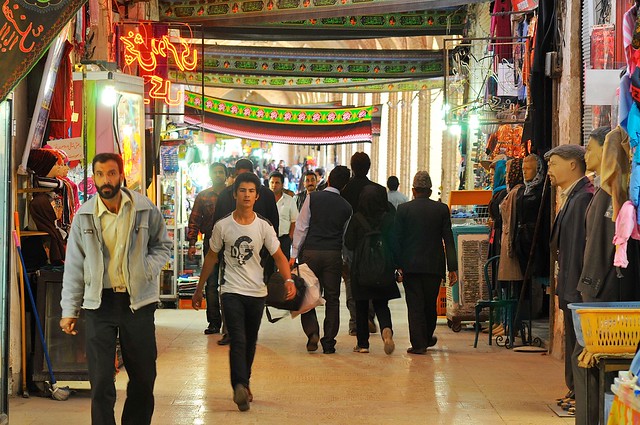
As a result, the bazaars in most Iranian cities continue to be the exact same sort of traditional bazaars that have existed for hundreds of years: mazes of inter-connected alleys with small domes forming the roofs—though these are barely noticeable from inside the markets, as you're not often tempted to look up and admire them amidst the bustle. These bazaars feel both exotic and, after a while, surprisingly commonplace and unremarkable.

Kerman's grand bazaar is located adjacent to the Ganj Ali Khan complex, which contains a large rectangular square surrounded by arched cells (like a madressa), complete with fountains and greenery, and surrounded on the sides with a caravanserai, a mosque, and a hammam (bath).

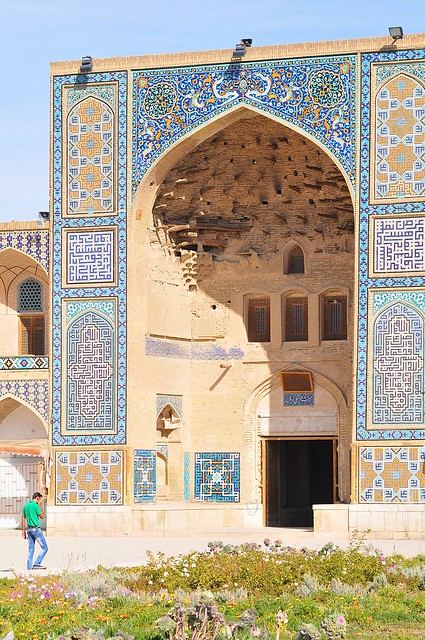
_DSC6609
Pishtaq leading to the caravanserai at the Ganj Ali Khan complex in Kerman, built in the Safavid era between 1591 and 1631. Although the large rectangular square looks like a giant caravanserai, the actual caravanserai is a small square courtyard behind the pishtaq.

_DSC6610 - _DSC6611
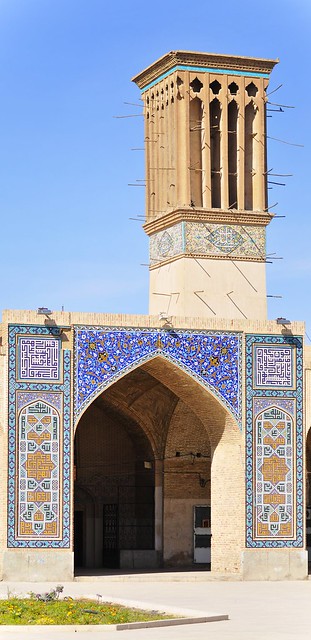
A bagdir (wind tower) along the north end of the square. Yazd is the most well-known center for bagdirs, which work by capturing small breezes and funneling the moving air down to ground level, where it often passes over a small pool of water that further cools it.

_DSC6614
View down the bazaar, which runs along the southern side of the complex.

Saturday, 17 November 2012

Welcome to Iran: the holy city of Mashhad, by way of Serakhs


From Merv to Serakhs

In the morning, after breakfast with my roommates, I set out to find a taxi to the border at Serakhs. I probably could have squeezed in a visit to the regional museum (which is supposed to be quite good), but share taxis typically leave in the morning and I wanted to make sure I would be able to make it all the way to Mashhad that day. The taxi lot is basically the parking lot in front of the train station, near the bus station, and I was able to find a driver without too much difficulty—we just had to wait for additional passengers.

I'm something of a Coke addict, so while waiting I bought some samsas from the food vendors next to the station, and also picked up a bottle of Coke. This is a bit of a weird purchase, especially since I was low on manat, but I wasn't sure if Coke, as a western brand, would be available in long-isolated Iran (it turns out I shouldn't have worried, as both Coke and Pepsi have continued to exist since their  introduction, likely before the revolution).

Although Mary doesn't look to be that far from Serakhs, don't discount how much farther things seem when the roads are horrible. Although even the main roads in Turkmenistan are surprisingly bad for a petrol country, the side roads are even worse, with lots of potholes that result in cars weaving from side to side to dodge them. Most of the ride to Serakhs was on exactly these kind of roads, and it took about three hours to get to Serakhs. We were dropped off a short distance from the immigration post, as there was a huge queue of trucks and cars lined up before the border.

Crossing the border

Leaving Turkmenistan was relatively painless, aside from again-mandatory border shuttle that we had to take, for the extortionate sum of $2, for a road that is about 1.5 kilometers long.

On the Iranian side, things were considerably more complicated, and there a huge number of people in the waiting area. I'm not quite sure how things are supposed to work, but you give your passport to someone, then take a seat in a large waiting area. And then you wait. And wait. And then you'll be summoned, asked a few questions, and then told to sit and wait some more. One of the customs officers—an older, stern looking guy with a grey mustache—talked to himself in Farsi while he looked at my documents, then beamed at me and said "I love you!" before he resumed muttering to himself. I think it might have been the only thing he knew how to say in English, and the contrast between his otherwise grim demeanor and the warmth with which he said it was amusing. He then gestured that I should go sit down again.

I was eventually summoned into a commander's office, where I answered some questions and was stamped in shortly thereafter—it appears he was out or busy before then, and for some reason I needed to speak with him. In any event, it actually took significantly longer to process me than it did to process locals, and I suspect that if you entered at a busier border that is more accustomed to foreigners things would be substantially easier.

The Iranian side of the border compound is pretty big, with lots of various buildings and inspection points—much more organized and professional than the rather perfunctory border posts of Central Asian countries. One of the interesting things I noticed was a large steel water reservoir with spigots and on each side, as a kind of public water fountain, with one side for women and another for men. Once I made it outside the border area, I stopped by the gate and fired up my netbook. I had downloaded an old version of the Lonely Planet Iran (this was the first country for which I didn't have a hard copy of LP), and hoped to find some useful information on how to get to Mashhad, but it honestly wasn't of much help.

Arriving overland usually makes the transition between countries and places much smoother, but in all honestly the difference between Turkmenistan and Iran was even greater than the difference between China and Kyrgyzstan (going between the CIS 'stans is relatively easy in comparison)—or perhaps it is more accurate to say that the differences made it more challenging. In Iran everything looks different. There is no Soviet-style architecture but a lot of narrow, low-rise concrete storefronts with glass windows running the width of them; no Cyrillic, and little Latin, but lots of Arabic script; the people look different, with lots of facial hair for men and hijabs for women; and decent infrastructure with French cars.

I was to quickly learn that Iranian drivers are crazy, but this wasn't immediately apparent as Serakhs seemed strangely dead when I headed into the city, and I wasn't sure where I should change money. Of course, the fact that most signs were in Arabic script didn't help matters. I wandered around the city for a while, hoping to find a bus station (or a friendly local to offer to help), but no such luck (this is likely because, as I later learned, I pass as Iranian—if you look white or western you'll have no problem attracting copious attention and inquiries), so I walked back towards the border point. Although I hadn't seen an share taxis nearby, I figured that they must congregate somewhere nearby. It turns out that I was correct, as there is a gas station along the main road to Mashhad, across from the park that separates the border point from the city, and cars to Mashhad congregate at the roadside there.


As in Turkmenistan and Uzbekistan, Iran subsidizes gasoline. Not to the extreme extent that Turkmenistan did, but it is still very cheap, which has a salutary effect on transportation prices (as did the massive devaluation of the rial that occurred in early 2012—it dropped from about 1,000 rial to the US dollar to about 3,000 to the USD, largely as a result of increased economic sanctions). I had little idea how much it should cost to get to Mashhad, but I was able to get there for the paltry sum of $3. Again, it helped that the driver wasn't a professional driver but just a private individual going to Mashhad and looking to defray costs, and it may have helped that I had to pay in dollars and they seemed unsure of what exchange rate to apply.