Showing posts with label Kharkhorin. Show all posts

Tuesday, 17 July 2012

Kharkhorin: Mongolia's ancient capital

Kharkhorin ended up being one of my favourite places in Mongolia. The main attraction, Erdene Zuu Khiid monastery, is gorgeous and deeply photogenic; the surrounding steppe, hills, and river are beautiful; and I was able to stay in a great, low key, home-style ger camp.

Suvd's Ger Camp & Family Guesthouse


The bus drops you off in the middle of a dirt parking lot just past Erdene Zuu Khiid, and as I got off I a woman gave me a photocopied pamphlet and asked if I wanted to stay in her ger camp, which she said was about 10 minute walk away (they appear to have a rudimentary website, here). I declined, as I'm always a little skeptical of being approached by touts and there was a ger camp recommended by LP near the monastery. I had noticed when we entered town that I hadn't seen the ger camp where LP described it as being, so after a couple minutes of looking around the empty lot and thinking about it I went back to the lady and said I would stay with her. She flagged a taxi and drove us north to her camp. It turns out that she actually was the owner of the camp listed in LP, but that she had moved since it was published. Unlike some of the massive and institutional ger camps down by the river in Kharkhorin, her camp was simply two or three gers in addition to her family ger in a fenced compound at the northern end of the city. Unlike most housing compounds, the fence around hers was slatted and low, giving it a much more open feeling (given the lack of privacy in traditional Mongolian life, I wonder why they usually use high, solid fences for their homes).

_DSC4584
Suvd's ger camp, at the northern edge of town. Doors on gers always face south.

There is a shower block that has a hot shower, as well as a rather unusual outhouse that has a normal western toilet that flushes mounted on a platform over a pit: it works like a western toilet, but you can hear the flushed water dropping some distance below. She also has internet that goes through a mobile-phone connection, so it's pretty slow but gets the job done. Both the shower and the toilet are cleaned daily.

_DSC4824
Unlike Kyrgyz or Kazakh yurts, the central aperture in a ger is supported by two wooden columns. Ropes on the outside let you open or close the aperture.

Her husband is a tour guide, so he's often away during the tourist season, but she has friendly kids of varying ages, as well as a dog. Dogs in Mongolia are often semi-wild, and not always terribly social. They are used as guard dogs, and they will literally bark for hours on end at night and can be very protective (the customary greeting when you approach a stranger's ger is to shout "hold the dog!"). The barking is really the only way I knew they had a dog, as I never saw him during the day except when I asked her son where it was (it was off sleeping in the shade of the family ger).


_DSC4825
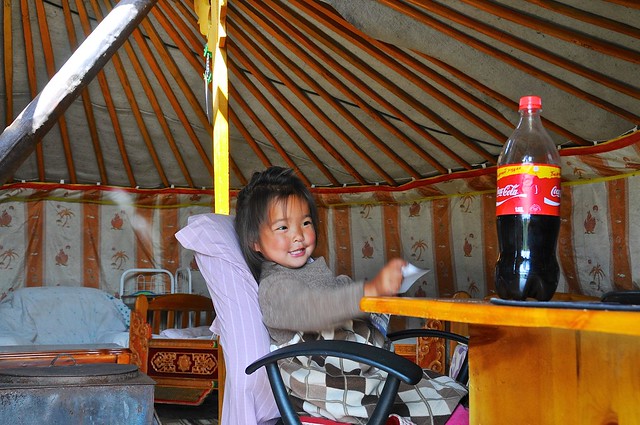
Beds line the outer walls and a stove is in the middle. Suvd's daughter is at the computer desk, inadvertently being tempted by the Coke I had left there.

_DSC4827
Mongolian kids are used to strangers, and are passed around as babies.

_DSC4832
She can take pictures of me, too.

First foray to Erdene Zuu Khiid

After settling in at Suvd's, I headed back into town and towards the monastery, which you drive by on the way into town.

_DSC4585
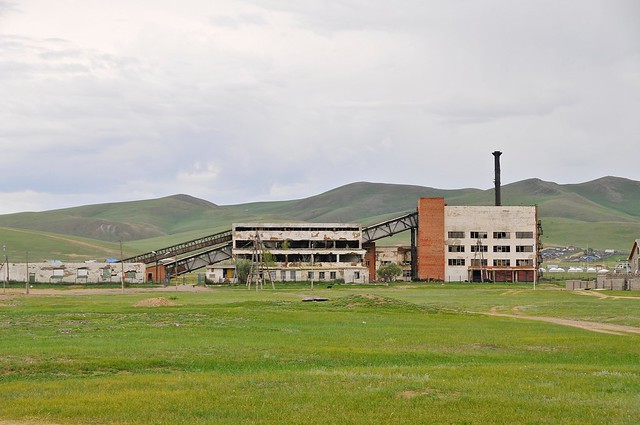
Abandoned Soviet-era plant or factory of some kind.

_DSC4586
Herd of animals between town and the monastery.

_DSC4589
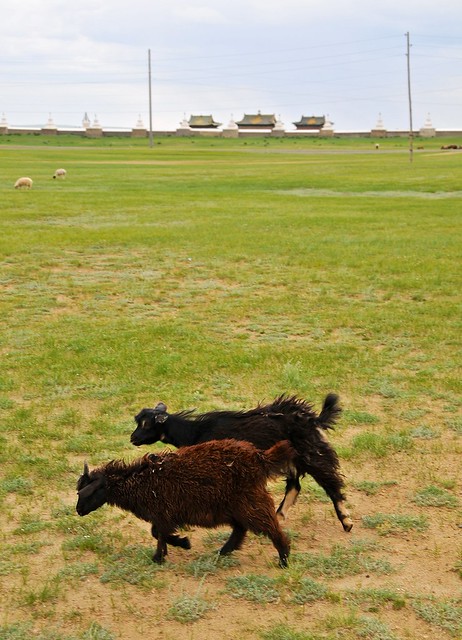
Two goats on the sandy, degraded land.

_DSC4591
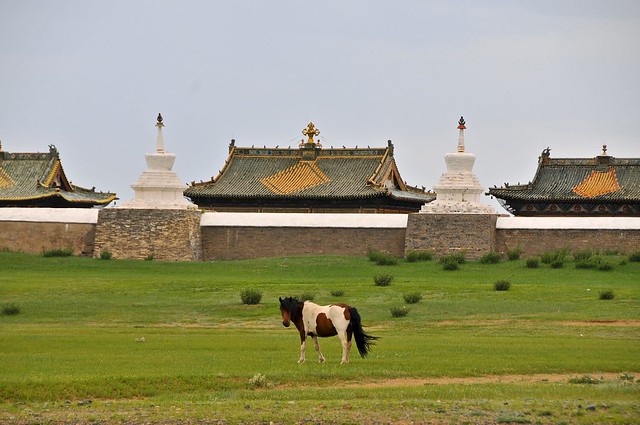
Horses also wander around, unhobbled and unrestrained.

_DSC4608
Corner stupas. There are 108 stupas on the walls around the monastery—108 is a holy number in Buddhism.

Sunday, 15 July 2012

The Bus from Ulaanbaatar to Kharkhorin

I ended up staying in UB for the duration of Naadam, despite the rapidly diminishing returns after the second day, which was enough time to see the Choijin and Gandan moasteries.

On the 15th I caught the bus to Kharkhorin, as I figured I would do as much as I could in Mongolia independently and without taking a tour. But even something as simple as taking a bus isn't as simple as you might think. First of all, buses to all destinations don't even run every day, let alone at all hours. Buses to different places also leave from different locations, and it's difficult to get up-to-date information. Thankfully, the information office located in, of all places, the lobby of the Erel bank (located midway between Sukhbaatar square and the State Department Store along Peace avenue) had the bus schedules for the different station on file in a binder.


Getting a ticket at the western Dragon Bus Terminal proved somewhat difficult, however, as everything is in Cyrillic and the ticket windows did not seem arranged according to any discernible system: whatever was written above the windows was not the destinations the windows served. Add into that the Mongolian-wrestling style of queuing, and it was difficult to shove your way to the front and pantomime your question, especially since the attendants would rather deal with a pushy Mongolian speaker than a clueless foreigner. I eventually found the correct place to get a ticket, but it probably took a good 20 minutes.

I was one of the last to get on the bus, and my bag went into the same compartment as the jerry-cans being used to transport airag (fermented mare's milk). These can predictably leaked (this is why they were put in a different compartment than most luggage), but my bag only let a small amount of airag in, which was nice.

The trip itself took about 7 hours to cover the paved 350 km, with a break about midway at a small collection of buildings and shops. Everyone on the bus made a beeline to the toilets/outhouses, as Mongolians are very bad at holding their bladders. I suspect it is because—like the Chinese—they have not trained themselves to hold it. Kids are encouraged to go wherever and whenever they want, and this seems to carry over into adulthood (they can obviously go whenever they want when living as nomads).

I spent the break taking pictures.
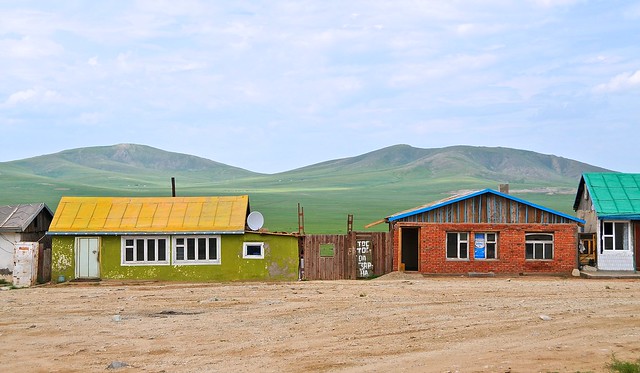
_DSC4565
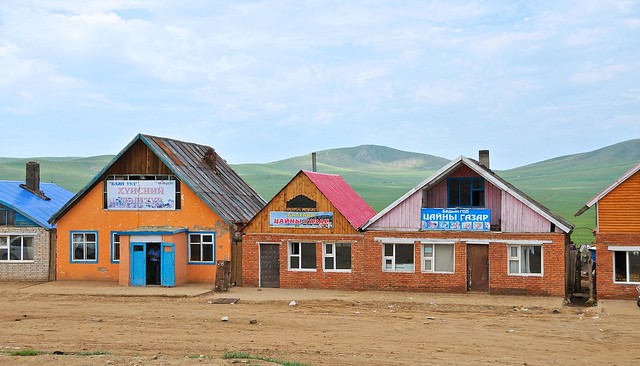
Look grim? Well, it's probably a typical small Mongolian community.

_DSC4564
Dirt streets strewn with trash—a nightmare when it rains.

_DSC4573 - _DSC4574
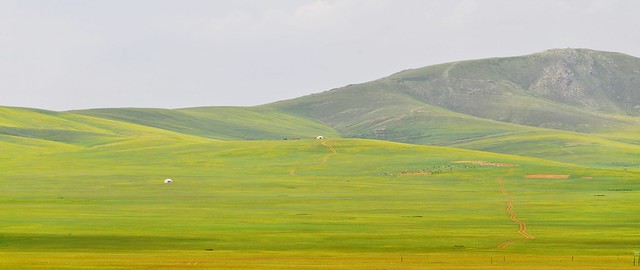
The gers in the surrounding fields look much more inviting... at least from a distance.

_DSC4576
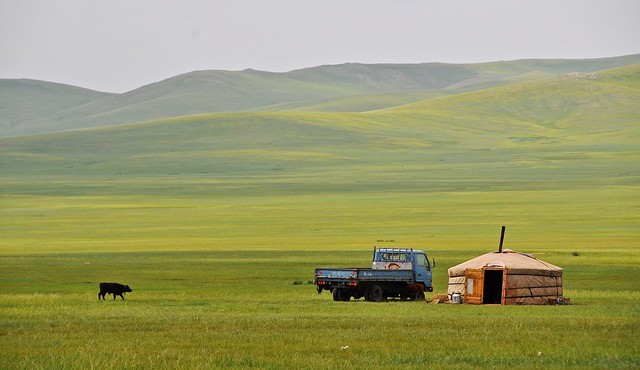
Most gers nowadays tend to have satellite dishes and solar panels.

_DSC4578
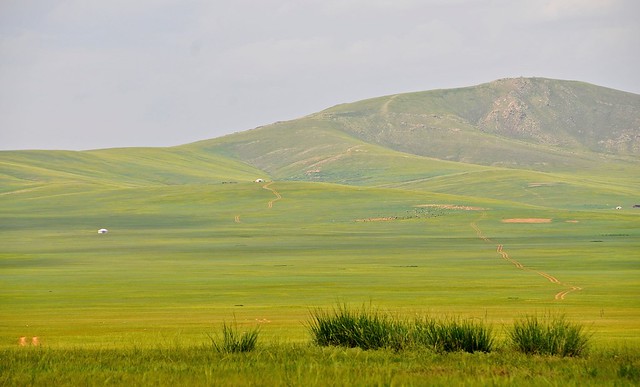
Less than 0.4% of Mongolia is arable: this land is about as good as it gets.

Just after we turned onto the road that led to Kharkhorin and Tsetserleg, we saw a car that had crashed into a truck head-on. Although the car was crumpled and mangled, the driver has standing in the ditch and talking on his phone. Airbags and crumple zones are wonderful things, though I can imagine the crash could be financially ruinous for him. But it's kind of hard to understand how this kind of crash could happen: there's not a lot of traffic in Mongolia, and this was on a straight, paved, and dry road. But I think the emptiness of the Mongolian landscape lulls drivers into a false sense of security, and does little to dissuade people from drinking and driving.