Showing posts with label Kashgar. Show all posts

Friday, 31 August 2012

Kashgar to Osh in two not-so-easy days

There are basically two ways to get from Kashgar to Kyrgyzstan: the Torugart pass and the Irkeshtam pass. The Torugart pass is arguably more scenic and takes you past the Tash Rabat caravenserai on the way to Naryn, but it's a very difficult route to take because China requires a special permit and guide to take you on this route, which effectively means you have to arrange for private transportation with a tour agency. The Irkeshtam pass is much more heavily traveled, and is served by a once- or twice-weekly international bus running between Kashgar and Osh, with tickets running close to $100.

In 2012, it was also possible to hitch-hike over the border. In order to do so, you would take a share taxi or minibus to Ucha/Wuqia/Ulugqat from Kashgar's international bus terminal, then go to the Chinese customs point in Ucha, where you would be stamped out of China (despite being about 135 km  from the actual border) and put onto a truck by Chinese customs officials. You would then take the slow and bumpy ride to the border, which can take up to 6 hours because of the roadwork that limited your speeds to as low as 20 km/h. After that, cross into Kyrgyzstan and then either take a share taxi from the border to Osh or Sary Tash, or jump back on the truck and make it to Osh the next day.

I decided to try this, as it was better than waiting for the bus (which is reported to be quite bad) and braving the multi-hour waits to buy tickets at the international bus station. If you're trying to do something similar today, Caravanistan and Far West China have all the details: the short story is that you absolutely need to take a taxi between Ucha and the border.

Road to Ucha/Ulugqat

When you arrive at the international bus station, there will be huge lines (I estimated it would take 6 hours to get to the front of the line, as I waited in one before realizing I didn't have to), but you don't need to wait in them in order to go to Ucha. Instead, head out of the doors and into the courtyard behind the station: although someone will check you for a ticket, just tell them you're going to Ucha/Wuqia/Ulugqat, and they'll let you through. At the back left, there should be a stand with the Chinese characters for Ucha. I paid 60 yuan for the ride to Ucha in a share taxi, which is apparently a huge overpay, but then again there were only three of us.


_DSC9535
Not far outside Kashgar.

_DSC9538
Views like this make me regret taking so many night buses and trains.

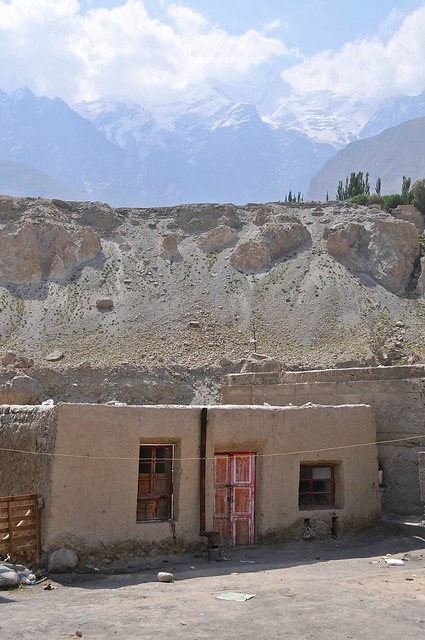
_DSC9539
Note the stone buildings and pens on the left.

Wednesday, 29 August 2012

Kashgar, take two

I had only been in Kashgar for two full days, but that was really enough time to see most of the things in the city. Really, there's the Sunday Market, the livestock market, the Id Kah mosque, and the Abak Khoja mausoleum. But most of all there's simply wandering around the old city and soaking up the atmosphere. I suppose one could explore the more Chinese parts of the city, but that holds little appeal for me. Maybe visiting the amusement park would have been interesting.

So on my final day in Kashgar, I didn't have much on my plate for the day, and I decided to accompany another tourist staying at the Pamir Hostel as he went to the Sunday Market to buy a carpet. This guy was a European who was living in a big city in Eastern China, and he wanted to buy a carpet or textile to use as a wall decoration.

Given the size of the Sunday Market, the are devoted to rugs and carpets is quite small, but it was interesting to tag along as I would otherwise be hesitant to enter one of the shops and waste the seller's time while being bombarded with high-pressure sales tactics. Accompanying someone else who was interested, while making it clear I wasn't buying anything, was a much better strategy. Virtually all the carpets on display at the shops we went to were used, and they were in a surprising array of styles—not simply the Yarkand or Hotan carpets one might expect to see. Pakistan, and Afghanistan were well represented, and they also had a fair number of Tajik or Uzbek suzani tapestries. I discovered that I quite like strong geometric patterns of the flat-woven kilim rugs they had, most of which were Afghan, and many of which were camel-hair. I know nothing about carpets, and have no idea how much things should cost or what a good deal would be—and in that respect, I'm sure I'm like most consumers.

The Uyghur carpet salesman recognized the two of us for what we were—a couple of tourists with little to spend—and didn't try too hard to sell us on his carpets, though he was friendly and informative. The European guy bought a small suzani for about $60. Small potatoes. But then the carpet seller said something that really encapsulates the reality of traveling in China: "Four or five years ago, Americans and Europeans were the biggest customers, and had lots of money to spend. Now, they buy little and it's the Chinese who spend a lot." It's like that for a lot of things. Those Westerners who are likely to travel to places like Kashgar are simply out-classed, economically speaking, by the kind of Chinese who can also afford to travel there. Prices for many things seem expensive even by Western standards, but that's because there are more than enough wealthy Chinese who think nothing of overpaying and for whom conspicuous consumption is a virtue.
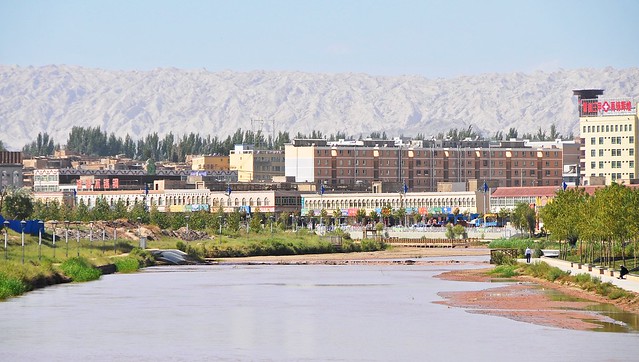
_DSC9520
Looking north from Aizirete road bridge, near the Sunday Market.

_DSC9521
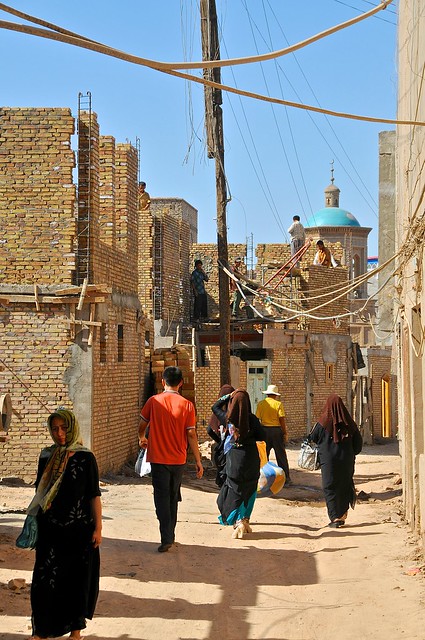
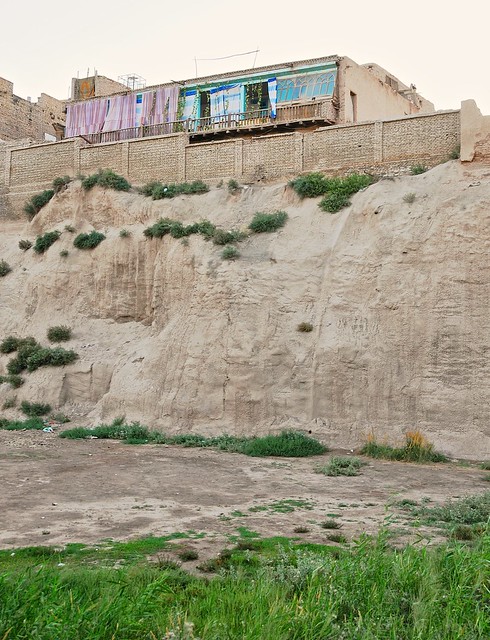
Making a staw & mud slurry to cover the new buildings along a stretch of old town that was destroyed & widened into a large road.

_DSC9523
New buildings going up. At least they didn't widen the road, so it will retain more of its old character.

_DSC9524
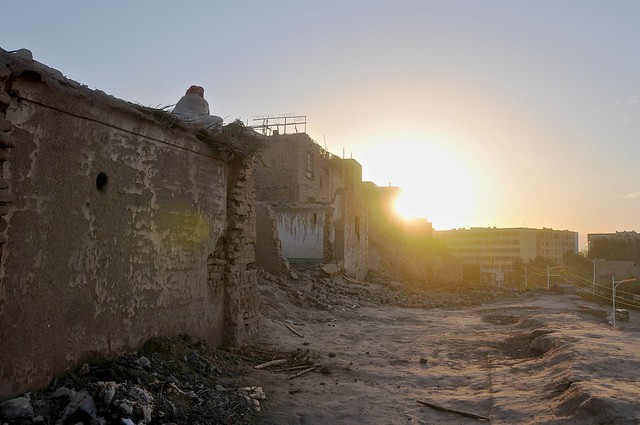
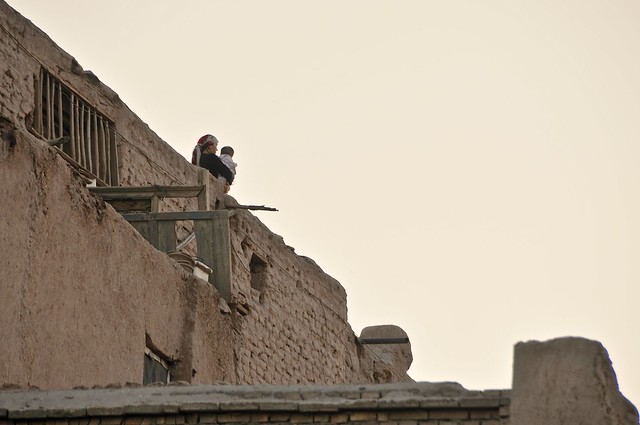
Sunset in an area still being destroyed. A woman sits on the roof, watching a vanishing way of life.

_DSC9526
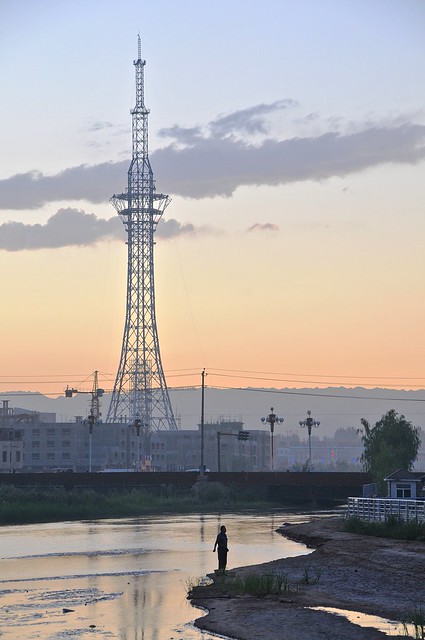
View along the Tuman river.

_DSC9534
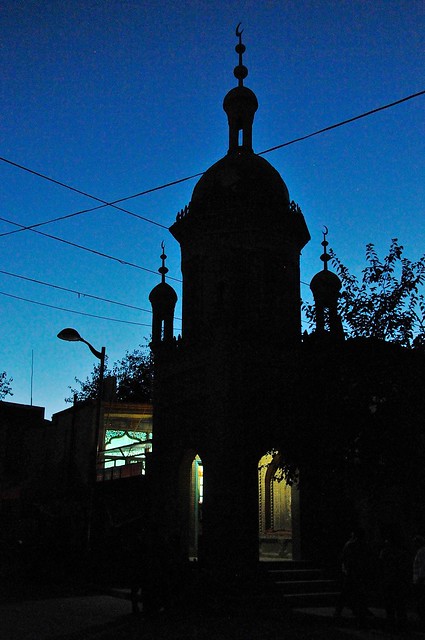
Mosque in the dwindling twilight.

Although I loved Xinjiang, and could have spent more time there backtracking to places I had skipped in my rush to get to Kashgar, it felt like it was time to move on to Kyrgyzstan, especially since summer was coming to a close (even if it didn't feel like it in sweltering Kashgar): I decided to try my hand hitching to Osh the next day, aided by a set of instructions posted by a fellow traveler at the hostel.

Budget

August 29: 78 yuan
  • Pamir Hostel: 50 yuan
  • Dinner: 15 yuan
  • Drinks: 15 yuan
  • Melon & naan: 8 yuan


Monday, 27 August 2012

Kashgar, take one

After being in Mongolia, I had learned the importance of getting a jump on things if you want to plan on booking a cheap tour or sharing expenses, so I had two early priorities in Kashgar: one, to figure out how much time I had left on my visa, and if I was limited to 30 days since my last entry (most Chinese visas stipulate that you are only allowed to stay for 30 days, and if you want to stay longer you need an extension, while my visa didn't specify a length of stay limitation); and two, how much it would cost to enter Kyrgyzstan via the Torugart Pass (which requires both a permit and private transportation on both sides of the border) and Irkeshtam Pass.

Thus, after checking into the Pamir Hostel, I made my way to John's Cafe. The Uyghur operators there were pretty helpful, but said that it would cost $400 if you did the Torugart Pass solo, dropping to $150 if you shared with three or more people. This was more than I wanted to spend, so the next step was to find out how much the international bus to Osh would cost and when it left. I went to the international bus station, but the lineups were incredible, so I figured I would come back at a different time when hopefully it would be less busy (it's always busy, from what I can tell, and talking to someone would involve waiting for hours).

I then made it to Kashgar's PSB (public security bureau) office to enquire about my visa status. Althoug htey weren't open to actually do any processing, I managed to get the officer working there to take a look at my visa and let me know if I needed an extension if I wanted to stay for more than 30 days. He took a look, and said that since it didn't explicitly say I was limited to 30 days per entry, I could stay until the expiration of my visa. This was a relief, but it also came a bit too late, because I had essentially rushed my way through Xinjiang in order to make sure I would be able to exit the country if I had been limited to 30 days—had I knew I had more time in advance, I might have stayed a day or so longer in Tashkuragan and Karakul, as well as possibly spent more time on the edges of the Taklamakan desert.

_DSC8855
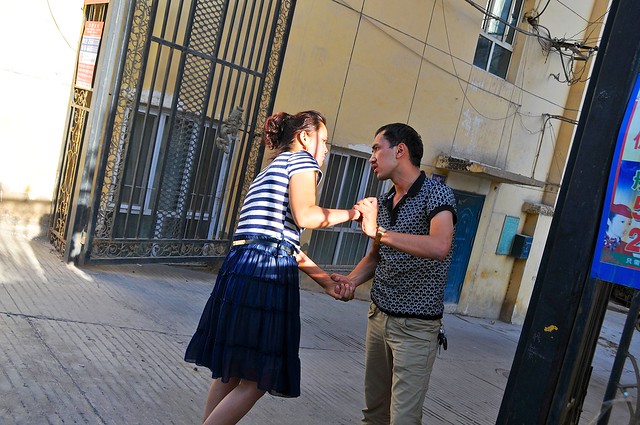
I saw this young Uyghur couple fighting in public, on a busy street near John's Cafe. This was really the first example of public violence I saw in China, and I stopped and looked to make sure it didn't escalate, taking a picture or two in the hope it would defuse the situation. She started pushing him and then he grabbed her neck, and then I stepped in to take his hand away from her neck. I'm not sure I would have done this in all places, but by now I think I had gotten a good enough idea of China to understand that this wouldn't be tolerated and that nothing would really happen to me for intervening. After the couple had calmed down, I was walking away and a older American approached me and asked if I was the Uyghur guy's friend, which he had somehow thought I was (I guess I can pass for Uyghur in an American's eyes).

_DSC8859
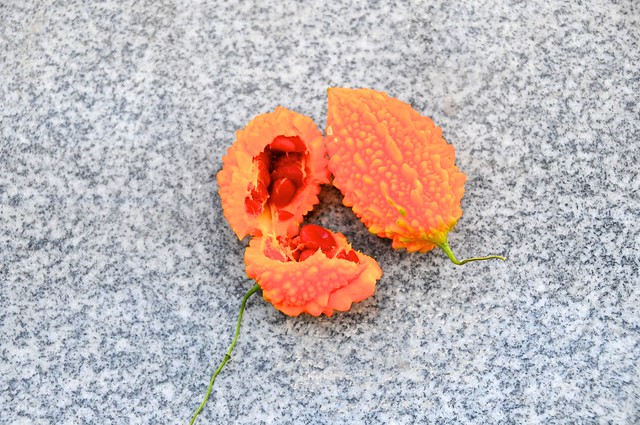
Is this simply a ripe bitter melon? You can eat the flesh around the seeds, but it was nothing special other than how it looked.

_DSC8861
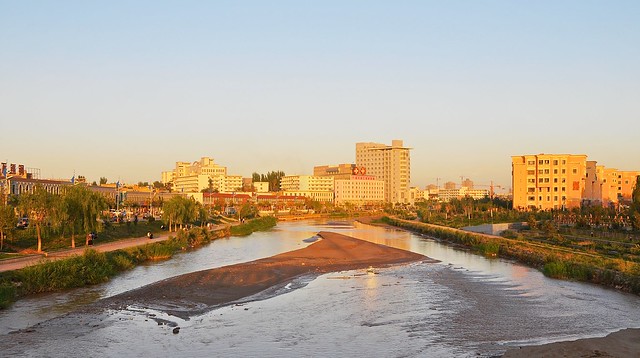
Looking east from the Yingbin Road bridge over the Tuman river; the international bus station is just to the northwest of the bridge.

_DSC8863
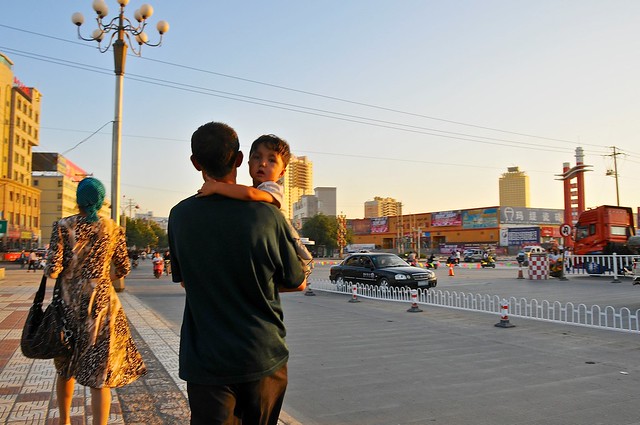
Modern Uyghur family, walking south over the bridge.

_DSC8866
One of my first glimpses of the old city, from a major throroughfare below.

_DSC8875
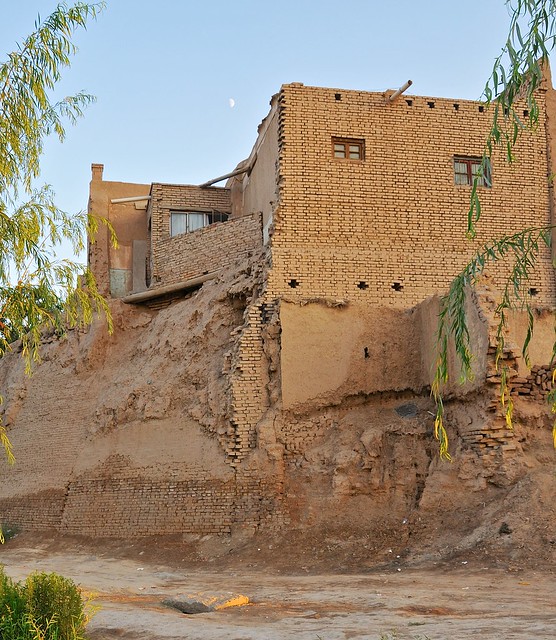
I wasn't sure how accessible the old city would be, since I had read that some places charge admission, so I climbed a tree to get this shot. Locals looked at me like I was crazy. In about 15 minutes I would be just outside that house, talking with kids who lived there.

_DSC8877
Mother and child watching the sunset from their roof.

Friday, 24 August 2012

Tashkurgan and the Chinese Karakorum Highway

I arrived at the Kashgar bus station before dawn, and briefly looked outside the station. The only people up and about were the odd taxi driver and the morning street sweepers. I went back inside to check the schedules to Tashkurgan, and decided that since I was already up and at the bus station, I might as well immediately take the bus there.

_DSC8691
The bus stops in Upal for breakfast, where I bought some naan and took a picture of the tandoor in which they (and samsas) are cooked. The baker will periodically season the inside of the tandoor by throwing fistfuls of salty water against the interior, which sizzles and leaves the salt coating on the interior. Sometimes you get a chunk of salt on the bottom of your naan. Apparently the government is giving incentives to have bakers switch to electric tandoors, instead of these inefficient coal-fired ovens.

_DSC8693 - _DSC8694
I had an aisle seat, so I wasn't able to take pictures through the window, and could only take pictures when we stopped. This is at the checkpoint at the head of the Ghez river. The Ghez river valley is a wide, stony plain that fills with melt water in the spring and summer, lined with mountains that range from grey to deep red.

_DSC8696
Dusty shopfront at the checkpoint.

After the checkpoint the road becomes steeper, and we do most of our climbing. At the end of the climb we arrive on a broad mountain valley—or pamir—at an altitude of about 3,500 meters. The first thing you see on entering the pamir is Bulungkol lake whose opposite shores are formed by sand-dune mountains.


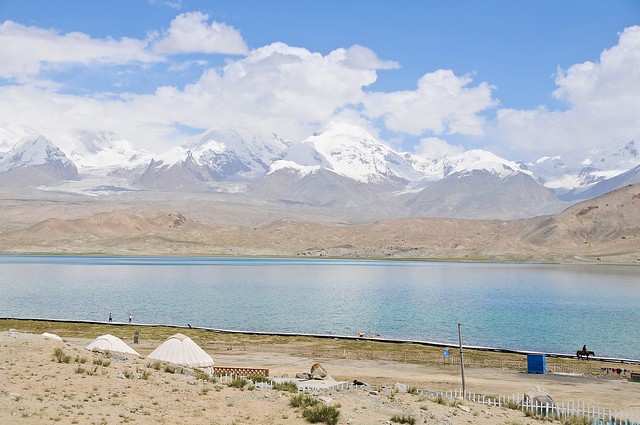
After the sand-dune mountains, the next major place of interest is Karakul lake. The bus will stop here, since it is a major tourist destination, and a few people will get off and maybe someone will get on. I was able to run away and take some pictures while we stopped, but the driver was annoyed because I ended up being the last one back on board and he had to wait a couple of minutes for me.

_DSC8698
Tourist yurts on the shores of Lake Karakul, elevation 3,600 meters.

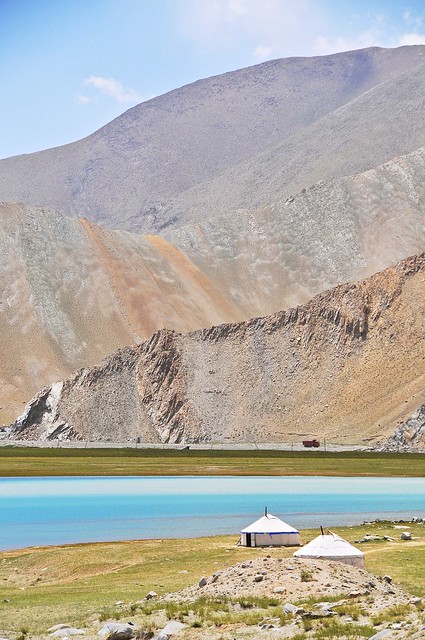
_DSC8700
Looking south over the silty, aquamarine lake.

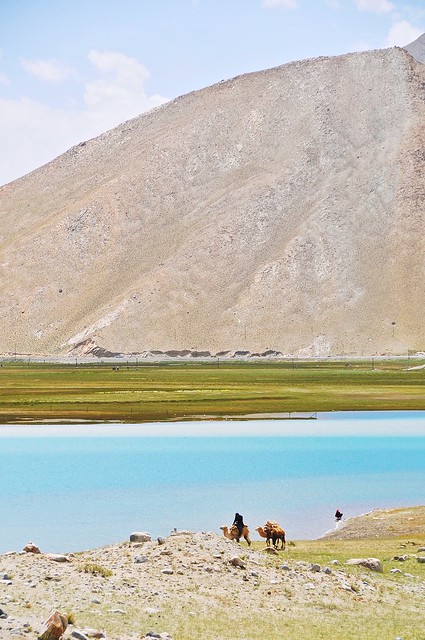
_DSC8701
A camel-herder bringing camels to the tourist area for rides.