Showing posts with label Osh. Show all posts

Thursday, 1 November 2012

A not-so-warm welcome to Uzbekistan, and a day in Margilan

The Gates of Hell

Because of my late night of internetting, I got a pretty late start on the 31st. I went to the supermarket to spend the last of my som, got some fried snacks from my favourite vendor next to the mosque, then hopped a marshrutka to the Uzbek border (which is just on the northwestern edge of Osh). It was a little after 1:00 when I arrived, and although there were lines at the Kyrgyz exit post, it only took a few minutes to pass through.

But after I passed into no-man's-land between the two border posts that I realized the insanity into which I had passed. This wasn't the big multi-kilometer gap that often exist between border points (and which frequently function as opportunities for mandatory but extortionate taxi shuttles): as an urban border point, the border-control outposts were close to each other. But because Uzbek border officers are ridiculously slow and engage in detailed searches and questions, people are stamped out of Kyrgyzstan much faster than they're stamped into Uzbekistan. So it was that there were hundreds and hundreds of people crammed into a space the size of a high-school gymanasium, which was completely uncovered and exposed to the mid-day sun. In the height of summer it must be excruciating, and extremely dangerous. The Uzbek exit from this no-man's-land compound was a gate, with a sturdy chute leading up the gate: think of a cattle pen and you won't be far wrong.

When I initially arrived, there were these touts perched on the railings of the chute that led to the actual gate to the Uzbek customs/passport area, frantically shouting with the people trying to cross into Uzbekistan. I had no idea what that was all about, but it wasn't official in any sense of the word, and certainly didn't reduce the crush of people trying to push their way to the front of the line. Also, women and men were segregated, with men on the right and women on the left.

Anyway, shortly after I arrived in this pen, a Kyrgyz border guard showed up and started pushing everyone around, and dragging people out of line and then pushing them to the back of the "line." This wasn't gentle pushing, but hard shoves that made a few people fall down, including some women. One elderly woman objected to this, and got slapped in the face after she pushed back. But after pushing people around for a while, and forming a quasi-line, he would leave for a few minutes and a knot of people would reappear near the chute... with the net effect that those who stayed in the line ended up further and further back, while those who pushed forward were able to consolidate their forward position when the soldier came out and re-formed the line.

Anyway, after going through this for about three hours—during which time one smartly-dressed family was given VIP treatment and escorted through the border by a guard—I was further from the gate than when I started. So when the policeman left for an extended period, I joined the throng of people pushing their way to the very front, and the touts re-appeared. It seems that these touts (who didn't seem to actually be taking any money, so perhaps "tout" is the wrong word) act as unofficial gatekeepers, and assign people numbers. This kind of makes sense, but works very poorly in practice since everyone pushes to the front despite having a number. Now, since I had no number, the touts were saying I could not exit, even though I had been there for over 4 hours. So this is one of the few occasions I decided to take advantage of the tourist's privilege of being something of a jerk, and I started to get really loud and shout at this guy who was trying to pull me away. This is really out of character for me, since I tend to speak quietly. Actually, I was just acting like them, as I had the group of 3-4 touts shouting at me, and I figure it's fine to shout back. This resulted in one of the touts, whose face I was in, getting rather startled and grabbing me by the neck as though the was going to choke me. This didn't go down very well with the crowd, who could clearly tell I was a foreigner by the way I was shouting in English, and they made the guy get away and let me join the next group to enter the chute. While in the chute an elderly lady behind me lost consciousness as we were being crushed against the fence by all the pushing from behind, with the heat no doubt making things more difficult. They had to pour a couple of bottles of water over her before she regained consciousness. I'm surprised no one dies at border crossings like this (heck, maybe they do), and it was somewhat ironic that there was a big billboard on one of the walls indicating that the OSCE had provided assistance to this border point.

Once inside the Uzbek border office, everything is serene and things move very slowly despite there being multiple border officers and only a few people admitted at a time. You have to fill out a detailed form asking for how much money you have (if you exit with more money than you bring in, you will have a problem), any valuables you have with you, and other questions. Then you have your bags inspected and X-rayed. I figure they process about 25 people per hour at that speed.

Megi passed through this border a few days later and indicated that foreigners/tourists are usually let through immediately and not made to wait with the locals, but that wasn't my experience. And even though I can possible pass for a local in appearance (but not in dress), I'm pretty sure the border guard knew I was a tourist since he seemed reluctant to push me nearly as hard as he was pushing the locals, and I told him in English that I had nowhere to move. At any rate it was an interesting insight into local life, and the trials and tribulations they endure. Needless to say, however, it wasn't a great introduction to Uzbekistan.

I didn't have much time in Uzbekistan—my visa expired on November 15th, since the embassy in Dushanbe decided to ignore the dates on my application and LoI and start the clock on the date of issue—but I decided that since I was in the Ferghana Valley I should see something there. Given that Margilan has a large bazaar that is only open on Thursdays and Sundays, and that it also has a silk workshop, I decided to spend my first full day—a Thursday—in Margilan.

On Uzbek taxis and black-market exchange rates

A short distance from the border is a big parking lot where people gather to meet those crossing over, as well as taxis for shared transportation to other cities. Most of these taxis were for Andijon or other larger cities, and it was difficult to find people going to Margilan. I was a little worried since it was after 5:00 and getting dark by that point, but I found a car heading to Margilan and we began to bargain over the price. Now, taxi drivers everywhere try to rip people off, but in Kyrgyzstan and Tajikistan the initial quote tends not to be outrageous: at most you'll be quoted twice the normal price, and usually the asking price is maybe 50% more expensive than you should pay. So that was my baseline for comparison, and although Lonely Planet indicates how much transportation should cost, their prices seem absurdly low in comparison to the distance covered (it's 120km to Margilan) and the price you would pay in Kyrgyzstan or Tajikistan (subsidized fuel prices are responsible for this). I was originally quoted six times the proper price, and ended up paying double the price that locals in my car paid when they arrived in Margilan.

Of course, to pay for my taxi ride, I first needed to obtain some Uzbek som. Getting som in an efficient way is more difficult than you might imagine, for a couple of reasons: Uzbekistan has a black-market currency exchange rate that gives you about a 30% better rate than the official rate, meaning it is always better for travelers to exchange their dollars on the black market; and there are almost no ATMs (it seems like there are less than 20 in the entire country, while in Kyrgyzstan and Dushanbe it was very easy to get dollars from ATMs) that accept international cards and dispense dollars.

When I explained to the driver that I needed to get some som, as I only had dollars, he made a quick phone call and arranged for us to meet a money changer in a town near the border. We pulled up to a random place and out came a woman to change money. As I wasn't sure if I would be getting a good rate (it's difficult to get up-to-date information on the current black-market exchange rate), I only changed $100. Of course, since the exchange rate was approximately 2,800 som to the dollar, and the biggest note is 1,000 som, I ended up getting a big bundle of money. I started to count it (Burma has similarly ridiculous currency, and  I learned that sometimes the changers try trick you by using different denominations, especially when changing a lot of money), but after doing a spot check I figured everything was in order. The rate I received was 2,670 som per dollar, which was actually a decent rate.

I wasn't able to see much in the darkness, but my initial impression of Uzbekistan was that it was much more highly populated and developed than Kyrgyzstan and Tajikistan, which is perhaps unsurprising since I was in the Ferghana valley, which is flat and fertile in a way that most of Tajikistan and Kyrgyzstan are not.

Margilan

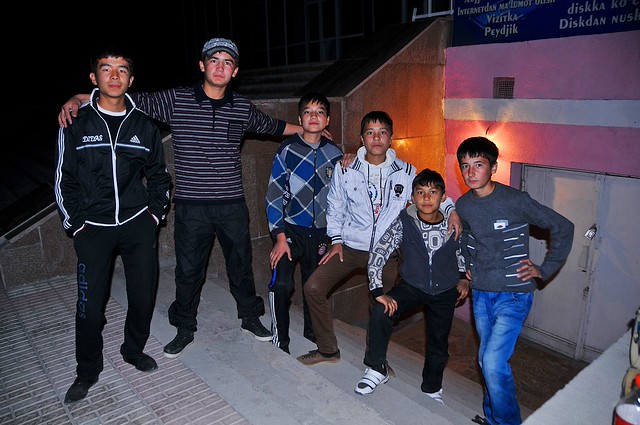
When we arrived in Margilan, I was dropped off near the cheap hotel mentioned in LP, but when I rang the bell at the locked lobby, the operator told me that they were no longer allowed to accept foreigners and that the only place in town was the Hotel Atlas, and he asked a couple of nearby kids to show me the way there. I already had a good idea of where it was, but I let the kids lead me to the main street on which the hotel was located. On the brief walk we were joined by some of their friends, and they asked me to take their picture. After this, however, they asked me for money (for their guide services or their picture, I'm not sure), which I declined.
_DSC4212
My guides, shortly before I refused to give them any money.

I started walking down the main road leading to the Atlas, stopping at a supermarket (which felt more like a specialty shop, with waist-high shelves, lots of things behind counters, and lots of staff hanging around) and checking out some of the stores I saw. Things in Uzbekistan felt surprisingly different.

_DSC4214
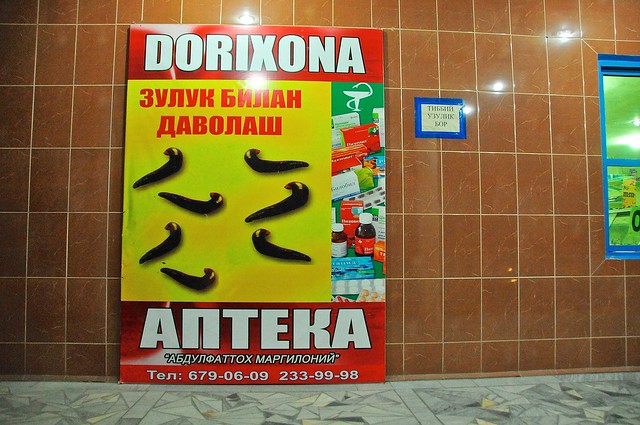
Apparently leeches are used in Uzbek medicine. Note the weird mixture of Latin and Cyrillic scripts in this sign. Uzbekistan officially switched from Cyrillic to Latin for Uzbek, but Russian is written in Cyrillic, so I'm not sure what the change really accomplishes except adding another script.

_DSC4215
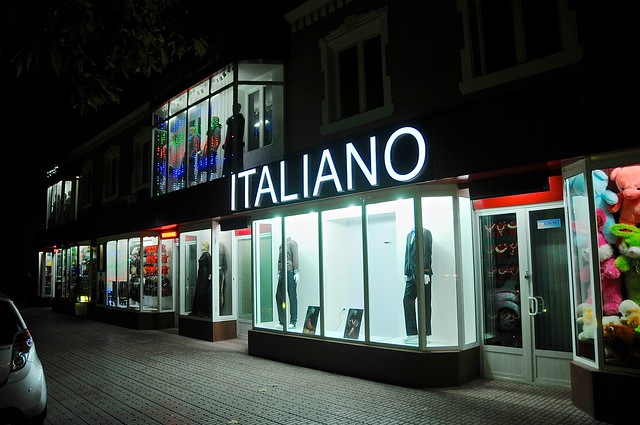
These kind of smart-looking boutiques aren't much seen in in Kyrgyzstan or outside of some parts of Dushanbe, and are part of what immediately makes Uzbekistan feel more prosperous.

The Lonely Planet suggested that the Atlas should have reasonable rates, but one look at the building and it seemed highly unlikely. It was an impressive building with an elegant lobby, and when I inquired they said their cheapest room was $55. I'm not much one for negotiating hotel rates, but I was in a jam but they wouldn't budge. There's no way I'm going to spend $55 on a hotel room, though, so I left to try and find some place to spend the night. I ended up finding a traditional chaikhana that was open 24 hours, and I spent the night there drinking tea. I don't think it would be possible to do this anymore (in Uzbekistan you have to stay at registered hotels at least every few days, and they've started to require that you stay in a registered hotel every day when you're in the more-religious Ferghana Valley), but it was an experience.

That's not to say it was a pleasant experience, however, as it was full of weird little moments that you simply wouldn't see in Kyrgyzstan on Tajikistan. I fired up my netbook to watch a movie, and I was interrupted by a guy who just walked up to me, sat down next to me (sitting partially on my camera bag), removed one of my earbuds and stuck it in his ear, then started pressing buttons on my computer in order to try and play the movie (I had paused it). There were no salaams or the customary questions, he just launched into this. His first attempt to communicate with me was to gesture that he wanted to buy my netbook. A very weird encounter. A little later a man walked up to me and said a prayer, then asked for money. Definitely not the greatest welcome to the country.

I left as it started to get light out the next morning, exploring the town. It was pretty dead, and even the mosque was empty (a bit surprising given the traditional dawn call to prayer).
_DSC4216
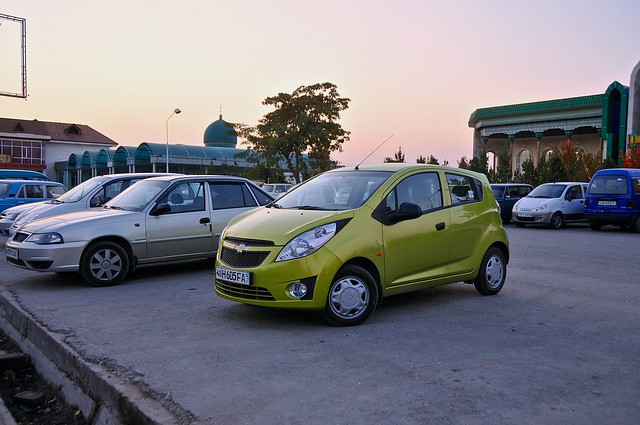
Almost all cars in Uzbekistan are Daewoo or, if newer, Chevrolet. This is the result of domestic car factories formerly owned by Daewoo but now controlled by Chevrolet, plus onerous duties on cars imported to Uzbekistan. The little Chevy Spark is very popular.

_DSC4217
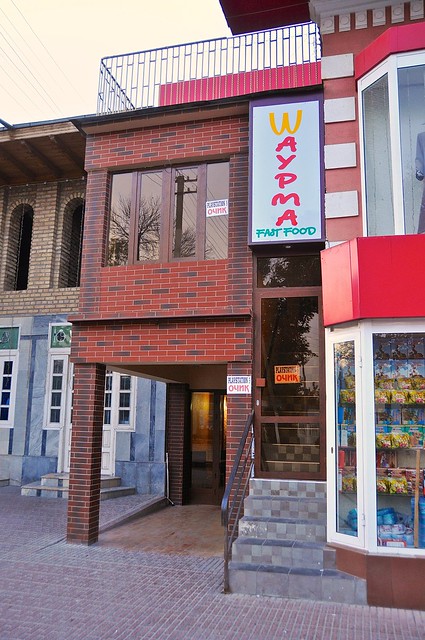
Inventive fast food joint. The inverted arches resembles the Cyrillic character for "sh," suggesting they sell shaurma/shawarma.

_DSC4220
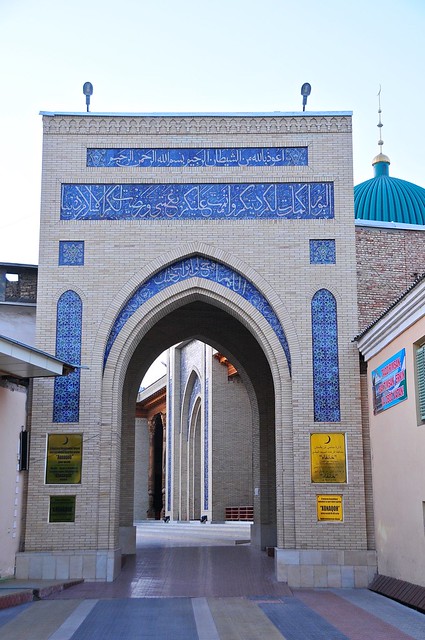
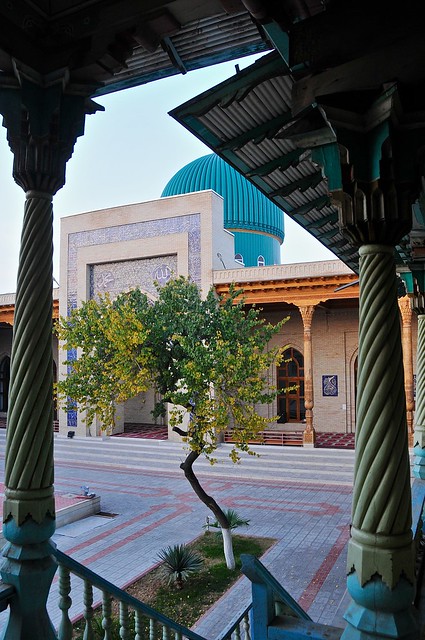
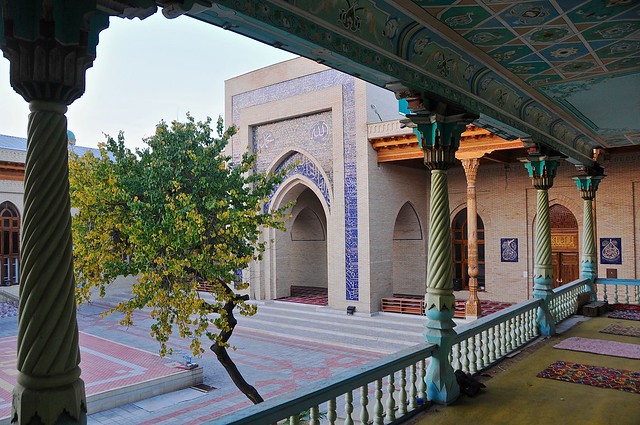
The entrance to a mosque and madressa in central Margilan.

_DSC4232
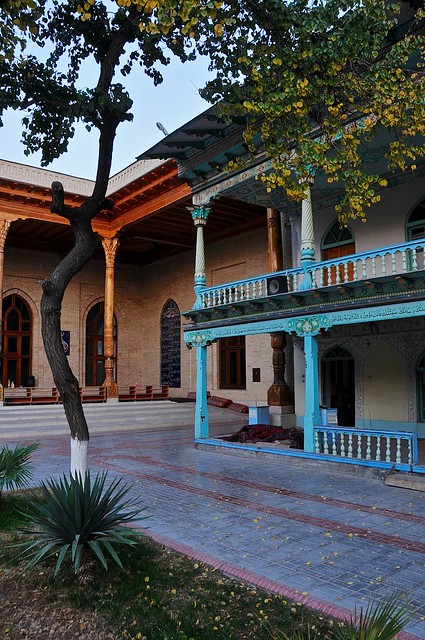
The new building is flanked by old wooden parapets on the madressa.

_DSC4235
View from madressa stairs.

_DSC4236
View from the top.

Yodgorlik Silk Factory


As it began to get later and the town came alive, I tried to find one of the main attractions in Margilan: the Yodgorlik Silk Factory. Good luck trying to find this place on your own if you only have the Lonely Planet to go by, as many locals either don't know where it is or can't give directions decent enough to find it. I added it to Google Maps so it should be there now (but if it's inaccurate, you also know who to blame), but I had a heck of a time trying to find it when I was there, even after asking locals.


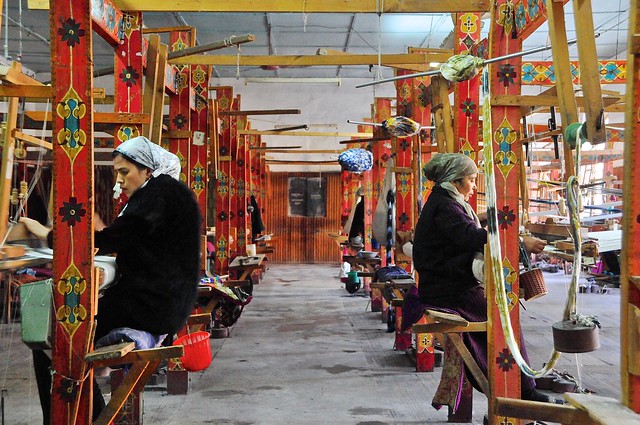
Much of what you see at the Yodgorlik is the same as at the Atlas workshop in Hotan, except that here you get a guide who speaks English, and a bit better explanation. The people at Yodgorlik also seem to be actually practicing the traditional silk-making techniques, whereas at Atlas it seemed largely for show.

As my guide was starting the tour, one of the workers approached him to talk. Now, the worker was female and my guide was male, and since Lonely Planet describes Uzbekistan's Ferhana Valley like it is the most conservative place in all of Central Asia I expected the conversation to be distant and formal. That said, I was surprised when they started by shaking hands and then talking in a very friendly way—you simply wouldn't see unrelated Uzbek men and women shaking hands in Osh, let alone in somewhere even more conservative like the Fann Mountains.
_DSC4256
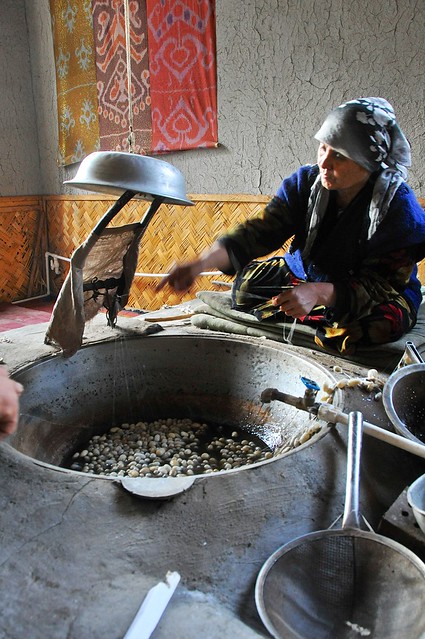
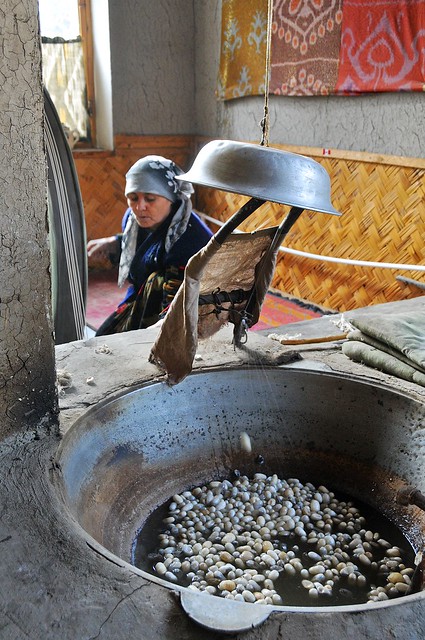
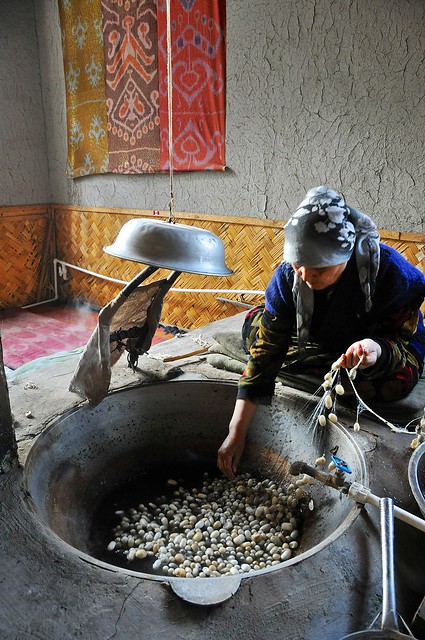
The cocoons are softened in hot water, then strands from a bunch of them are gathered together

_DSC4257
They're then threaded through a grommet.

_DSC4258
Then spread out again under the upside-down bowl, then bought together again at the top of the canvas, then fed to the spinning wheel.

_DSC4259
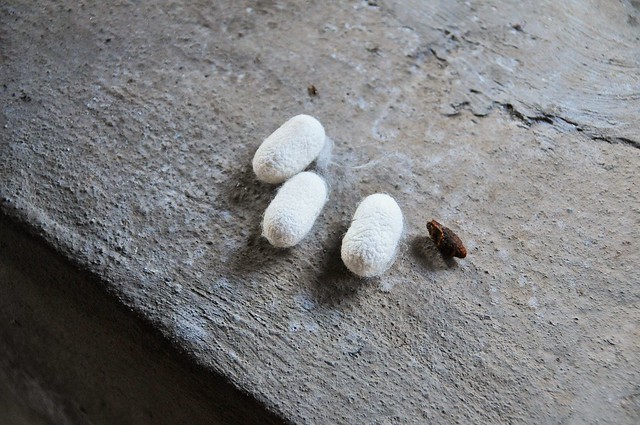
Cocoons and the silk worm inside.

_DSC4263
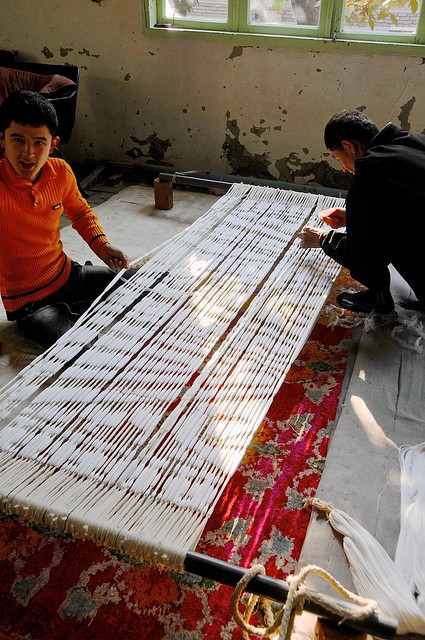
Tying bundles of silk in preparation for dying. The tied sections resist the dye, and you have to re-tie the bundles with each successive colour.

_DSC4265
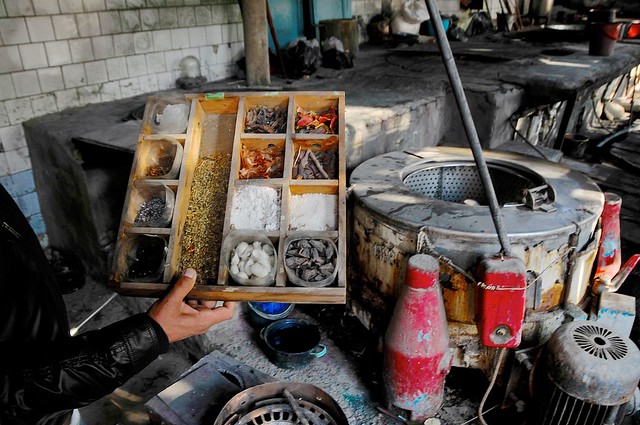
Some of the spices and plants used to naturally dye the silk.

_DSC4267
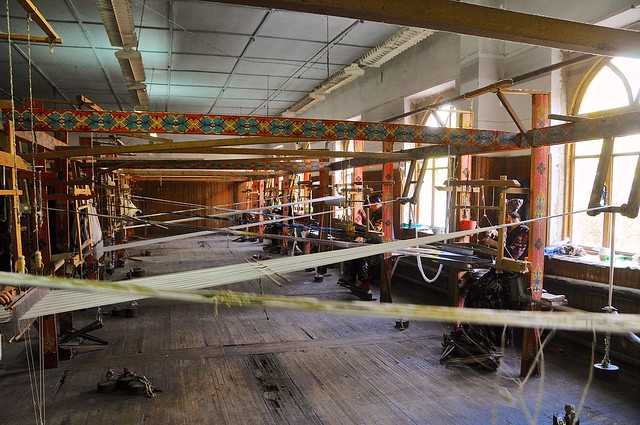
The same sort of looms that we saw in Hotan.

_DSC4268
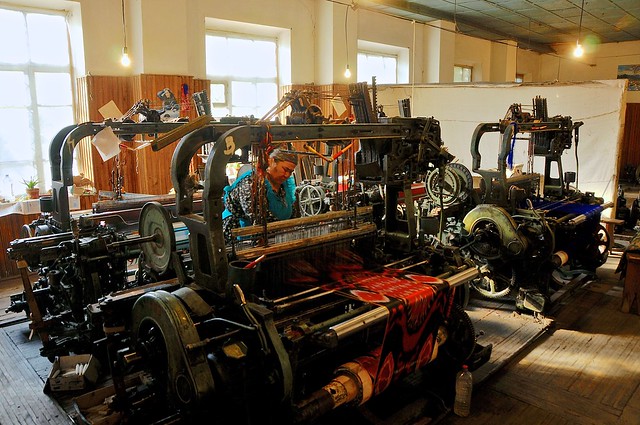
Except there are more people weaving here, and the room is appropriately scruffy and cramped as befits a real, working factory.

_DSC4270
They also have (very noisy) automated looms at Yodgorlik.

_DSC4271
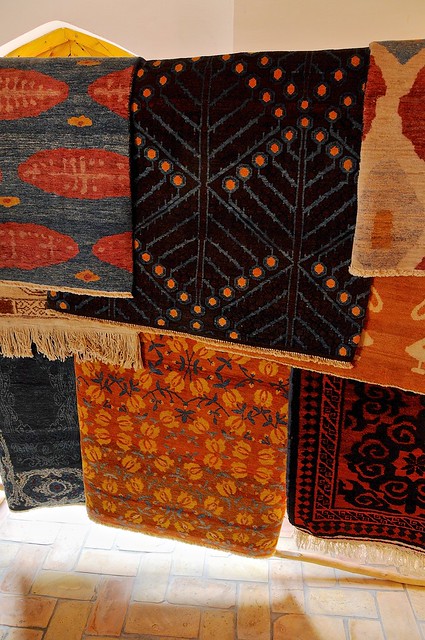
In their shop they sell not only silk products but carpets and ceramics.

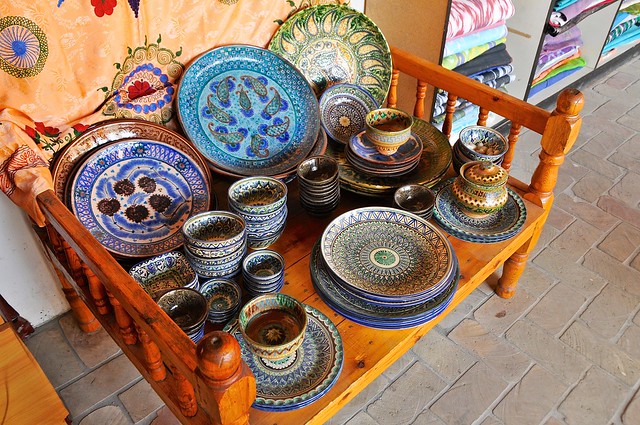
_DSC4272
These kinds of ceramics are very common at all tourist sites in Uzbekistan, and are actually quite attractive. In nearby Rishtan there's a famous workshop.

Kumtepa Bazaar

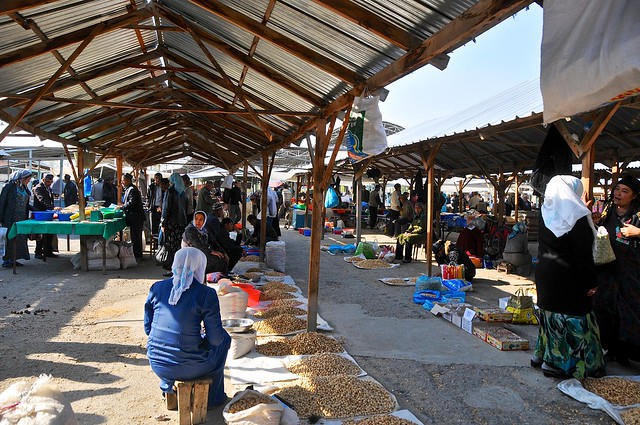
Kumptepa is a huge semi-weekly bazaar on the outskirts of Margilan, operating on Thursdays and Sundays. For some reason Lonely Planet seems quite enamored of this bazaar, but we obviously have very different tastes given that they also like Osh's bazaar a lot, too. But although Kumtepa is big, is pretty darn soulless, with an industrial feel and little charm. Sure, there are large sections selling silks and fabrics, but you see this at a lot of bazaars, and much of the bazaar deals with hardware, parts, and other random things.

It is pretty easy to get there, though, as regular marshrutkas run there from the east-west road running past the central green market, which is just north of the Yodgorlik workshop.
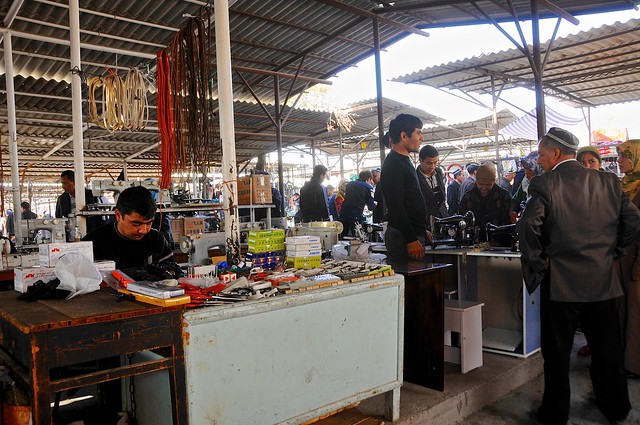


_DSC4281
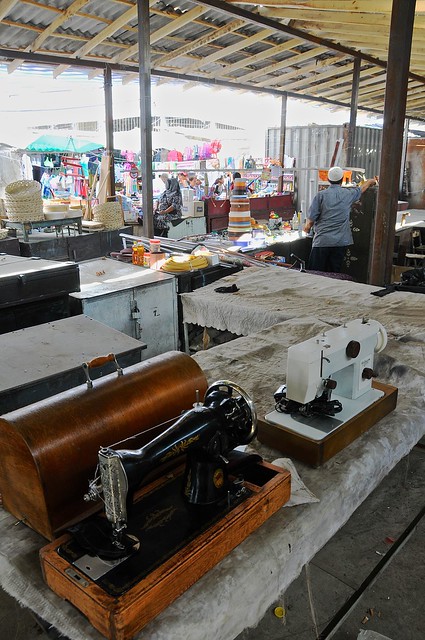
Sewing machines, bric-a-brac, home appliances, and all sorts of stuff are sold at Kumptepa.

_DSC4282
Woman sell nuts and fabrics, but most of the sellers are men.

The green market

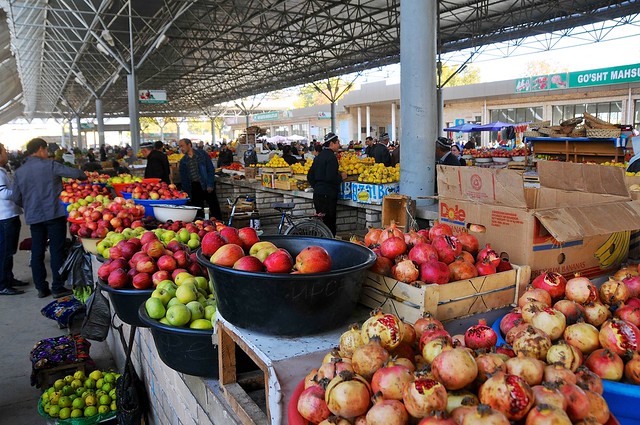
Back in town, the green market was actually a lot more interesting to me. As in Dushanbe and Almaty, they artfully stack their produce in little pyramids, which is so much more appealing than random piles of fruits and vegetables.
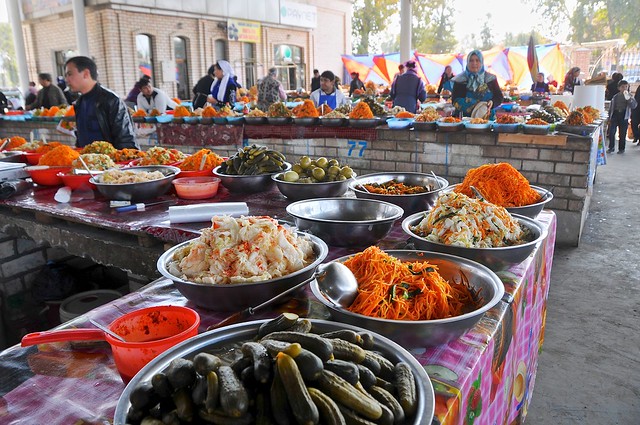
_DSC4283
There are often sections devoted to pickled vegetables, including a surprising number of Korean salads.

_DSC4286
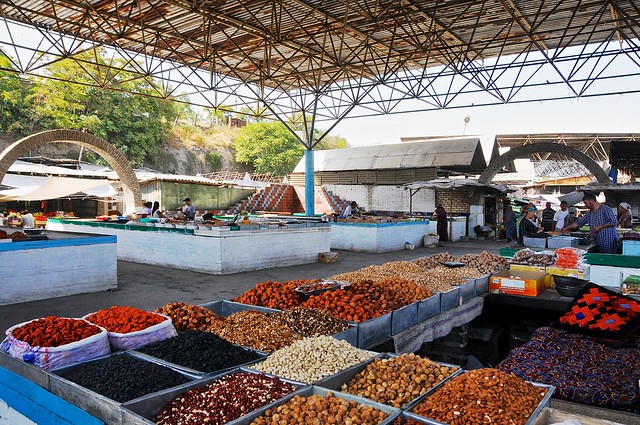
Women sell the salads, while men sell the produce. This style of covered market is typical of Uzbekistan.

Margilan to Tashkent

With the help of a local I was pointed in the direction of the gathering point for share taxis to Tashkent, and once there I stuck to my guns and negotiated down to the price listed in Lonely Planet. This actually involved the driver pretending he wouldn't agree and me standing around for a while until another driver agreed (not much risk with this strategy, as you're going to be waiting for the car to fill up, anyway). The upshot was that I paid 27,000 for the 315km ride from Margilan to Tahskent—the exact same as I paid for the 120km ride from the border to Margilan.
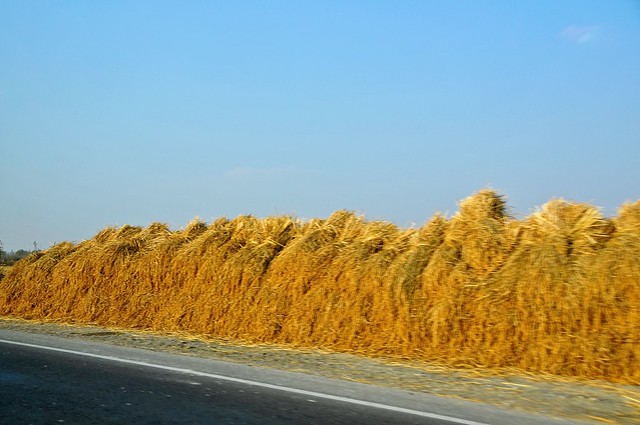
_DSC4287
Hay stacked by the side of the road.

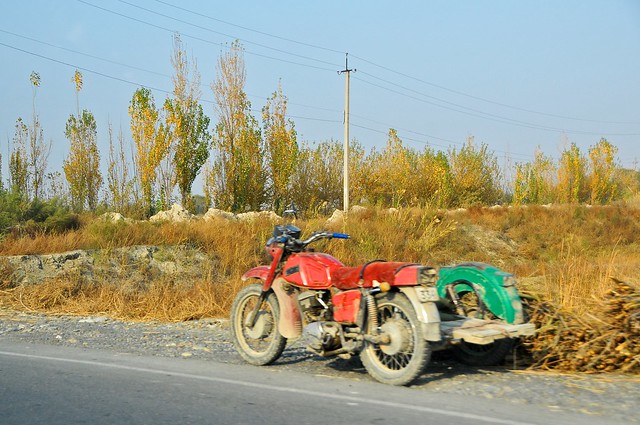
_DSC4288
A motorbike and cargo-carrying side car.

The Ferghana Valley is separated from the rest of Azbekistan by a small chokehold of the Tian Shan mountains, pinched from the north by Kyrgyzstan and the south by Tajikistan. The Kamchick Pass rises to 2,267 meters, while the Ferghana Valley is between 400 and 450m, while western Uzbekistan is even lower. There's a police checkpoint in the pass, where documents are checked (Uzbekistan seems fearful of Islamic funadmentalism, and the Ferghana Valley is the most devout region of Uzbekistan).
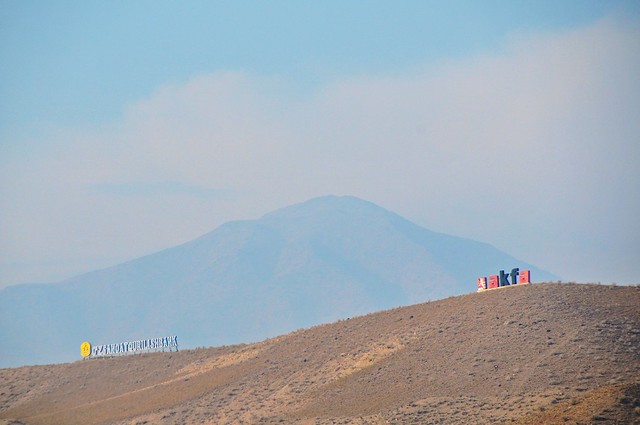
_DSC4289
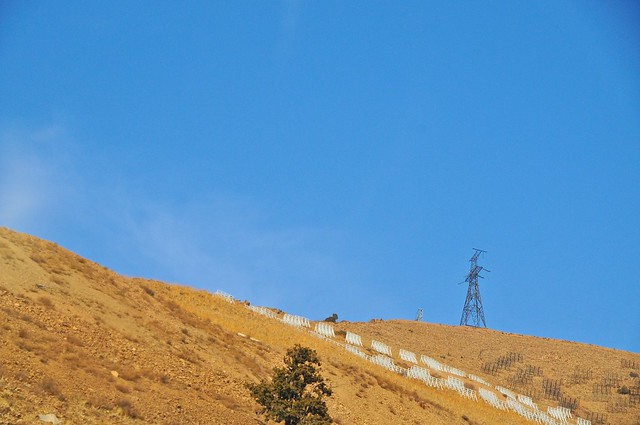
Billboards on the mountain ridges hint at Uzbekistan's economic development.

_DSC4291
These weird frames that look like they might be for placement of solar panels—or for preventing avalanches in the winter, line some of the slopes.

It was dark by the time we arrived in Tashkent, which has a population of over two million. On the outskirts of Tashkent there was another weird inspection station, but I think this one had more to do with tolls or car inspection than anything else, as we got out of the car while it drove to some inspection station, then rejoined it when it reappeared about 100 meters down the road. This happened to pretty much all the cars on this road, so there was a bustling business in selling snacks and refreshments. It was all a bit bizarre, and although we were still quite a ways from he city,  signs of urbanization were evident soon thereafter, as Tashkent is a sprawling city.

We were dropped off somewhat near the train station, and I followed a tram line back to the station, and after checking out the train schedules I took the subway to Chorsu, where I tracked down the Gulnara Guesthouse in the old town (the main street on the border of old town is full of upscale bars and KTV joints, so stepping off them into the old-town alleys is interesting).

Tashkent is pretty expensive, and at the Gulnara it was 42,000 som—$15—for a bed in the dorm room, breakfast included. That being said, the guesthouse was actually pretty nice, with real furniture like a real house, and not the spartan decoration and cheap furniture that you tend to see in guesthouses, hostels, and cheap hotels. What's more, it had an actual bath in one of the bathrooms, so I was able to indulge in a short bath for the first time since Jeti-Oguz. As a bonus the Gulnara issues registration slips for stays of even one night (you need to stay in a registered hotel at least once every three nights, where they give you registration slips that you may have to show to the police or border officials, but some hotels won't register you or give you slips unless you stay a certain number of nights).


Budget

October 31, from Osh to Margilan: 270 Kyrgyz som + 31,300 Uzbek som
  • Fried goods: 30 som
  • Chocolate, snickers, bread, cookies, tissues, coke, etc: 240 som
  • Taxi from Dostyk to Margilan: 27,000 som
  • Internet: 2,500 som
  • Drinks: 1,800 som

November 1, from Margilan to Tashkent: 81,700 som
  • Grechka, tea & sugar at overnight chaikhana: 6,400 som
  • Taxi to Kumptepa: 1,800 som
  • Taxi to Tashkent: 27,000 som
  • Room at Gulnara: 42,000 som
  • Bread, 2 drinks, carrots: 3,200 som
  • Internet: 1,600 som
  • Subway: 700 som

Tuesday, 30 October 2012

Pamir Highway, part 2: Murghab to Osh

Even though it was late in the tourist season and there were few tourists because the Pamirs had been closed for a couple of months, Megi and I didn't have to wait long for a jeep from Murghab to Osh, as we obtained one leaving the morning after our first inquiries. Although we were supposed to leave well before 10:00, we spent a while waiting for additional passengers and then going to a few houses to pick up cargo, so it wasn't until after 11:00 that we actually hit the road.

The M41 leaves Murghab to the east and then curves north through a wide, flat valley, while another road continues straight east from Murghab towards the Chinese border at the Qolma pass.The first stretch of road, before the valley narrows and the road begins to climb the the Ak-Baital pass, runs through a wide, dry valley.

_DSC4048
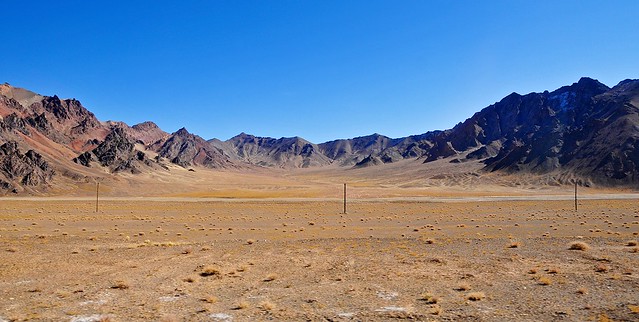
Looking east, just north of Murghab.

_DSC4052
Barren but beautiful in the autumn sun.

_DSC4053
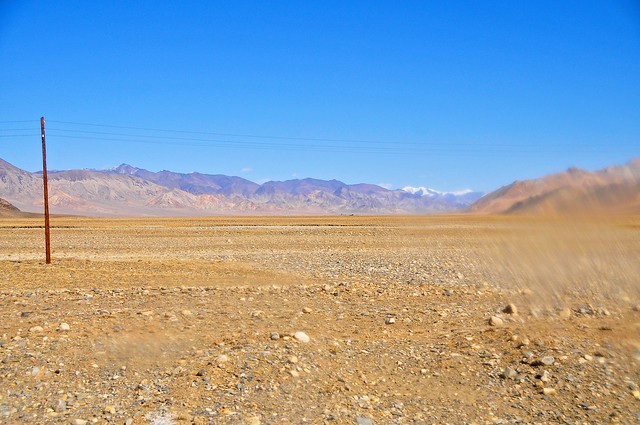
Smudges on the jeep's windows made it hard to take pictures. The road to Rang-kul lies through this gap in the mountains.

_DSC4055
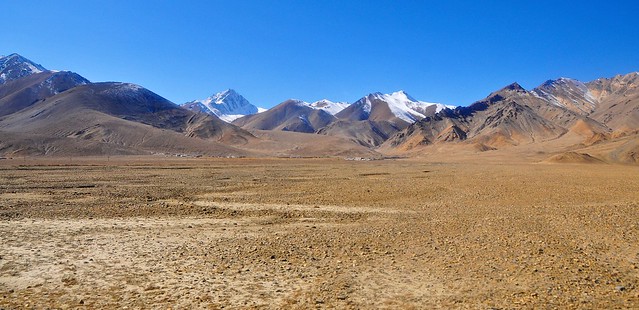
The mountains close back in on the valley.

_DSC4059
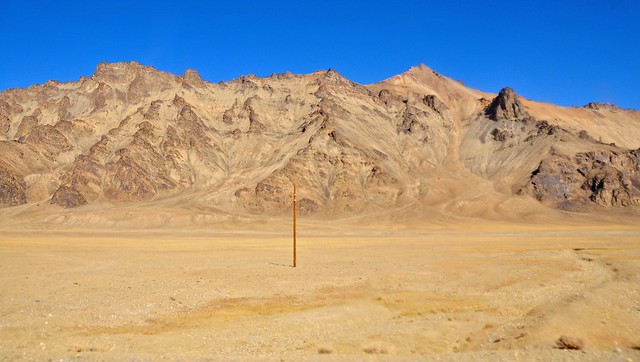
A little further north the mountains have a bit more colour, as I saw from the mountain-top on the northern outskirts of Murghab.

Monday, 8 October 2012

Osh, and lessons in ethnic violence

The return to Osh brought a welcome increase in temperature. Where the daily highs in the Alay valley were about 5°C, down in Osh—some 2,400 meters lower—the daily highs were right around 20°C.

2010  Osh Riots and ethnic tensions

Back at the Taj Mahal hotel I was joined in the dorm by a couple of journalists from Bishkek. One was a French guy who had come to Bishkek to help set up a French-language newspaper, and the other was a Kyrgyz girl who was working with him at the paper. I was surprised there was enough of a market for a French-language paper in Kyrgyzstan, but he said there was.

Anyway, they were in the Osh to write about the 2010 ethnic violence in the area. Lonely Planet had a little bit of information about this—which was somewhat surprising given that the guidebook was published in 2010 and most of their stuff seems to be written a year in advance of actually publishing it—but the journalists told me that the widespread and severe, and that the interim Kyrgystani government had commissioned an independent report on the violence, and then totally disavowed the report once its highly-critical findings were published. Somewhat strangely, the 2014 edition of LP is even less helpful on the issue, merely saying that the issue was controversial.

I downloaded and began to read the Report of the Independent International Commission of Inquiry into the events in Southern Kyrgyzstan in June 2010, and I also spoke with the guys at the Osh Guesthouse while reading the 104-page report. At the beginning, some of the things they told me seemed far-fetched, and I suspected they were exaggerating. It turns out their claims were pretty plausible, and I was more surprised after reading the report that their accounts of what happened in 2010 weren't filled with more rancor.

Pretty much everyone agrees that at least 400 people died, and that over two-thirds of those killed were ethnic Uzbeks (others suggest these total represent only a fraction of the actual deaths, given that those buried quickly in accordance with Muslim beliefs were not counted at all). They also agree that over 100,000 international refugees were created, as Uzbeks crossed the border to Uzbekistan en masse. An additional 300,000 people were internally displaced within Kyrgyzstan—again, almost all of whom were Uzbeks fleeing the violence.

The immediate backdrop for this violence was the overthrow of President Bakiyev in April 2010, but the longstanding tensions between ethnic Kyrgyz and Uzbeks in southern Kyrgyzstan and the Ferghana valley also played a large role: Uzbeks had been marginalized from participation in civil society and employment in governmental positions for a long time, and there was significant resentment of prosperous, urban, Uzbek businessmen from the mountain-dwelling Kyrgyz in southern Kyrgyzstan.

Now in the aftermath of Bakiyev's overthrow, there is widespread belief that Bakiyev and his supporters wanted to foment racial violence in order to demonstrate the need for a strongman-style leader in Kyrgyzstan (as in neighboring CIS countries) who could effectively and ruthlessly control the country. Under this theory, Bakiyev's allies and relatives in the region began to spread rumors about Uzbeks intended to create violence, and Bakiyev thugs may have initiated the violence. We do know that in May, after his April overthrow and exile, Bakiyev supporters took control of government buildings in Osh, Jala-Abad, and Batken, although control of these buildings were quickly recovered.

We once again see that tales of inter-ethnic rape is always a reliable way to incite violence. We saw it in the violence targeting Uyghurs in the Shaoguan Incident in 2009 (which helped spark the Urumqi riots), and it seems to have been the most effective rumor used in June 2010 in southern Kyrgyzstan. After some small skirmishes on June 10, rumors spread of Uzbeks raping Kyrgyz girls at a university dormitory, and it seems that this rumor was spread to Kyrgyz communities in the mountains in an organized manner, prompting numerous Kyrgyz to come down to Osh and Jala-Abad from their mountain communities.

What seems to have happened after this is that Kyrgyz streamed into Osh and Jalal-Abad, and that the Uzbeks largely barricaded themselves into their districts in order to protect themselves. The arriving Kyrgyz then raided police stations and security vehicles that had been deployed by the police, seizing weapons and ammunition from these forces, who did not attempt to prevent them from doing so. Apparently a few Armed Personnel Carriers were also taken from the complicit police, and used to help break into Uzbek areas: direct military involvement seems probable.

Applying its evidentiary standard to the evidence, the KIC considers that there was some military involvement in these attacks. This arises from presence of expertly driven APCs carrying men in military uniform, the apparent readiness with which the military surrendered APCs, weapons and ammunition, the repeated system and order to the attacks and the evidence of planning in the specific targeting of neighbourhoods, people and property. Such discipline and order is not commensurate with the normal actions of spontaneously rioting civilian crowds.

Women were seized and raped, while men were tortured and killed. Police sniper rifles were also used against Uzbeks, though it's not certain if these were from civilians who had seized the weapons or from actual police or army officers. Those Uzbeks who could sought refuge across the border in Uzbekistan, while others fled their homes to seek refuge elsewhere in Kyrgyzstan.

Once the situation stabilized and peace returned to the area, almost all of those who were investigated and charged with violence were Uzbeks, and police failed to protect those Uzbeks from physical assault during their trials. It's clear that ethnic tensions continue to percolate in the region.

This happened only two years before I was in Osh and Jalal-Abad. Although many buildings had been burned out, I had failed to notice any, and if I did notice any I certainly didn't connect them to the violence. For someone coming from a stable and diverse country like Canada, it was really difficult for me to understand this level of ethnic strife, and to understand how people could continue to function as a society in the knowledge that there was so much widespread ethnic hatred which could be re-ignited at any moment. It was difficult to understand why there wasn't more anger from the Uzbeks. I'm sure that part of it is that as a tourist you simply aren't able to access and understand the tensions that simmer beneath the surface in most societies (I'm not sure that most tourists to the US really feel the the tense state of race relations there, even though events continually pop up that hint just how bad they are), but even accounting for this there simply seems to be a greater acceptance of—or resignation to—tremendous injustice, discrimination, and unfairness.

Friday, 5 October 2012

Kyrgyzstan's Alay Valley in autumn: Sary Moghul and Sary Tash


My earlier decision to sleep at the Taj Mahal but use the nearby Osh Guesthouse for information was a good one, as the Taj Mahal is much quieter and allows for better sleep. After waking up refreshed I stopped by the Osh Guesthouse in the morning to see if they had received my boots. Boots? Yes, boots. You see, my Blundstone boots had developed a rip in the leather where it joins the sole— a chronic problem, as this was the second pair to develop the same problem, and I already had the first pair replaced in the US under warranty.

Blundstone: horrible US warranty service, amazing Australian warranty service

Getting warranty service on the first pair was not easy, as I didn't have the receipt and didn't live close to where I bought them. I contacted Blundstone's US distributor, but they never returned my emails. I finally resorted to contacting Blundstone Australia directly, and after sending them a couple of pictures showing the problem, they airmailed a pair of replacement boots from Australia! That's pretty amazing, even if their US distributor is crap.

So when my replacement pair developed the same problem in Mongolia, I was pretty disappointed, especially since it meant my right foot would now get wet in shallow puddles (Blundstones are waterproof for brief periods, and walking through ankle-deep water usually isn't a big problem). Given my prior experience with Blundstone Australia, I figured they would help me out, but being on the road I didn't really have a good place to get them sent. But when i went through Osh the first time, knowing that I would be back there in a few weeks on my way to Tajikistan, I asked at the Osh Guesthouse if they had an address I could get stuff sent to (and how safe it would be to do so). They said it should be pretty safe, as they would just get a note in the mail telling them to come pick something up, but that it could take a while to get there. I asked Blundstone Australia if they could send out a replacement to the Osh Guesthouse, and they readily agreed to.

GBAO permit through the Osh Guesthouse

I had hoped that the boots would have arrived safely by the time I got back to Osh, but they weren't there. While talking to the guys at the guesthouse, however, and talking about the problems of getting a GBAO permit and inquiring as to whether the pamirs were really open for tourists, I was told that not only were the pamirs open and permits being issued, but that I could get a permit from them at the guesthouse. It would take a few days processing and $40, but it was possible. This was great news for me, as it would mean I could take the direct route from Osh to Murghab, instead of first heading to Dushanbe and backtracking to the pamirs and coming back to Osh on my way out of Tajikistan.

I applied for the GBAO permit and decided to spend the processing time in the villages of Sary Mogol and Sary Tash in the Alay Valley near the Tajik border. This was the same valley I had driven through as I entered from China, and from Sary Mogol you apparently have great views of Pik Lenin, a 7,000+ meter peak on the Tajik border.

Osh's CBT office: not helpful

I went to the Alay Hotel, where the regional CBT office is located, to see what sort of options CBT had in the region and to see if I could reserve a spot in the Sary Mogol CBT homestay that night. The CBT office was really quite unhelpful, telling me that they wouldn't call the Sary Mogol homestay and that I could simply arrive and find the home-stay quite easily as everyone knew where it was. It's easy to see why the system isn't working as well as it could, as I described in my Arslanbob post. I suspect that if I wanted a service for which I would have directly paid the guy at the office he would have been more helpful.

I went down to the marshrutka and taxi stations near the market to see if I could get a ride to Sary Mogol, and ended up finding a ride in what Lonely Planet calls the Agromak 4WD stand (which is really just a big parking lot behind some street-front blocks, and most of the vehicles are not 4-wheel-drive. I ended up grossly overpaying, as I apparently agreed to pay 700 som for a ride to Sary Mogol, which Lonely Planet says is twice what I should have paid (though I think their prices for the Osh-Sary Tash route are too low). It seemed reasonable in light of the 1,000 I paid from Irkeshtam, but c'est la vie. I hate haggling, especially since it seems entirely haphazard whether the driver initially quotes you a fair price or a wildly-inflated price.

The M41 between Osh and Sary Tash

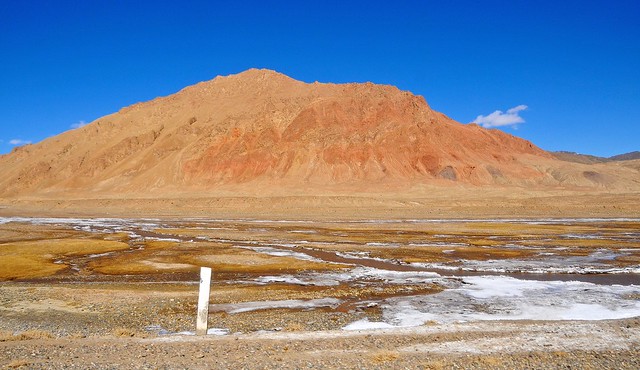
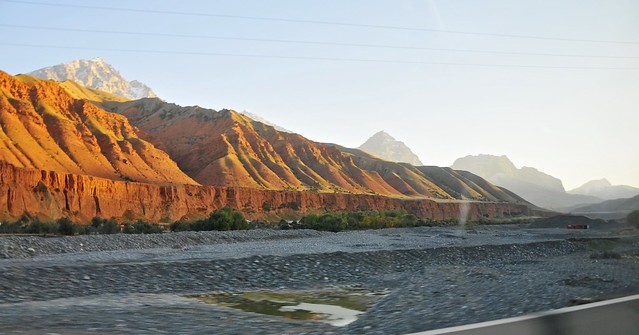
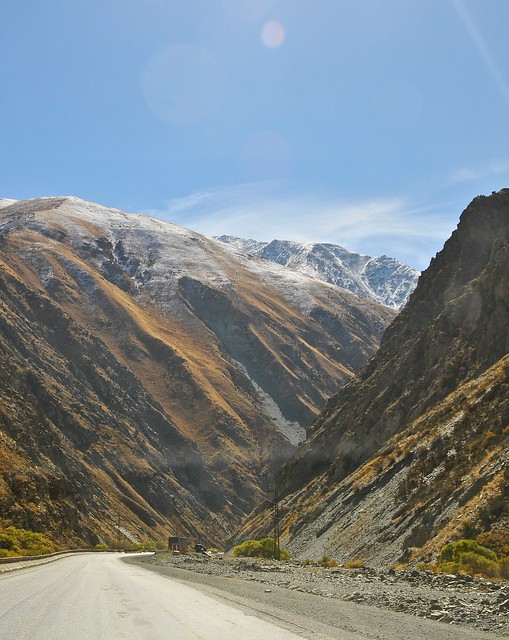
The ride up to Sary Tash would be the first time I had done this stretch of the M41 during the day, and it was really quite impressive. The first half hour or so from Osh is relatively flat farmland that is part of the Ferghana valley, but it eventually starts to climb into a mountain valley, culminating in the 2,391 meter Chiyrchyk Pass, some 80 km from Osh. After that pass you drop down into the town of Gulcha (1,546 m) and up the Kurshab valley. Whereas the mountains before the Chiyrchyk pass were grassy and green, the mountains in the Kurshab valley are red and craggy, with a wide and stony riverbed that looks tame and narrow in the fall but must appear very different during the spring melt.

At a couple of places along the road, where the valley was narrower and the highway had more bends, I saw wrecked tractor-trailers. For the most part they had failed to negotiate a corner and had gone straight off the road. I had a difficult time imagining that the government really cares that much about removing wrecked trucks from the sides of roads, so I imagined that they had been there for some time. I was wrong about this, however, as when I returned to Osh a few days later they were gone (maybe they are valuable as scrap?). I suspect that these crashes may have been fatal, as nobody in Central Asia likes to wear a seatbelt, and drivers (and front-seat passengers) only pretend to wear them by slinging them across their bodies when they pass police checkpoint. In fact, wearing your seat belt is likely to be taken as an insult by your driver, who will proceed to tell you how good a driver he is. Such a good driver that not even the argument that you are protecting yourself from the other bad drivers on the road will be satisfactory: he's so good he can avoid those bad drivers.

_DSC1201
The Kurshab riverbed and mountains after Gulcha.

_DSC1203
The lower mountains are surprisingly grassy.

Tuesday, 2 October 2012

The M41 from Bishkek to Osh

Finding a share taxi to Osh was significantly more difficult than I expected. There weren't any at the place indicated in the 2010 Lonely Planet, and I kind of had to wander around Osh Market until I found a place with randomly-parked cars half-full with people. Although the going rate from Osh was only 1,000 som, I ended up paying 1,300 som for the return trip. It wasn't all bad, though, as I was given the front seat even though I was the last passenger, and because I was the last passenger we left right away. It turned out that this was really just a family returning to their home in Jalal-Abad, and they were picking up a passenger to help pay for gas.

The car was a Japanese-market, right-hand-drive Lexus. It was about 6 years old, had pretty low mileage, and apparently he only paid something like $6,000 for it. Having lived in Japan, this really isn't that surprising: Japan has an aggressive licensing system known as shaken that requires cars to undergo inspections every couple of years, and after a couple of inspections it generally becomes cheaper to sell the cars on the export market than perform the repairs deemed necessary. Of course, because there is a limited market for right-hand-drive vehicles, the resale price is pretty low. Add in the fact that Japanese drive limited distances and take care of their cars pretty well (even if the inspectors feel repairs are warranted), and used Japanese cars are usually a very good deal.

From what I saw on the road, however, it seems that Kyrgyzstan is the only country in the area that allows for the import of right-hand-drive cars (Mongolia also does), which is a good deal for Kyrgyzstanis but a bad deal for others (Kazakhs don't have the same need for cheap cars, Uzbekistan taxes foreign-made cars so heavily that almost all vehicles are made by the domestic Chevrolet factory, and in Tajikistan the market for cheap cars seems to be met by cars stolen from Europe).

Shooting into the sun through a windshield isn't the best way way to take pictures, but it's a heck of a lot better than from the back seat (especially the middle seat, which I had on the way up to Bishkek), and I took advantage of the opportunity on the way south.


_DSC1149
The first 60 km from Bishkek you simply head west on a flat road that passes through numerous small villages and towns in the Chuy valley. At Kara Balta you turn south onto the M41, and head towards the Ala Too mountains to the south.

_DSC1150
Passing through Sosnovka village, which marks the entrance to the mountain canyons and the exit from the flat and fertile Chuy valley.

_DSC1151
The steep and narrow valley that the M41 runs through.

Monday, 3 September 2012

Osh: in Soviet Central Asia, culture shocks you

Like almost everyone—including most of those who travel there—I had no idea what to expect from Central Asia and the 'stans. Whatever expectations I did have as I entered from Xinjiang, however, were confounded by the reality I faced in Osh: although Osh is in one of the most religiously conservative areas of Central Asia—and certainly the most conservative urban area—the overwhelming impression, in sharp contrast to Kashgar, was Russian. The music was Russian pop. The architecture was Soviet Russian, with large communist blocks and stucco houses with tin roofs— no mud brick here. The language was Russian, as it remains the lingua franca throughout former Soviet CIS (Commonwealh of Independent States) territories—especially when talking with foreigners and outsiders. Even for the native Kyrgyz and Uzbek language, the script was Cyrillic and not the Arabic seen in Xinjiang. Russian food was back on the menu. Sandwiches, Russian-style hamburgers, and western bread were common, as were cheese and sour cream. Cleaning products—both of the household and personal variety—were a much more prominent section of local supermarkets, and bathrooms tended to bear evidence of their use.

In some ways it was like being back in Mongolia, except the Russian influence was even greater in Osh, and of course in Mongolia I hadn't had a more authentic version of  Mongolia to compare Russified Mongolia to, whereas in Xinjiang I had exactly this sort of contrast in Central Asian life.

Another way Osh and Kyrgyzstan resembled Mongolia was in terms of how many people looked. Ethnic Kyrgyz (and Kazakh) look very Asian, and quite Mongolian, which is fairly unsurprising given their proximity to Mongolia and Chinggis Khan's vast empire. Kyrgyz and Kazakhs also traditionally shared the Mongolian nomadic lifestyle and herder lifestyle. Kyrgyz are not very religious and enjoy drinking.

Although in Kyrgyzstan, however, Osh has a majority population of Uzbeks, who—like the Uyghur—are more Caucasian in appearance. Uzbeks are also religiously conservative—especially those in Kyrgyzstan, as the government in Uzbekistan has cracked down on devout Islam in recent times—and dress much more conservatively, with women covering their hair, and men often wearing beards. Between their physical appearance and their dress, Uzbeks look much more similar to Uyghur than Kyrgyz do.

As one might expect, the nomadic, herder Kyrgyz typically live in the mountainous areas of Kyrgyzstan, while the Uzbeks live in the valleys, plains, and other fertile areas where they can farm. Osh is on the edge of the Ferghana valley, at the border with Uzbekistan, and consequently has a majority Uzbek population. It probably would have made more sense to put Osh in Uzbekistan, but under Stalinist border-formation policies, the Soviets thought it best to relocate both ethnicities and borders in order to ensure that the republics would be ethnically divided amongst themselves, as this was thought to be a way from any of the republics ever becoming cohesive enough to unify against the central Soviet government. The result of this government-by-division is that many Central Asian states have ridiculous borders that make little geographic or ethnic sense, as well as significant internal tensions.

Anyway, after getting only a few hours of sleep in an Ulugqat ditch the day before, I was really tired when I arrived in Osh. I was also a little banged up, as I had hurt my knee while taking a fall while running back to the truck I was hitching in (we were stuck in a queue near the border, during which time I ventured a fair distance away; when the trucks started up, I ran back, worried that they were going to be moving more than a hundred meters or so) and I had to limp up the stairs in the hotel. This meant I slept in and took things pretty slowly in Osh, especially since things were so cheap compared to China. 400 som (about $9) for a single room with shared toilet and shower? I was paying that much for a dorm room in Kashgar.

Finally adjusting my watch to Xinjiang time (which is the same as Kyrgyz time), I gained two hours in which to sleep in (which also means I basically lost two hours of daylight), and I took full advantage of this on my first day in Osh. I then moved from the Alay hotel to the Osh guesthouse, mainly because the Osh guesthouse was where everyone stayed in Osh, and was the best place to meet people and get travel information. Osh guesthouse is basically a Soviet-style apartment, converted into a place that sleeps 10 or 12 people. It's noisy, cramped, and hard to find, but its a good place to meet people and the two Uzbek guys who run it are interesting to talk to.

After settling in, I went to explore the city.

Lonely Planet talks up the market quite a bit, describing it as one of Central Asia's largest bazaars and a great place to buy things. In reality, it's much less impressive than it sounds, as it's basically an network of a cuple of parallel shopping alleys lined with stalls that run north-south on both sides of the river, with smaller market squares appearing as little nodes along the alleys. Compared to Xinjiang, it wasn't particularly impressive, and it would be far from my favourite Central Asian market. Probably the most interesting part would be the fruit and vegetable market, which runs on the east side of the river on a pedestrian street, and terminates not far from the Osh guesthouse.

_DSC9718
Sewing machines ranged from treadle-operated to modern plastic appliances. Any male wearing a skullcap is almost certainly Uzbek.

_DSC9721
Baby bassinets display obvious Russian influence, with local embellishments (such as the fabric choice).

_DSC9722
Dried fruits and nuts, in an old Russian-style section of the market.

Heading south from the market, there's a river-side park that follows the river for a considerable distance. This is a Russian-style park, which differs substantially from a Chinese -style park. Instead of artificial ponds and lakes with beautiful common spaces, you have a jumble of trees and dilapidated paths, with scraggly grass and a slightly seedy atmosphere.

Towards the southern end, near the monument to Lenin, there was a small amusement park and Ferris wheel, and an old airplane on a pedestal. I looked around at the plane, hopping up to look inside through the missing door. At this point I was called out by a lone policeman. Uh oh. I immediately figured I was in for a scam, and it seemed likely that he was indeed looking for a bribe. He asked for my passport, and looked through it, while saying something to me in Russian and me asking him things in English while explaining I don't speak Russian. As we did this, I moved so that we were near the main street, and kept offering to go with him to the police station. He eventually let me go, but it left me with a suspicious feeling, especially considering this was my first day in Kyrgyzstan. As it turned out, this was really the last time on my trip I would have any problem with the police, so it was really unfortunate timing.

_DSC9723
British pub. We're substantially closer to Rome than Tokyo.

Friday, 31 August 2012

Kashgar to Osh in two not-so-easy days

There are basically two ways to get from Kashgar to Kyrgyzstan: the Torugart pass and the Irkeshtam pass. The Torugart pass is arguably more scenic and takes you past the Tash Rabat caravenserai on the way to Naryn, but it's a very difficult route to take because China requires a special permit and guide to take you on this route, which effectively means you have to arrange for private transportation with a tour agency. The Irkeshtam pass is much more heavily traveled, and is served by a once- or twice-weekly international bus running between Kashgar and Osh, with tickets running close to $100.

In 2012, it was also possible to hitch-hike over the border. In order to do so, you would take a share taxi or minibus to Ucha/Wuqia/Ulugqat from Kashgar's international bus terminal, then go to the Chinese customs point in Ucha, where you would be stamped out of China (despite being about 135 km  from the actual border) and put onto a truck by Chinese customs officials. You would then take the slow and bumpy ride to the border, which can take up to 6 hours because of the roadwork that limited your speeds to as low as 20 km/h. After that, cross into Kyrgyzstan and then either take a share taxi from the border to Osh or Sary Tash, or jump back on the truck and make it to Osh the next day.

I decided to try this, as it was better than waiting for the bus (which is reported to be quite bad) and braving the multi-hour waits to buy tickets at the international bus station. If you're trying to do something similar today, Caravanistan and Far West China have all the details: the short story is that you absolutely need to take a taxi between Ucha and the border.

Road to Ucha/Ulugqat

When you arrive at the international bus station, there will be huge lines (I estimated it would take 6 hours to get to the front of the line, as I waited in one before realizing I didn't have to), but you don't need to wait in them in order to go to Ucha. Instead, head out of the doors and into the courtyard behind the station: although someone will check you for a ticket, just tell them you're going to Ucha/Wuqia/Ulugqat, and they'll let you through. At the back left, there should be a stand with the Chinese characters for Ucha. I paid 60 yuan for the ride to Ucha in a share taxi, which is apparently a huge overpay, but then again there were only three of us.


_DSC9535
Not far outside Kashgar.

_DSC9538
Views like this make me regret taking so many night buses and trains.

_DSC9539
Note the stone buildings and pens on the left.