Showing posts with label Bishkek. Show all posts

Tuesday, 2 October 2012

The M41 from Bishkek to Osh

Finding a share taxi to Osh was significantly more difficult than I expected. There weren't any at the place indicated in the 2010 Lonely Planet, and I kind of had to wander around Osh Market until I found a place with randomly-parked cars half-full with people. Although the going rate from Osh was only 1,000 som, I ended up paying 1,300 som for the return trip. It wasn't all bad, though, as I was given the front seat even though I was the last passenger, and because I was the last passenger we left right away. It turned out that this was really just a family returning to their home in Jalal-Abad, and they were picking up a passenger to help pay for gas.

The car was a Japanese-market, right-hand-drive Lexus. It was about 6 years old, had pretty low mileage, and apparently he only paid something like $6,000 for it. Having lived in Japan, this really isn't that surprising: Japan has an aggressive licensing system known as shaken that requires cars to undergo inspections every couple of years, and after a couple of inspections it generally becomes cheaper to sell the cars on the export market than perform the repairs deemed necessary. Of course, because there is a limited market for right-hand-drive vehicles, the resale price is pretty low. Add in the fact that Japanese drive limited distances and take care of their cars pretty well (even if the inspectors feel repairs are warranted), and used Japanese cars are usually a very good deal.

From what I saw on the road, however, it seems that Kyrgyzstan is the only country in the area that allows for the import of right-hand-drive cars (Mongolia also does), which is a good deal for Kyrgyzstanis but a bad deal for others (Kazakhs don't have the same need for cheap cars, Uzbekistan taxes foreign-made cars so heavily that almost all vehicles are made by the domestic Chevrolet factory, and in Tajikistan the market for cheap cars seems to be met by cars stolen from Europe).

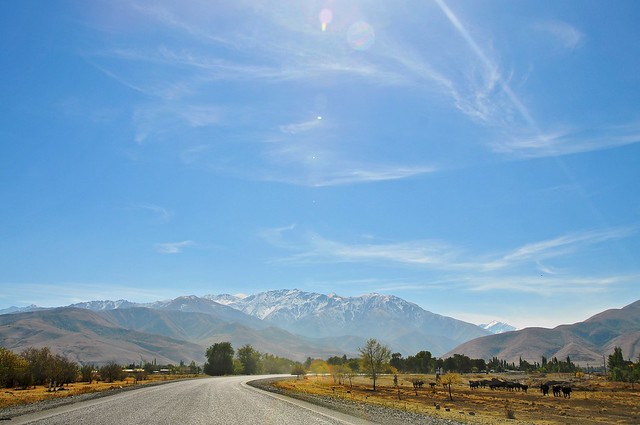
Shooting into the sun through a windshield isn't the best way way to take pictures, but it's a heck of a lot better than from the back seat (especially the middle seat, which I had on the way up to Bishkek), and I took advantage of the opportunity on the way south.


_DSC1149
The first 60 km from Bishkek you simply head west on a flat road that passes through numerous small villages and towns in the Chuy valley. At Kara Balta you turn south onto the M41, and head towards the Ala Too mountains to the south.

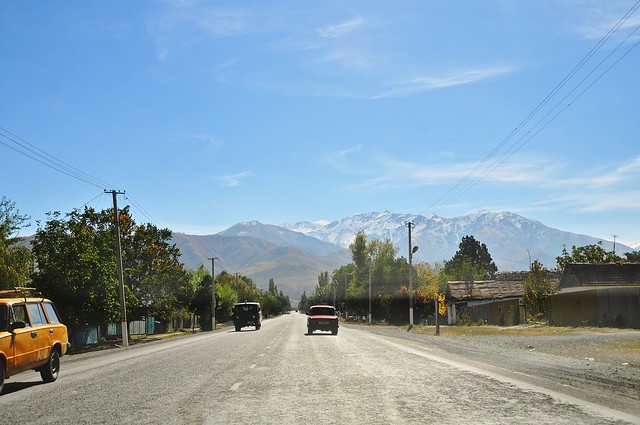
_DSC1150
Passing through Sosnovka village, which marks the entrance to the mountain canyons and the exit from the flat and fertile Chuy valley.

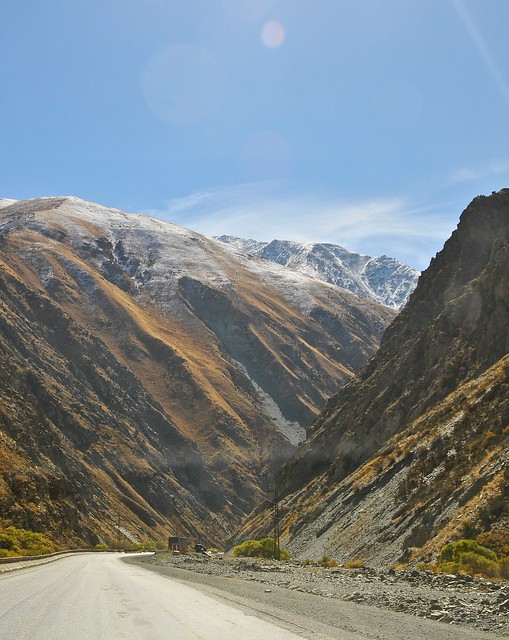
_DSC1151
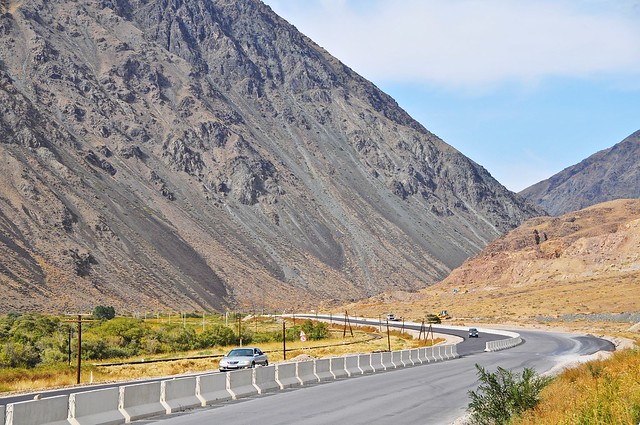
The steep and narrow valley that the M41 runs through.

Monday, 1 October 2012

Bishkek the third: picking up the Tajik visa en route to Osh

Coming back from Jeti Oguz, I was given a ride to the main road by the store owner's nephew, who was a stockbroker from Bishkek and spoke English. Before the did that, though, they downloaded some of my pictures to their USB drive, which was a bit surprising since the guy had no idea about computers (but his children did). In China, you could go into a modest looking shop and find that the shopkeeper had a new flat-screen computer behind their shelves, and that they were amusing themselves playing Mahjong or watching videos on Baidu, but in Central Asia such a scene would be truly shocking.

It was raining at the junction, so the owner's nephew let me stay in his car until a marshrutka passed, and we talked a bit about politics and the nearby gold mines. The Kumtor mine creates something like 10% of Kyrgyzstan's GDP, but it's owned by a Canadian company which keeps more of the profits than protestors like, as they accuse the government of striking a sweetheart deal. In his opinion there wouldn't be a profitable mine at all if you tried to let locals run it, but it's easy to see why people are upset when they see foreigners profiting off of local resources.

Back in Karakol I headed straight to the bus station to catch the marshrutka back to Bishkek. I lucked out in the sense that the marshrutka was almost full, which means little waiting. It still ended up taking me about 10 hours to take the 422 km trip from Jeti Oguz to Bishkek, despite knowing exactly how to get there and what transportation to take. This is a sobering reality about transportation in Kyrgyzstan: it takes a long time, even in the best of circumstances.


I wasn't surprised to find the Sakura full when I arrived there, so it was another night at the cheap hotel. No worries.

The next day I moved over to the Sakura in the morning to secure a bed, and otherwise I had little to do other than pickup my Tajik visa. Compared to the Iranian visa, the Tajik visa was easy-peasy. I just went to the embassy, told them I had applied for a visa a couple of weeks ago, and they picked through the applications sitting in the in-box to find mine, then processed it and gave me my visa. Even though there were rumblings that the GBAO permits were being issued in Dushanbe and that the Pamirs were once again open for tourists, I was told that they still weren't issuing them in Bishkek and that I would have to apply in Dushanbe. That was a major disappointment (as well as an additional expense in Dushanbe), but there's not much you can do about it.

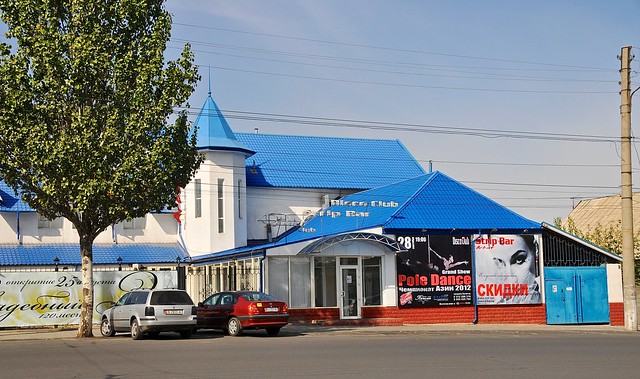
The Tajik Embassy in Dushanbe is now listed on Google Maps and thus pretty easy to find. One of the more interesting things you may encounter on your visit to the embassy is the strip club on the nearest major road: certainly not something I expected to see advertised so openly in what is, after all, still a somewhat conservative Muslim country.

_DSC1141
The strip club near the Tajik Embassy.

_DSC1142
Looking down the entrance park to the Kyrgyz State University, next to the Philharmonic.

_DSC1145
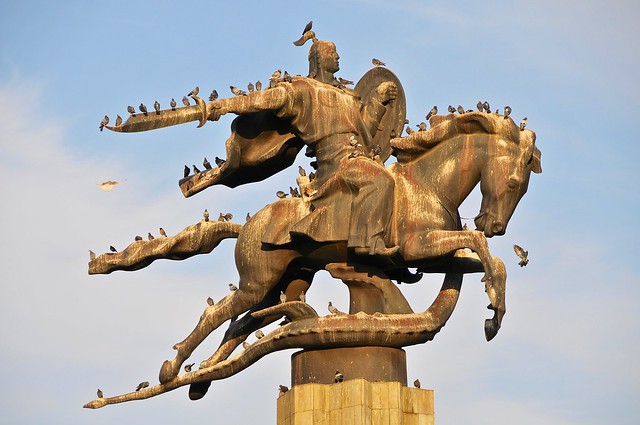
A statue of Manas in front of the Philharmonic keeps the pigeons happy.

Budget

September 30, 2012, from Jeti Oguz to Bishkek: 958 som
  • Room at cheap hotel: 300 som
  • 2 x super snicker, pic-nic chocolate bar, M&Ms: 121
  • Van to Karakol: 30 som
  • Marshrutka to Bishkek: 300 som
  • Coke: 40 som
  • Dinner at roadstop (bifsteak): 130 som
  • Coke: 37 som
October 1, Bishkek: $65 + 670 som
  • Bed at Sakura: 350 som
  • Sandwich: 33 som
  • Bus x 2: 16 som
  • Ice cream, lemon soda: 21 som
  • Lozenges, eggs, sandwich, pepsi, tomatoes, coffee packets: 150 som

Thursday, 27 September 2012

Karakol: a Russified village nestled between the Tian-shan mountains and Issyk-kul lake


You can catch a marshrutka to Karakol from the Western Bus Station in Bishkek. It cost 300 som for the 6-hour drive there, following the northern shore of Issyk-Kul lake. Issyk-Kul was a popular resort area during the Soviet era, and beach resorts line the northern shores. Slightly saline, the lake doesn't freeze over in the winter, which is why its name means "hot lake" in Kyrgyz.

_DSC0568
It's a six-hour marshrutka ride from Bishkek to Karakol, broken up by a rest stop at a real, full-fledged restaurant in the lone pass between Bishkek and Issyk-Kul lake.

_DSC0569
View from the rest stop.

Because the ride from Bishkek takes six hours, there's not much time to do anything once you arrive in Karakol and find a place to stay (especially since the bus stop is some distance from the center and the CBT office probably isn't open, in case you were hoping to stay at a CBT guesthouse).

I ended up staying at the Neofit hotel, which was 450 som for a single room, including breakfast. Bathrooms were shared, but they had ample hot water and good pressure. I thought it was a good value, but not the best place to stay if you want to meet other people and arrange trekking in the area.

_DSC0570
The colourful entrance to the Neofit Hotel's restaurant. The hotel entrance is around the corner on the left.

_DSC0579
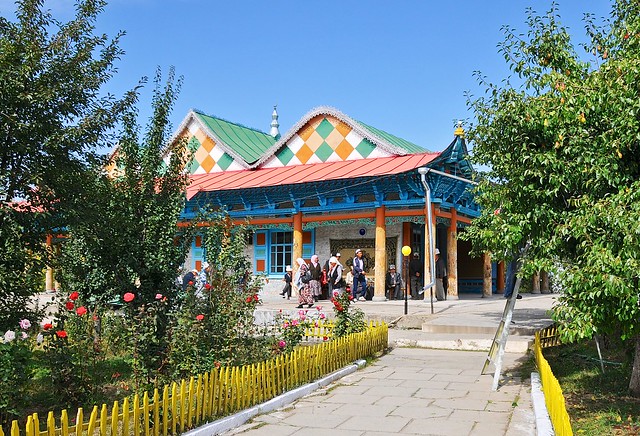
Karakol's Chinese Dungan Mosque. Dungans are the local term for Han Muslims, and are basically what the Chinese would call Hui. The ladder on the right is to harvest the pears ripening on the tree.

_DSC0581
Most of the worshippers look more Kyrgyz than Dungan/Han to me.

_DSC0584
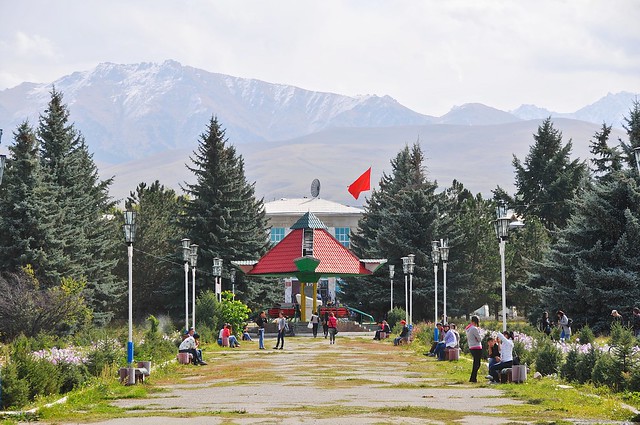
Students line the park in front of the University. I quite like the unkempt look.

Monday, 24 September 2012

Bishkek, part two: in search of the elusive Iranian visa


It's always something of a relief to return to familiar places, especially when you arrive fairly late, as you know where things are and how to get to where you need to be. This is becoming less and less of an issue with the GPS-equipped smartphones and offline maps that everyone has nowadays (as well as Google maps having a lot more listings with every passing year), but any way you slice it there's a lot less stress when you're on familiar territory.

I arrived at the Western Bus Station and made it to the Sakura without any problems, only to find that they were full. Not that surprising, really. They told me that there was a cheap hotel nearby, a couple of blocks south next to the casino. I made my way there and eventually roused the slumbering receptionist, if that's the right term. She was really more of a keeper of the keys, ensconced in a room behind a window. 300 som for a night was fine by me, so she gave me an old fashioned key and told me my room. Endless jiggling of the key eventually yielded entry, and I was in a simple 3-bedded room blessed with a functional electrical outlet.

I'm not entirely sure what this place was, but my best guess is that it was some sort of place where students stayed. Not all of the building was used as a hotel. I visited the bathroom and there were some dire squat toilets and barely functional faucets, but no showers. The bathroom had a common entrance for both males and females, with a divider down the middle that didn't reach the roof. For 300 som and one night, it wasn't a big deal.

Applying for the Iranian visa was a bit of a mess. You have to do all of the applying in the morning, and then pick up your visa in the afternoon of the next day. I already had my passport pictures and confirmation code ready (and thankfully they were able to find it this time), but they also surprised me by requiring proof of travel insurance. I didn't have insurance, so I had to go out to an internet shop and buy some online (it turned out being worth it, as I was able to make a claim on my damaged lens, which paid out more than the cost of the insurance). After submitting my now complete application, I had to go to the National Bank of Pakistan and deposit the visa fee of 50 Euros to their account there (perhaps the only embassy which doesn't price things in US dollars).

Had I arrived back in Bishkek a day earlier, I could have shaved a couple of days off of my stay in Bishkek: embassies aren't open on weekends, and by applying on Friday it meant I had to stay until Monday afternoon. Blah.

_DSC0497
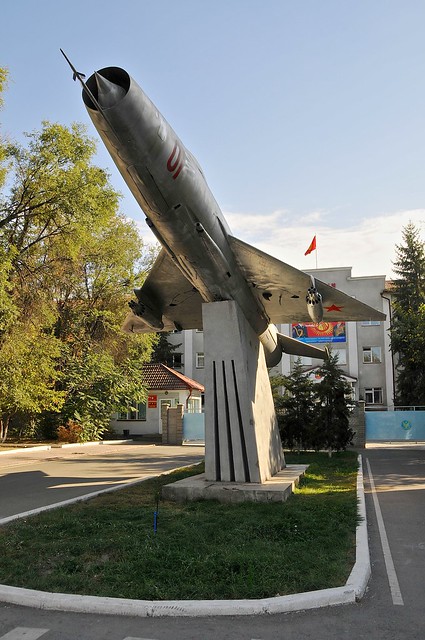
MiG-21 on display. Kyrgyzstan's flight training school used to be the major source of income for the republic, and Syria's Hafez al-Assad was trained there.

_DSC0499
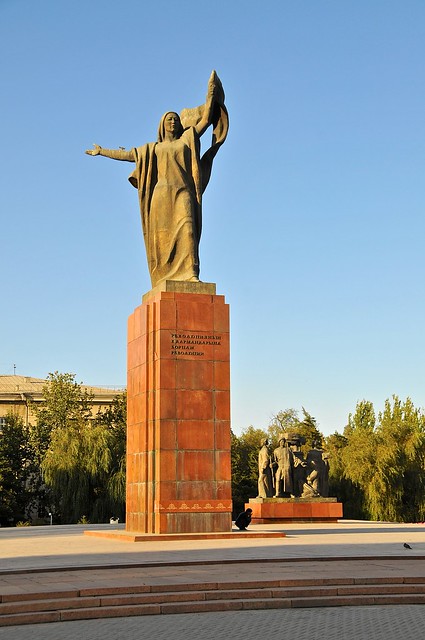
Monument to Fighters of the Revolution.

_DSC0505
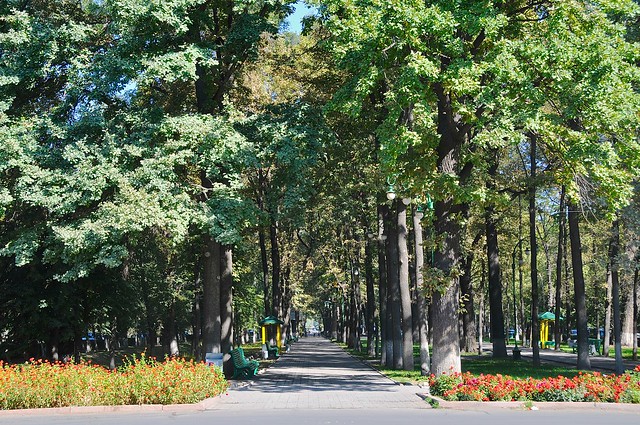
The wooded park that runs north-south along Erkindik Avenue. Unruly poppies and trees make it look both domesticated and wild at the same time—a common theme in Russian-style parks, it seems. I was sitting there reading my kindle one day when a Kyrgyz University student came up to me and started talking to me. She was embarrassed when I identified myself as a tourist that didn't speak Russian, and returned to her friends. So apparently I can pass as a Kyrgyzstani in Bishkek, where lots of people dress like me, even if few people in the country would make that mistake.

_DSC0506
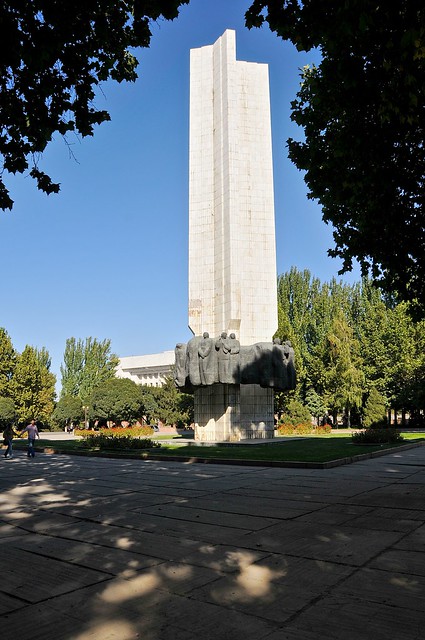
People's Friendship Monument, celebrating the anniversary of Kyrgyzstan's entry into Russia.

_DSC0507
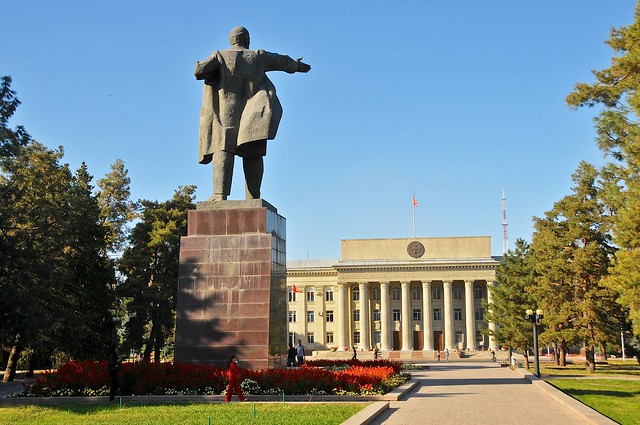
The statue of Lenin now sits behind the Historical Museum.

Thursday, 20 September 2012

Back in Almaty

I returned to Almaty with a broken Kindle and without my iPhone. This meant I had no internet-capable device, and no handy way to get my email (assuming a wi-fi signal). I also was in need of additional storage space for my camera, as my 70 GB of storage were just about up, even though I was shooting in jpeg.

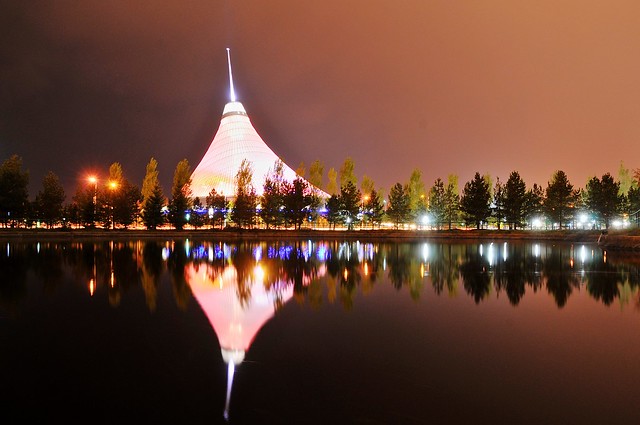
Incidentally, shooting in jpeg was a huge mistake (which I should have known, if only I had done some serious testing before leaving). I had always shot RAW before, but I had relied on bromides about jpegs from modern cameras being good enough for just about anything. For whatever reason, the jpegs produced by my D300 are atrocious. I mean, I'm not just talking about banding problems, but about severe and rather incomprehensible haloing as a result of its image processing engine. It's almost like the clumsy masking that you can see in some HDR photos. If you're wondering what I mean by this, look at the picture of Khan Shatyr, below.
_DSC0390

Look at the edge of the illuminated tent, and notice how the area around the tent is artificially dark, and how it suddenly turns lighter a fixed distance from the tent, as though the tent has a dark halo. This is with minimal adjustment to brightness and contrast, and with more manipulation (to brighten the sky, for example) the effect will only become more evident. This horrific and inexcusable effect more typically appears in pictures where a darker object like a tree is pictures against a bright blue sky, where the sky immediately around the object is artificially light. Do any manipulation and the haloing becomes quite obvious. I only discovered this when I returned home and started to do some serious work on my pictures, by which time is was too late.

Anyway, since I was running out of space I already knew I would need either some new CF storage cards for my camera, or a portable hard drive to move files to. Given the difficulty in finding the less common CF cards, as well as the heightened expense that such a specialty product would have in smaller markets (SD and micro-SD cards were much more common, given their use in mobile phones as well as car stereos in the CIS), a portable hard drive seemed like the most likely option. But after I lost my phone, I gave serious consideration to a netbook. Thankfully I was in Kazakhstan when this happened, which meant there were real computer stores with reasonable prices: everything in Bishkek was at least 50% more than you would pay in the US (and if someone had decided to import things like Google Nexus or Kindle Fire tablets they could make a killing there). I found a refurbished ASUS netbook without an OS for 32,000 tenge, which was a reasonable price even by the low, low standards of US pricing, and decided to buy it. It wasn't that difficult decision, given that a portable hard drive would have cost at least 10,000 tenge, and likely more.

The decision to buy was only slightly complicated by a Canadian guy at the Apple Hostel who was interested in selling his Nexus 7 tablet, something which had only been released after I started traveling. He was happy with his Nexus phone, but I ultimately decided against it since it didn't have nearly enough storage and I would need to buy a hard drive as well.

This Canadian guy was really, shall we say, interesting. He was in his late 40s, and was Armenian-Canadian. He spoke Russian fluently, and was taking a year off to travel mainly in China, where—in his experience—foreigners are treated like kings. When I disagreed with that assesment, he said that maybe it was only white foreigners who were treated that way (although he was slightly swarthy, he strongly resembled Ron Jeremy, and said that his copious arm and body hair fascinated the Chinese). I think he's really the one who reminded me that I'm not white and that I do get treated differently than white Westerners, but some fair-haired Europeans at the hostel also disagreed about white people being treated like royalty, so I suspect that things have changed considerably since the last time the Canadian had been in China.

Anyway, he was spinning his wheels in Almaty because he had somehow managed to lose both his passports and all his travelers cheques (who carries these, anyway? ATMs give you just as good, or better, rates) on the streets of Almaty. Am-Ex was refusing to reimburse him because they found his account of his loss suspicious, and the Canadians were unable to issue a new passport in less than either 30 or 90 days (based on my attempt to get a new passport in Washington, DC, I believe it was the latter): the best they would do was issue him an emergency travel document to allow him to return to Canada. His Georgian passport (more on that in a minute) was his lone ray of hope, as they said they would be able to issue him a new passport in under two weeks, though he would have to go to Astana to pick it up.

How, you may wonder, does an Armenian-Canadian get Georgian citizenship. Well, according to him, the President Mikheil Saakashvili was a rabid xenophile with a Dutch wife, and he had instituted a policy where any foreigner (or maybe any Westerner) who lived in Georgia for more than 3 months could apply for citizenship. So that's what this Canadian guy did, and he got his citizenship. As a former CIS member with reasonably close ties to other former-Soviet republics, carrying a Georgian passport made travel within CIS states considerably easier. It sounds preposterous, as did his claim that Saakashvili mandated that foreigners be given a free bottle of wine on arrival at the airport, but that was his story.

As a result of losing both passports and all the money he had on him, he had to make a lot of phone calls to different parts of the globe. This involves different time zones. Because this was very confusing, he decided on the basis of his confusion that everyone in the world should switch to a common time system. And since we would all be switching, anyway, why stop at the simple adoption to GMT or UTC? Why not go to a complete base-10 system, and away from 60 minutes and 24 hours? I pointed out that Swatch Internet Time, with its 1,000 beats per day, embodies exactly this idea, but for some reason had not been widely adopted. He was very insistent that the idea was superior and that change should be foisted upon us, and could not be convinced otherwise.

For someone who looked like Ron Jeremy, he had a surprisingly intense interest in younger women. Although he had been in Almaty for less than a week, he had already gone on a date with a divorced Kazakh woman he had met through an online service. As a divorced woman with a daughter, I suspect her prospects in Kazakhstan were limited, and perhaps someone with a Canadian passport sound appealing. That's the only thing I could figure. He was also very enamored of this Georgian girl who had once interviewed him about how he obtained Georgian citizenship, saying she dressed like a hooker in her Facebook pictures, and was eager to show them to a Dutch guy who was going to Georgia. She was in her mid-twenties, and the Canadian said she was almost too young for him. The Dutch guy then asked him who he would consider to be too young for him, a question to which we never got a real answer.

Despite his quirks, he could be an interesting guy to talk to, as he speaks Russian fluently and Russian is what everyone in Kazakhstan speaks. Unlike in Kyrgyzstan, where Uzbeks will speak Uzbek to other Uzbeks, and Kyrgyz will speak Kyrgyz to other Kyrgyz (although the language are both Turkic, as are Kazakh, Uyghur, and Turkmen, there are enough differences to make them only as mutually intelligible as Italian and Portuguese, for example), Kazakhs will speak Russian even when amongst other Kazakhs. To a large extent this is because many Kazakhs speak no Kazakh, and even more are not fluent in it. Indeed, it is remarkable to hear Kazakhs actually speaking Kazakh in public.

The Canadian's view on this was kind of surprising, because he thought Kazakhs should use their local language more. The reason this was surprising was because he also thought that there should be no sympathy for people like the Georgians who insisted on using a backwater language with a unique writing system that effectively limited their economic opportunities as compared to if they all spoke Russian or another major language. In his mind, economic progress was really the only thing that mattered, which is why he was also effectively on the side of the Han in dismissing the complaints of the Uyghur and Tibetans in China. On the other hand, he was also critical of Japan, which hasn't apologized for war-time and colonial atrocities in Nanjing and elsewhere, and where the Prime Ministers continue to visit Yasukuni shrine, where multiple convicted war criminals are interred. I pointed out that this kind of anti-Japanese antagonism only makes sense from a moral perspective, and not from an economic one, and that if we were adopting a moral perspective then the Han treatment of Tibetans and Uyghur were equally problematic.

He eventually got really mad at me and told me to stop talking to him when I pushed back against his time-zone idea and suggested that it would introduce a lot more problems than it solved. I think everyone else in the hostel (and life) was content to simply tolerate his views as the source of amusement, especially since he had some difficulty understand when people were taking the piss out of him. At one point he touched the screen of someone's laptop, then apologized for doing so. I said that he probably didn't like it when people touched his screen, and he said that when people at work did that to his computer, he would briefly excuse himself and walk to the bathroom, return with a mess of wet paper towels, scrub and dry his screen, then turn back to screen-toucher and ask them to continue their thoughts. He said this usually prevented them from doing it again. I suspect it prevented them from ever visiting him again.

But it was nice to go out with him and have him be able to translate things or decipher menus or ask what things in cafes were.
_DSC0452
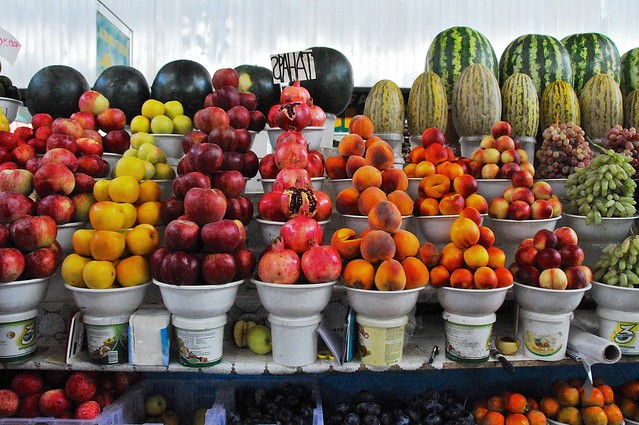
The Green Market in Almaty is a nice mix of an organized Central Asian market and Western hygiene, especially in the central fresh-market area. The surrounding areas are just seedy enough to feel exotic and "authentic."

Almaty is a very chic place. There are top-notch international stores and brands, and in many ways it feels like what I imagine certain Baltic states must feel like: very European and modern, but with unmistakeable traces of Soviet influence, or that it had been a little down on its luck not so long ago. The edges are roughest around the Green Market, but they never really get that rough.

Part of that is because of the people, who are really very young and stylish. The German girl I met in Xiahe said the women were really attractive (something I also heard from others), and it's true: they are. I'm not sure many of them are actually any different than Mongolians or Kyrgyz so far as fundamental appearance goes, but it's just that they dress like Russians, put as much money and effort into their appearance as Russians, and have very Western style sensibilities combined with the resources to implement those sensibilities. What does make some Kazakh women unique, however, is that the large numbers of Russians in the country have resulted in some Kazakh women being of mixed heritage, and many of these women (and men) can be incredibly stunning (and perhaps the only people from whom the word "Eurasian" actually makes any sense). Sometimes Russian blood manifests itself in light, sandy hair, which is sometimes explained as them being "real" Kazakhs, on the theory that many in Chinggis Khan's army had fair hair. Other times it's visible in a mixture of Asian and European facial features, or green eyes. Sometimes the effect can seem a little awkward, in a captivating sort of way, while sometimes it is simply stunning. People of mixed ethnicity are relatively rare, however, and it is even more rare to see someone who appears to be the direct result of inter-ethnic parents.
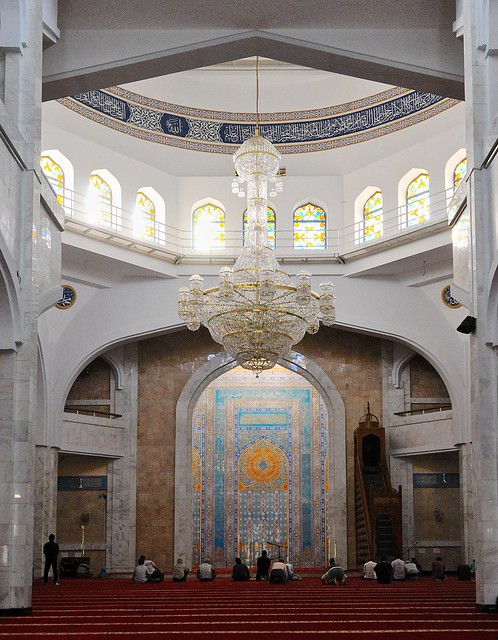
_DSC0457
The dome of Almaty's Central Mosque, finished in 1999.

_DSC0459
Interior of the mosque.

Tuesday, 11 September 2012

Bishkek: everyone's favourite visa hotspot

After three nights in Arslanbob, I decided to head to Bishkek. The American tourist staying at my homestay was heading to Sary Chelek (which was highly recommended by a couple of Kyrgyz people I spoke with, but a bit off the beaten trail) and agreed to give me a ride down to Kochkor-Ata, from where I could catch a ride to Bishkek. I knew that the price of a ride from Osh to Bishkek was 1,000 som, so I figured that a ride from Kochkor-Ata—about two hours closer—should be cheaper. Despite that, I had been quoted the same 1,000 som price from both Arslanbob and Jalal-Abad, which didn't make much sense. When we arrived at Kochkor-Ata we parked a bit away from the taxi stand and the Kyrgyz driver went out and negotiated a price (the Russian guide couldn't go, since as a white guy he would likely get quoted a tourist price), and it turns out that the going price actually was 1,000 som, even though we were a lot closer.

After waiting an hour or so for the car to fill up (share taxis only leave when full, even if it means waiting for hours—or sometimes even days—and only cars and not minibuses do the run between Bishkek and Osh), we started on our way. I've heard that minibuses used to do this run, but I honestly can't (or don't want to) imagine them bombing down the twisty mountain roads. Kochkor-Ata is on the northern end of the Kyrgyzstan Ferghana valley, and about 65 km away in Tashkomur the road leaves the valley and starts cutting through mountain valleys to the north.


At first the road follows the Naryn river, and you soon reach a hydroelectric dam, behind which lays Toktogul reservoir. The road skirts the reservoir, and instead of following the Naryn river on the other end, it continues to circle around the north end of the reservoir and climbs another pass before emptying out into the wide, long Suusamyr valley. This valley, in its width and length, is very similar to the Alay valley at the southern end of the country, and through which I entered from China, with the important difference being that it is almost 1,000 meters lower, at about 2,200 meters, meaning it is greener and more hospitable for a longer time. Both valleys are gorgeous wide grasslands with mountains to the north and south, however, and had I been there in the height of summer it would have been nice to spend some time there.

Caravanistan has a nice feature giving you an idea of what you can see on this road (though some of the pictures are a bit out of sequence), as does this cyclist's blog.

_DSC0094
Looking north in the Suusamyr valley.

_DSC0095
View from a gas station along the M41 in the Suusamyr valley.

About halfway through the Suusamyr valley, however, the road turns to the north and you make a long climb up relatively gentle slopes until you come to the upper reaches of the mountains, where you find a 2.5-kilometer-long tunnel through the top of the range at the Too Ashuu pass. Coming out of the tunnel, the northern side is nothing like the southern side, as it's all craggy mountains and steep slopes, and the road switchbacks down into the canyon-like valleys before emptying out into a fertile and heavily populated valley that runs to Bishkek. And although the road here is straight and flat, it's just about the slowest part of the trip since it's not a proper highway but a road through populated areas where it basically acts as main street for each of the respective towns and villages it crosses.

We arrived in Bishkek and were dropped off near the Osh bazaar in the western part of the city, and I hopped a bus and made my way to the Sakura Guesthouse, a very popular hostel owned by a Japanese man but run by his Kyrgyz wife. I think all the guy did was drink beer with his friends at night, and make noise well after quiet hours started, but I suspect the concept and standards behind the hostel were his. What do I mean by this? Well, it had spotless toilets and showers with good water pressure and lots of hot water,  extremely clean rooms, and free wi-fi. Although it is hard to find, has a tiny kitchen, and a cramped outdoor common area, it seems to be the place where everyone in Bishkek goes (especially cyclists and those who are driving their own cars or motorbikes). Because it's popular and because people tend to stay in Bishkek for a while to collect visas and catch up on civilization, it's extremely busy and you often have people sleeping in the hallways or on the roof in the multi-story main building (which is quieter than the dorm room near the entrance and kitchen).

In doing some research while writing this entry, it appears that the owner has been involved in a highly questionable incident with a young, black-out drunk Japanese tourist, and I can't say that this seems highly out of character for him. If you are a female tourist, be careful around him and definitely do not drink with him.

Like so many others in Bishkek, I also needed to get some visas sorted out. The key ones were the Tajik and Iranian ones. Tajik visas are relatively straightforward to get, and Bishkek is a good place to get them. They can grant single-entry visas on the spot for $75, or in a week for $55, with a double-entry costing $10 more. You just need to visit their embassy and fill out a form. If you want it on the spot, they process it immediately. If you're willing to wait, they just put your application on a pile and retrieve it when you come back: there's no need to pay in advance or leave your passport. I took the one-week service, since I knew I would need to come back to Bishkek later, and double-entry, since I knew I might want to visit the Afghan Wakhan.

The Iranian visa is probably the most difficult visa of all the ones I needed—and this was before citizens of all English-speaking countries needed a tour guide to get a visa. The main stumbling block is that you need an invitation from a tourist agency in order to get a visa. In theory, you provide an itinerary to the tourist agency, they apply to the government, and the government either approves you or rejects you, and then the agency sends you a confirmation number that you present to an embassy to which the tour agency has said you'll apply for your visa. The problem is that there are a mall number of people are randomly rejected, and that a number of agencies have a reputation for giving rejected applicants false confirmation numbers, so it's important to select a decent agency. The second problem is that North American banking regulations are quite strict, and it is very difficult to actually pay for these visa invites, as most payments to anyone even remotely associated with Iran will be blocked. I had payments to multiple UK bank accounts blocked, and was only able to successfully make a payment by giving a Dutch traveler some cash and asking him to make the bank transfer for me from his bank. I went to the Iranian embassy in Bishkek, but they said they couldn't find my confirmation number, and suggested I come back later. Uh oh. I confirmed with my agency that they had sent my confirmation number to the Bishkek embassy, and then hoped it would be there when I came back to Bishkek.

Aside from going to embassies, I walked around Bishkek and took in the city. Bishkek used to be known as Pishpek, which is the name for the churn used to make kumys, which seems about as apt a name as any for a settlement in this dairy-mad, kumys-guzzling country.

Today, the city is a fairly nice, relaxed place. And while Osh is the second-biggest city in the country, it pales in comparison to Bishkek, which seems like a city in ways that Osh simply doesn't. A little shabby, and not well integrated into the global marketplace (meaning that Western brands are unavailable or expensive), but nevertheless much more cosmopolitan and glamorous in a decayed Soviet kind of way.

One thing you may notice is a gender imbalance. You see a lot more women in the streets than you do in Osh, and while this might make some sense given how conservative Uzbek society is and how modern Bishkek is, the reality is that Bishkek is a city dominated by women. Indeed, much of Kyrgyzstan is, and Tajikistan is even worse. I later spoke to a couple of French journalists helping establish a French-language newspaper in Bishkek who said that over 60% of the working-age population in Bishkek was female, since so many men go to work in Russia. When you go into poorer villages and talk to people, you see old men, children, and women. Talk to them (family is usually the second or third question that arises, after where you're from and how old you are) and they'll tell you about their son, brother, or husband who is in Russia, working hard to send money home. If they're lucky, they've seen him in the past year. In central Bishkek banks are most noticeable by their signs advertising remittance services. It's even worse than the Philippines (another country highly dependent on foreign remittances from overseas workers), and kind of like the reverse of the cluster of towers in Hong Kong that cater to Filipina domestic workers wanting to send money home.

photo 25
Your bar has a dress code? Well, all the classy bars in Bishkek have face control, too.

_DSC0096
Soviet-style monumental architecture is often kind of interesting. This building was being turned into a casino.

_DSC0097
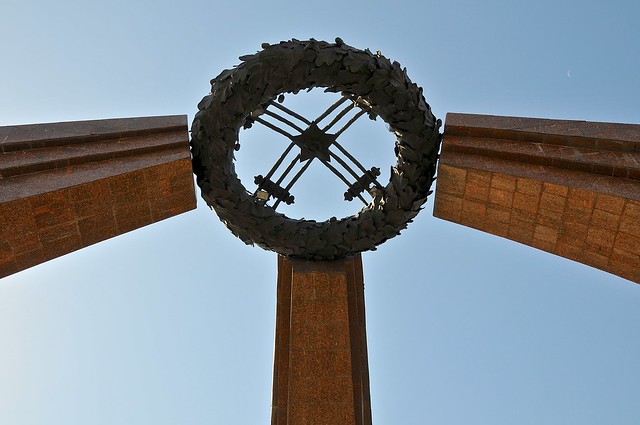
This circle with crossed strakes is what the central aperture, or tunduk, of a Kyrgyz yurt looks like, and is the motif on the Kyrgyzstan flag. Here it appears on the Monument of Victory.

_DSC0099
Typical Soviet statuary, this one to general Panfilov.

_DSC0107
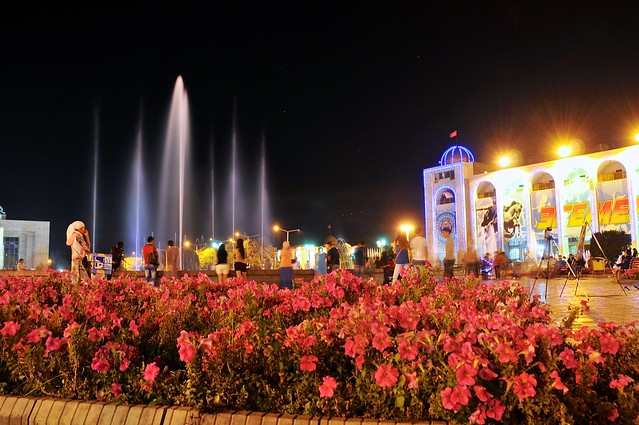
There is a light show by the fountains in downtown Bishkek. Here they have the souvenir photographers with digital cameras and printers you often see in low-income countries, as well as people selling cheap Chinese toys. One of the popular attractions for young males was a test of strength involving a thick pull-up bar that could freely-rotate. The object was to do a pull up and keep your position as long as possible—but since the bar could rotate, you couldn't use a natural pull-up grip.

When I had originally applied for my Kazakh visa, in Mongolia, I had originally thought that I would be entering Kazakhstan from China. Instead, I had come up through Kygyzstan. This was a bit of a problem because my visa was only good from August 22 to September 21, which meant I had been under some time pressure to make it to Kazakhstan before my visa ran out. I thus only spent one full day in Bishkek before going to Kazakhstan—this was probably a good idea given that visas mean one has to spend more time in Bishkek than one might otherwise like. (At least it's a better place to spin your wheels than Ulaanbaatar.)

Because the Sakura is such a popular place, I was able to hear about a new guesthouse that had just opened in Almaty—a godsend since the city is expensive and there aren't any other hostels there. I heard about it from this Indian-American guy who has been traveling continuously for years, making money by programming on projects that require no face time. He had been to something like 130 countries, and his goal was to visit more countries than Hillary Clinton's 180-something countries, if not to visit every UN-recognized country in the world. This seemed like a bit of a strange goal for me, especially since he was only spending 3 days in Kyrgyzstan before crossing it off and moving on to the next country. His advice on the new Apple Hostel in Almaty was very solid, however.

Budget

September 10, 2012, from Arslanbob to Bishkek: 1765 som
  • Share taxi to Bishkek: 1,000 som
  • Dorm at Sakura: 350 som
  • Snacks and drinks: 210 som
  • Dinner: 205 som
September 11, Bishkek: 1051 som
  • Dorm at Sakura: 350 som
  • Samsa and dumplings: 60
  • Drinks, fruit chocolate, toothbrush, vegetable peeler: 180
  • Fruit and snaks: 90 som
  • City bus: 16 som
  • Passport photo: 100 som
  • Sandwich and iced tea: 40 som
  • Dinner: 215 som