My earlier decision to sleep at the Taj Mahal but use the nearby Osh Guesthouse for information was a good one, as the Taj Mahal is much quieter and allows for better sleep. After waking up refreshed I stopped by the Osh Guesthouse in the morning to see if they had received my boots. Boots? Yes, boots. You see, my Blundstone boots had developed a rip in the leather where it joins the sole— a chronic problem, as this was the second pair to develop the same problem, and I already had the first pair replaced in the US under warranty.
Blundstone: horrible US warranty service, amazing Australian warranty service
Getting warranty service on the first pair was not easy, as I didn't have the receipt and didn't live close to where I bought them. I contacted Blundstone's US distributor, but they never returned my emails. I finally resorted to contacting Blundstone Australia directly, and after sending them a couple of pictures showing the problem, they airmailed a pair of replacement boots from Australia! That's pretty amazing, even if their US distributor is crap.So when my replacement pair developed the same problem in Mongolia, I was pretty disappointed, especially since it meant my right foot would now get wet in shallow puddles (Blundstones are waterproof for brief periods, and walking through ankle-deep water usually isn't a big problem). Given my prior experience with Blundstone Australia, I figured they would help me out, but being on the road I didn't really have a good place to get them sent. But when i went through Osh the first time, knowing that I would be back there in a few weeks on my way to Tajikistan, I asked at the Osh Guesthouse if they had an address I could get stuff sent to (and how safe it would be to do so). They said it should be pretty safe, as they would just get a note in the mail telling them to come pick something up, but that it could take a while to get there. I asked Blundstone Australia if they could send out a replacement to the Osh Guesthouse, and they readily agreed to.
GBAO permit through the Osh Guesthouse
I had hoped that the boots would have arrived safely by the time I got back to Osh, but they weren't there. While talking to the guys at the guesthouse, however, and talking about the problems of getting a GBAO permit and inquiring as to whether the pamirs were really open for tourists, I was told that not only were the pamirs open and permits being issued, but that I could get a permit from them at the guesthouse. It would take a few days processing and $40, but it was possible. This was great news for me, as it would mean I could take the direct route from Osh to Murghab, instead of first heading to Dushanbe and backtracking to the pamirs and coming back to Osh on my way out of Tajikistan.I applied for the GBAO permit and decided to spend the processing time in the villages of Sary Mogol and Sary Tash in the Alay Valley near the Tajik border. This was the same valley I had driven through as I entered from China, and from Sary Mogol you apparently have great views of Pik Lenin, a 7,000+ meter peak on the Tajik border.
Osh's CBT office: not helpful
I went to the Alay Hotel, where the regional CBT office is located, to see what sort of options CBT had in the region and to see if I could reserve a spot in the Sary Mogol CBT homestay that night. The CBT office was really quite unhelpful, telling me that they wouldn't call the Sary Mogol homestay and that I could simply arrive and find the home-stay quite easily as everyone knew where it was. It's easy to see why the system isn't working as well as it could, as I described in my Arslanbob post. I suspect that if I wanted a service for which I would have directly paid the guy at the office he would have been more helpful.I went down to the marshrutka and taxi stations near the market to see if I could get a ride to Sary Mogol, and ended up finding a ride in what Lonely Planet calls the Agromak 4WD stand (which is really just a big parking lot behind some street-front blocks, and most of the vehicles are not 4-wheel-drive. I ended up grossly overpaying, as I apparently agreed to pay 700 som for a ride to Sary Mogol, which Lonely Planet says is twice what I should have paid (though I think their prices for the Osh-Sary Tash route are too low). It seemed reasonable in light of the 1,000 I paid from Irkeshtam, but c'est la vie. I hate haggling, especially since it seems entirely haphazard whether the driver initially quotes you a fair price or a wildly-inflated price.
The M41 between Osh and Sary Tash
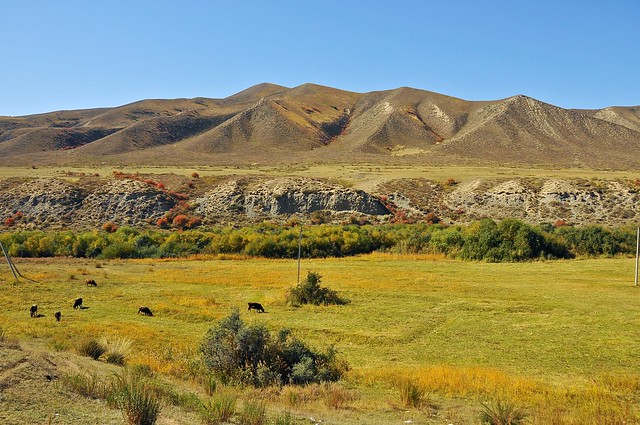
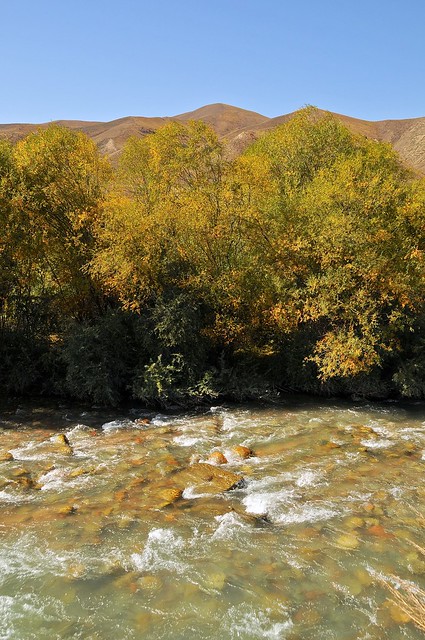
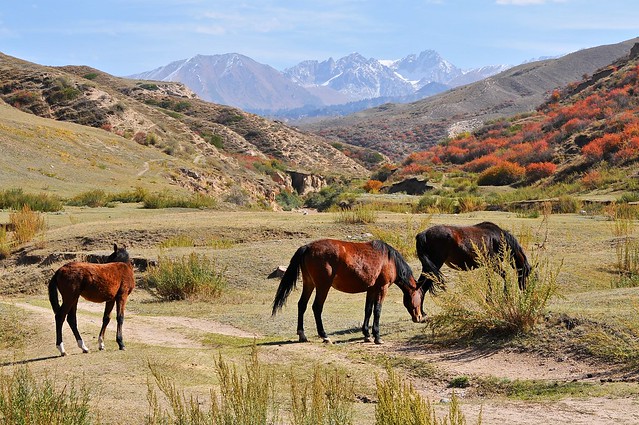
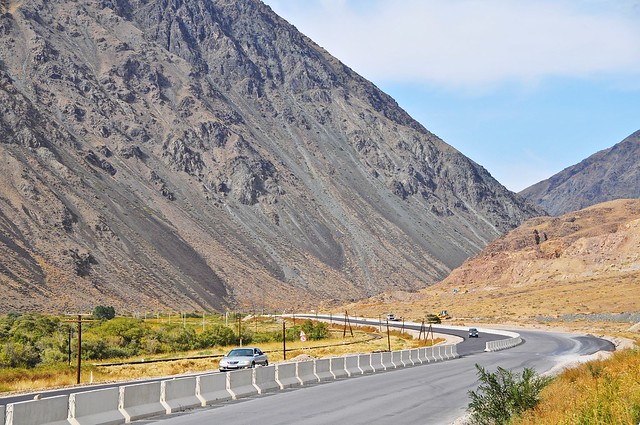
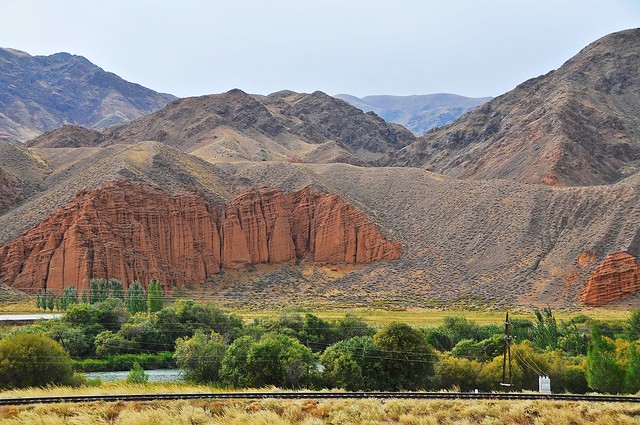
The ride up to Sary Tash would be the first time I had done this stretch of the M41 during the day, and it was really quite impressive. The first half hour or so from Osh is relatively flat farmland that is part of the Ferghana valley, but it eventually starts to climb into a mountain valley, culminating in the 2,391 meter Chiyrchyk Pass, some 80 km from Osh. After that pass you drop down into the town of Gulcha (1,546 m) and up the Kurshab valley. Whereas the mountains before the Chiyrchyk pass were grassy and green, the mountains in the Kurshab valley are red and craggy, with a wide and stony riverbed that looks tame and narrow in the fall but must appear very different during the spring melt.At a couple of places along the road, where the valley was narrower and the highway had more bends, I saw wrecked tractor-trailers. For the most part they had failed to negotiate a corner and had gone straight off the road. I had a difficult time imagining that the government really cares that much about removing wrecked trucks from the sides of roads, so I imagined that they had been there for some time. I was wrong about this, however, as when I returned to Osh a few days later they were gone (maybe they are valuable as scrap?). I suspect that these crashes may have been fatal, as nobody in Central Asia likes to wear a seatbelt, and drivers (and front-seat passengers) only pretend to wear them by slinging them across their bodies when they pass police checkpoint. In fact, wearing your seat belt is likely to be taken as an insult by your driver, who will proceed to tell you how good a driver he is. Such a good driver that not even the argument that you are protecting yourself from the other bad drivers on the road will be satisfactory: he's so good he can avoid those bad drivers.
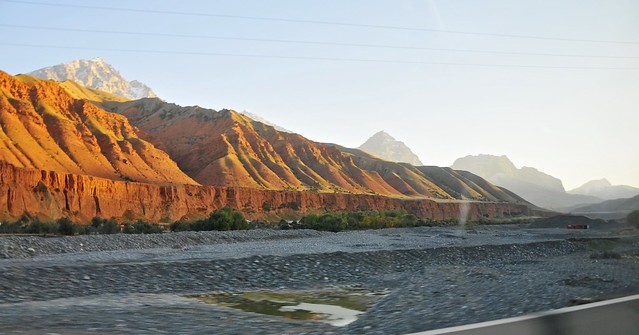 |
| The Kurshab riverbed and mountains after Gulcha. |
 |
| The lower mountains are surprisingly grassy. |