Showing posts with label Uyghur. Show all posts

Wednesday, 29 August 2012

Kashgar, take two

I had only been in Kashgar for two full days, but that was really enough time to see most of the things in the city. Really, there's the Sunday Market, the livestock market, the Id Kah mosque, and the Abak Khoja mausoleum. But most of all there's simply wandering around the old city and soaking up the atmosphere. I suppose one could explore the more Chinese parts of the city, but that holds little appeal for me. Maybe visiting the amusement park would have been interesting.

So on my final day in Kashgar, I didn't have much on my plate for the day, and I decided to accompany another tourist staying at the Pamir Hostel as he went to the Sunday Market to buy a carpet. This guy was a European who was living in a big city in Eastern China, and he wanted to buy a carpet or textile to use as a wall decoration.

Given the size of the Sunday Market, the are devoted to rugs and carpets is quite small, but it was interesting to tag along as I would otherwise be hesitant to enter one of the shops and waste the seller's time while being bombarded with high-pressure sales tactics. Accompanying someone else who was interested, while making it clear I wasn't buying anything, was a much better strategy. Virtually all the carpets on display at the shops we went to were used, and they were in a surprising array of styles—not simply the Yarkand or Hotan carpets one might expect to see. Pakistan, and Afghanistan were well represented, and they also had a fair number of Tajik or Uzbek suzani tapestries. I discovered that I quite like strong geometric patterns of the flat-woven kilim rugs they had, most of which were Afghan, and many of which were camel-hair. I know nothing about carpets, and have no idea how much things should cost or what a good deal would be—and in that respect, I'm sure I'm like most consumers.

The Uyghur carpet salesman recognized the two of us for what we were—a couple of tourists with little to spend—and didn't try too hard to sell us on his carpets, though he was friendly and informative. The European guy bought a small suzani for about $60. Small potatoes. But then the carpet seller said something that really encapsulates the reality of traveling in China: "Four or five years ago, Americans and Europeans were the biggest customers, and had lots of money to spend. Now, they buy little and it's the Chinese who spend a lot." It's like that for a lot of things. Those Westerners who are likely to travel to places like Kashgar are simply out-classed, economically speaking, by the kind of Chinese who can also afford to travel there. Prices for many things seem expensive even by Western standards, but that's because there are more than enough wealthy Chinese who think nothing of overpaying and for whom conspicuous consumption is a virtue.

_DSC9520
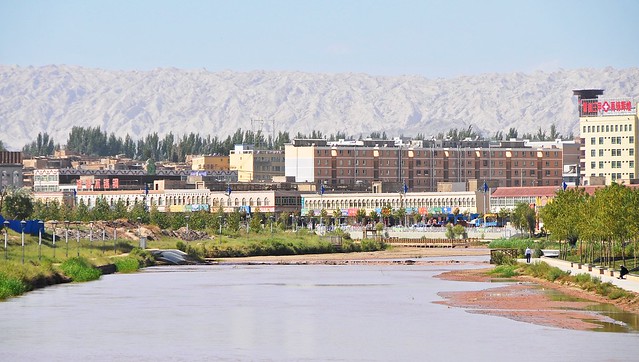
Looking north from Aizirete road bridge, near the Sunday Market.

_DSC9521
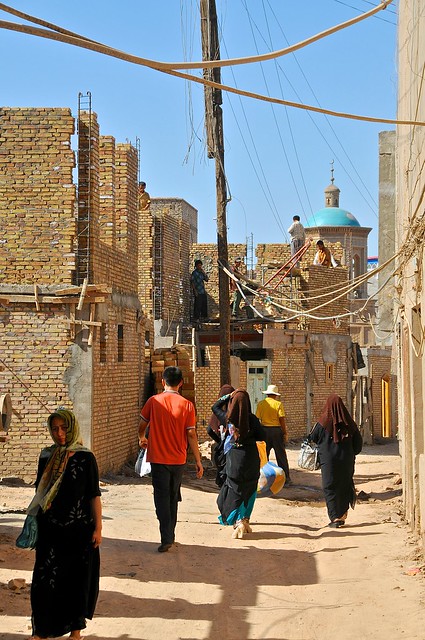
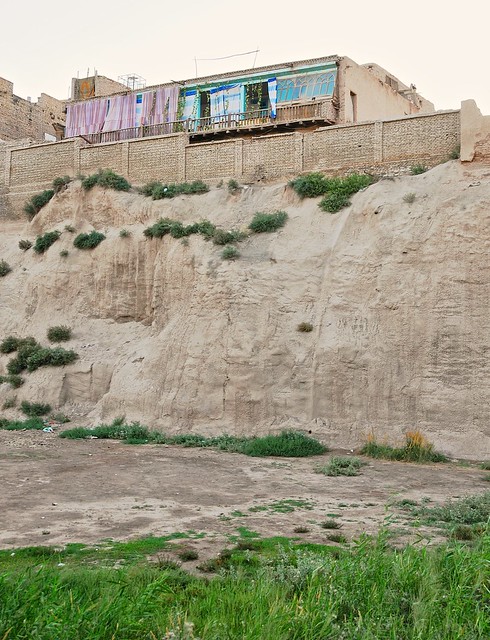
Making a staw & mud slurry to cover the new buildings along a stretch of old town that was destroyed & widened into a large road.

_DSC9523
New buildings going up. At least they didn't widen the road, so it will retain more of its old character.

_DSC9524
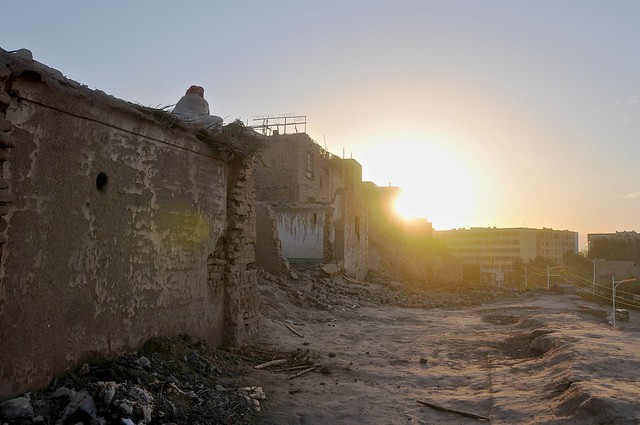
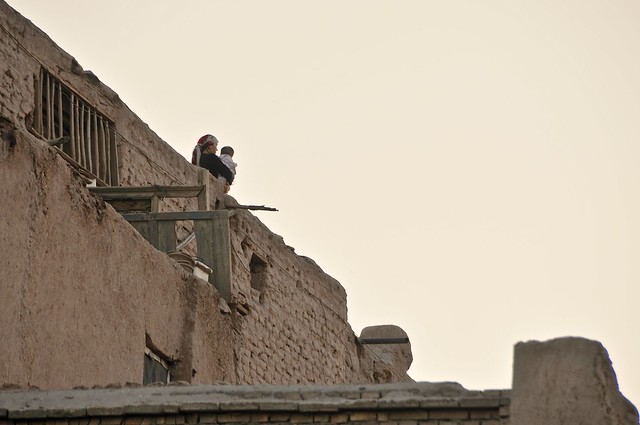
Sunset in an area still being destroyed. A woman sits on the roof, watching a vanishing way of life.

_DSC9526
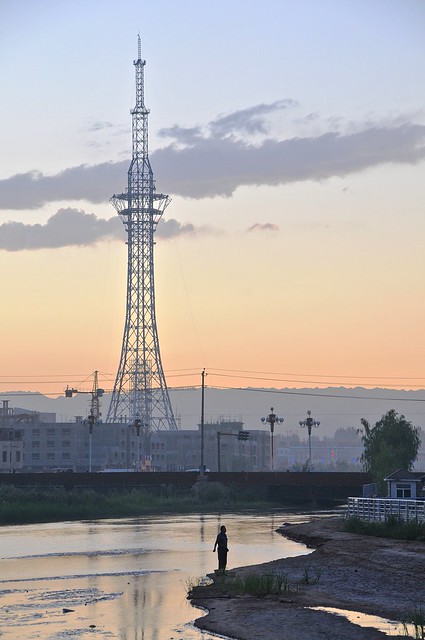
View along the Tuman river.

_DSC9534
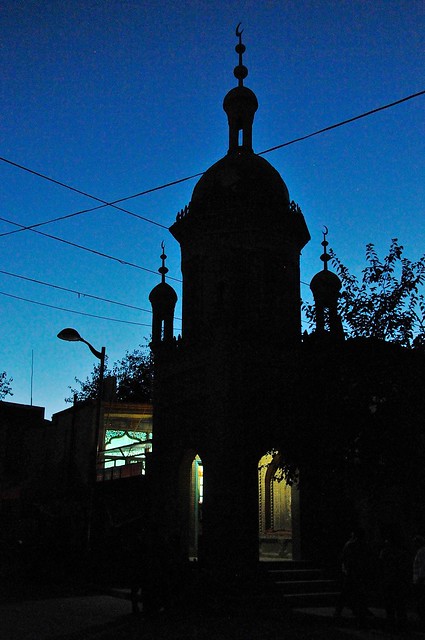
Mosque in the dwindling twilight.

Although I loved Xinjiang, and could have spent more time there backtracking to places I had skipped in my rush to get to Kashgar, it felt like it was time to move on to Kyrgyzstan, especially since summer was coming to a close (even if it didn't feel like it in sweltering Kashgar): I decided to try my hand hitching to Osh the next day, aided by a set of instructions posted by a fellow traveler at the hostel.

Budget

August 29: 78 yuan
  • Pamir Hostel: 50 yuan
  • Dinner: 15 yuan
  • Drinks: 15 yuan
  • Melon & naan: 8 yuan


Monday, 27 August 2012

Kashgar, take one

After being in Mongolia, I had learned the importance of getting a jump on things if you want to plan on booking a cheap tour or sharing expenses, so I had two early priorities in Kashgar: one, to figure out how much time I had left on my visa, and if I was limited to 30 days since my last entry (most Chinese visas stipulate that you are only allowed to stay for 30 days, and if you want to stay longer you need an extension, while my visa didn't specify a length of stay limitation); and two, how much it would cost to enter Kyrgyzstan via the Torugart Pass (which requires both a permit and private transportation on both sides of the border) and Irkeshtam Pass.

Thus, after checking into the Pamir Hostel, I made my way to John's Cafe. The Uyghur operators there were pretty helpful, but said that it would cost $400 if you did the Torugart Pass solo, dropping to $150 if you shared with three or more people. This was more than I wanted to spend, so the next step was to find out how much the international bus to Osh would cost and when it left. I went to the international bus station, but the lineups were incredible, so I figured I would come back at a different time when hopefully it would be less busy (it's always busy, from what I can tell, and talking to someone would involve waiting for hours).

I then made it to Kashgar's PSB (public security bureau) office to enquire about my visa status. Althoug htey weren't open to actually do any processing, I managed to get the officer working there to take a look at my visa and let me know if I needed an extension if I wanted to stay for more than 30 days. He took a look, and said that since it didn't explicitly say I was limited to 30 days per entry, I could stay until the expiration of my visa. This was a relief, but it also came a bit too late, because I had essentially rushed my way through Xinjiang in order to make sure I would be able to exit the country if I had been limited to 30 days—had I knew I had more time in advance, I might have stayed a day or so longer in Tashkuragan and Karakul, as well as possibly spent more time on the edges of the Taklamakan desert.

_DSC8855
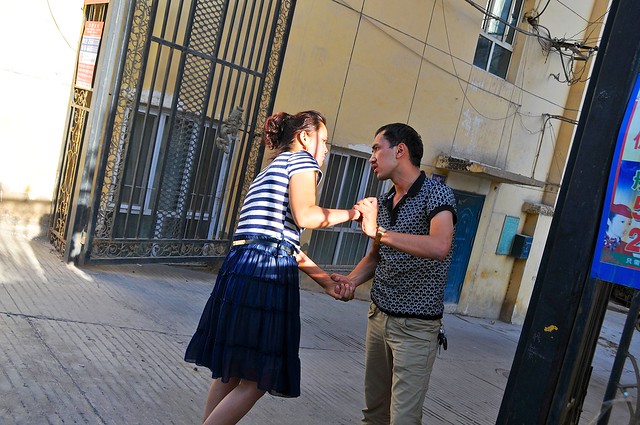
I saw this young Uyghur couple fighting in public, on a busy street near John's Cafe. This was really the first example of public violence I saw in China, and I stopped and looked to make sure it didn't escalate, taking a picture or two in the hope it would defuse the situation. She started pushing him and then he grabbed her neck, and then I stepped in to take his hand away from her neck. I'm not sure I would have done this in all places, but by now I think I had gotten a good enough idea of China to understand that this wouldn't be tolerated and that nothing would really happen to me for intervening. After the couple had calmed down, I was walking away and a older American approached me and asked if I was the Uyghur guy's friend, which he had somehow thought I was (I guess I can pass for Uyghur in an American's eyes).

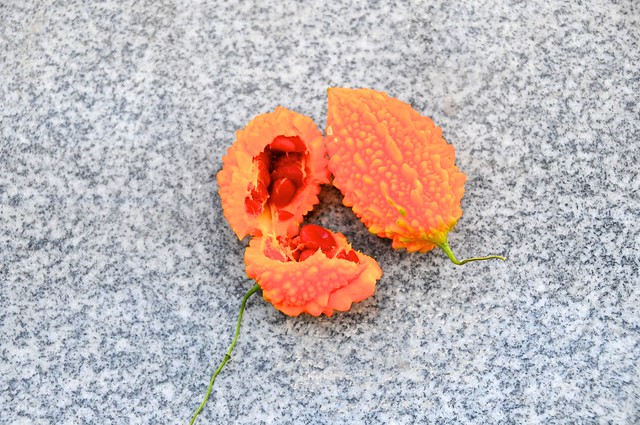
_DSC8859
Is this simply a ripe bitter melon? You can eat the flesh around the seeds, but it was nothing special other than how it looked.

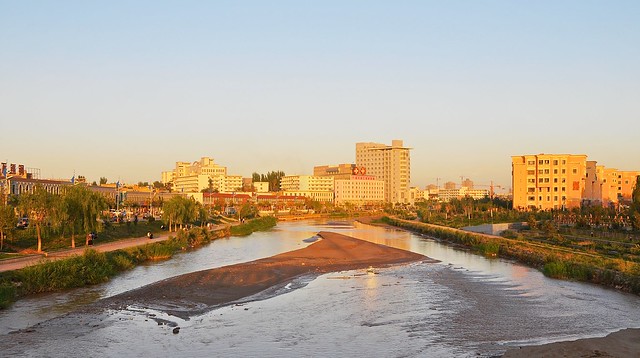
_DSC8861
Looking east from the Yingbin Road bridge over the Tuman river; the international bus station is just to the northwest of the bridge.

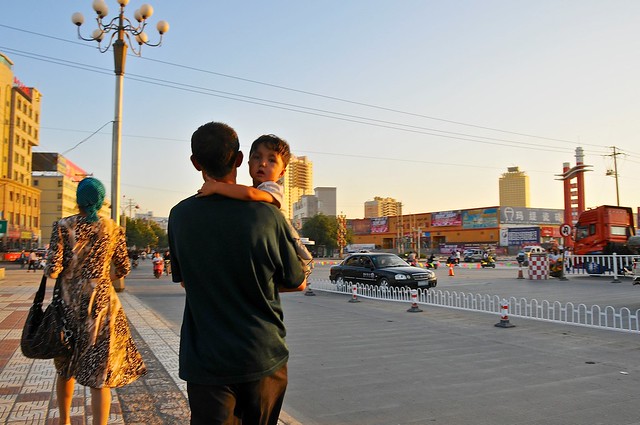
_DSC8863
Modern Uyghur family, walking south over the bridge.

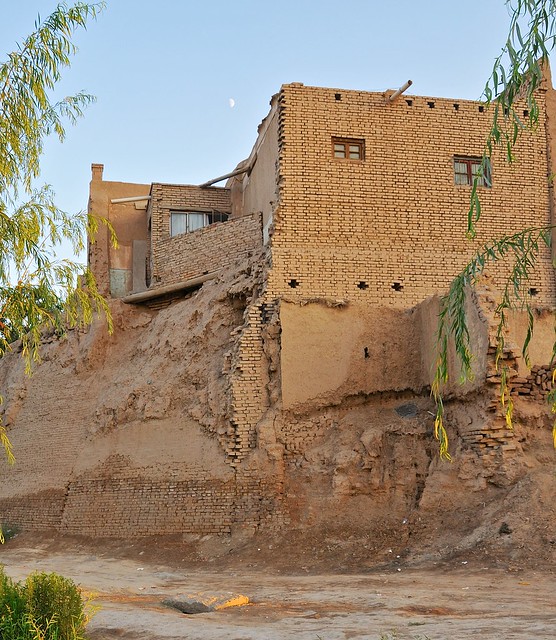
_DSC8866
One of my first glimpses of the old city, from a major throroughfare below.

_DSC8875
I wasn't sure how accessible the old city would be, since I had read that some places charge admission, so I climbed a tree to get this shot. Locals looked at me like I was crazy. In about 15 minutes I would be just outside that house, talking with kids who lived there.

_DSC8877
Mother and child watching the sunset from their roof.

Tuesday, 21 August 2012

Urumqi and Xinjiang—Han colonialism and Uyghur resistance

Urumqi offers little for the traveler. Its a large and relatively anonymous Han-dominated Chinese city, full of modern buildings. Although there is a substantial Uyghur population, traditional Uyghers live in what are effectively ghettos, under the careful watch of Chinese security forces. Much of the security is in response to Uyghur-Han tensions and isolated Uyghur acts of violence.

As a whole, Xinjiang is 43% Uyghur and 41% Han, with the Han proportion growing as a result of governmental efforts to encourage migration (including, reportedly, granting prisoners early release conditional on them moving there): as in Tibet and Inner Mongolia, the two other autonomous regions in China, they're trying to marginalize the indigenous ethnic populations by flooding their territory with Han. In 1945, for example, Xinjiang was just 6% Han and 83% Uyghur.


On the other hand, Urumqi—the capital city of Xinjiang and its economic powerhouse—is about 75% Han and 13% Uyghur. Although Urumqi has been a Han city for a long time, the major difference is that it's now a city of over 3 million people, while in 1949 it had only 100,000 people (of which 62% were Han). 


Year Total Uyghur %Uyghur Han %Han
1949 100,710 18,310 16.99 67,588 62.29
1950 121,746 21,074 17.30 77,554 63.70
1951 125,275 21,955 17.52 78,902 62.98
1955 171,897 31,769 18.48 109,842 63.89
1960 634,844 76,496 12.04 477,321 75.18
1965 615,189 62,439 10.14 463,804 75.39
1968 679,165 72,339 10.65 511,547 75.31
1972 765,788 73,265 9.56 587,813 76.75
1975 930,430 91,708 9.85 716,550 77.01
1980 1,060,502 108,239 10.20 812,557 76.62
1985 1,172,335 138,546 11.81 868,789 74.10
1990 1,384,300 173,200 12.51 1,007,355 73.30
1996 1,478,922 188,327 12.73 1,076,319 72.77
2000 2,081,834 266,475 12.80 1,567,621 75.30


Urumqi is the capital city of Xinjiang, and in many ways it's a pretty good representation of what the government wants to turn Xinjiang into: predominantly Han, visually similar to other bland, large cities in China, with materialistic Han culture as dominant, and with minorities relegated to what are functionally ghettoes, and doing all this while maintaining sanitized versions of minority culture as tourist attractions for the Han. The Uyghur are well aware of what the government has done in Inner Mongolia and Tibet, and are aware that their culture and way of life are under threat, and in many ways Urumqi has become ground zero in the battle for Xinjiang—although there have been tensions and incidents throughout Xinjiang, and even in Kunming and Beijing, Urumqi remains the most identifiable source of ongoing tension.

Obviously, the pivotal incident in the recent history of these tensions is the 2009 Urumqi riots, which themselves were a response to an incident in eastern China in which Uyghur workers were killed after false rumors circulated that Uyghurs had raped a Han woman.

Whatever the genesis of the recent tensions, it seems clear to me that the Uyghur have learned from the experience of Tibet and seen how ineffective the Tibetan passive resistance and self-immolation has been, and instead adopted a more aggressive approach. Instead of punishing themselves as a way of drawing attention to their disagreement and unhappiness with Han domination, the Uyghur instead have acted in a way to make the Han feel unwelcome and unsafe in Xinjiang. This seems to have had the desired effect: while Tibet has been overrun with Han migrants and tourists (so much so that even some Han will admit there are too many tourists), Xinjiang enjoys a reputation among the Han as being too dangerous to visit and a relatively unattractive migration destination.

To the extent that the Uyghur really don't want Han in their homeland—even as tourists—I think that the Western media gets a lot of the story wrong. A recent NY Times article, for example, lamented the decline in tourism in Xinjiang as though this was a blow to people living in Xinjiang, and not an actual goal of not only the terrorists but of many Uyghurs. (Also, it seems as if any English-language article on Xinjiang must describe it as 'restive.') A drop in tourism is unlikely to affect that many Uyghurs, especially since it seems like most travel agencies, hotels, etc., are run by Han, and not Uyghurs. This extends everywhere, from the big travel agents to hotels, and even to hostels (typically run by young Han migrants, even if they do tend to be very sympathetic to the Uyghur). The Han dominance in this industry merely reflects Han dominance of all lucrative industry: even though Uyghur benefit from quotas that make it easier to attend university (and are exempt from the one-child policy), almost all jobs seem to be filled by Han, and most Uyghur seem to work in the traditional farming and animal husbandry sector, while it's Han migrants who are employed in newer industrial projects.

The government response to the threat of Uyghur terrorism is to institute a police state. There are license plate cameras everywhere, including on highways in the middle of nowhere. Police checkpoints where they scan the RFID micro-chip equipped ID cards of all passengers are also common, and are located between major cities. The government keeps track of where everyone is, at all time, where they stay (you scan your ID card when checking in at a hotel, just as you do when purchasing a train or bus ticket), and what you're looking at on the internet (you scan your ID card at internet cafes and you need a government permit in order to have an open internet hotspot). Indeed, for almost a year after the 2009 riots the government totally disabled the internet in Urumqi: no one could access anything more than about 100 local sites. Luggage must be X-rayed when taking both the train and bus. Gas stations are barricaded and all passengers must get out before the barricades are lifted and cars allowed onto the premises. Security guards in riot gear patrol potential flashpoints. The fear and paranoia is palpable.
_DSC8367
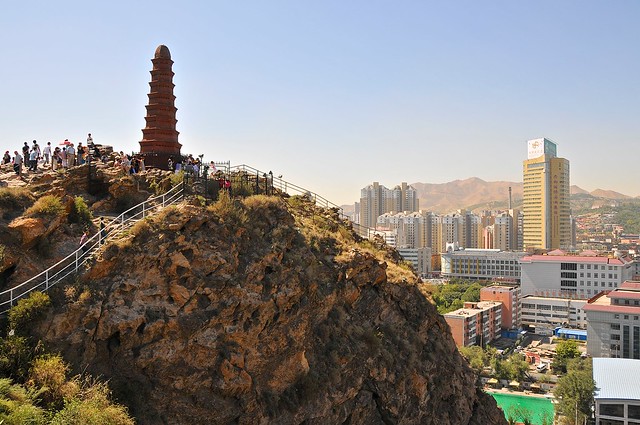
Pagoda on the western edge of Hong Shan (Red Rock) park. Unsurprisingly, all of the parks are Han style. You can see lots of tourists taking pictures by the pagoda, which is the highest point in the park and city centre. I saw a Uyghur man stand in front of a Han Chinese family so their picture couldn't be taken, then pretend not to understand Mandarin when they rather politely asked him to move.

photo 23
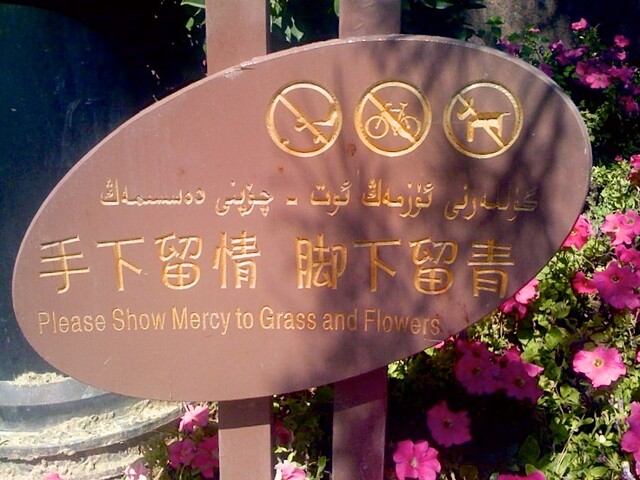
Chinese signs of this nature are often quite poetic, but I wonder about their efficacy since empathy doesn't seem to be a Han strength.

_DSC8373
Looking southeast from Hong Shan park. Urumqi is on the northern edge of the Tian Shan mountain range that runs from Kyrgyzstan all the way through north-central Xinjiang to the edge of Gansu.

Sunday, 19 August 2012

Turpan & Jiaohe

The Turpan depression is the lowest point in China, and the second lowest in the world after the Deadd Sea, at 155 meters below sea level. It's also the hottest place in China, with a recorded high of 48°C.
Turpan was also my first exposure to Xinjiang, even if it was almost 800 km from the border with Gansu. As the bus from Dunhuang was ultimately headed for Urumqi, I was dropped off at the northern end of town, where the highway clips the edge of town.
I had no idea where I was but started walking south along a major road. I eventually reached town, but even at 8:00 in the morning I had to stop a few times to cool down. After walking around the center of town for a bit, I headed to the Turpan Hotel—which was supposed to have dorms—hoping that they still accepted foreigners. It took a while for the English-speaking attendant to show up, but she said I would be able to check in later—I think they accepted foreigners because they were a large three-star hotel that also hosted tour groups in their main hotel operations.
When I checked in that afternoon, I discovered that the dorms were actually located in the basement of a side building whose entrance was to the right of the main hotel entrance steps. Lots of people seem to complain about these dorms, but in my mind they were actually pretty good: 3 beds in an air-conditioned room with a TV and attached bathroom featuring a western toilet, and daily cleaning from hotel staff, all for the typical hostel price 50 yuan per night. Given that hostels usually lack AC and are much dirtier, being in a fairly dark and humid room (there was window high up on the wall, but always closed since people tend to use AC instead) was fine with me, especially since I didn't plan on being there that much.

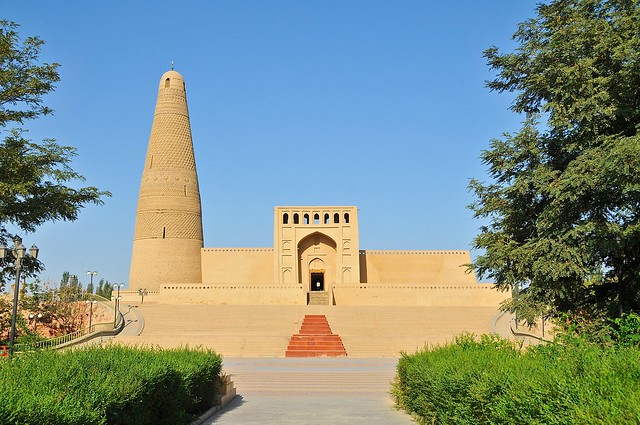
Emin Ta Minaret aka Sugong Ta

After dropping my bag at the hotel, I decided to see one of the major attractions in Turpan: the Emin Ta Minaret.

You can take bus 1, 6, or 102 to get there. I took bus 6, which takes back streets and drops you off near the rear entrance to the mosque. I ended up walking all the way around to the front entrance because I couldn't read the signs pointing out the shortcut access, which seemed to indicate it was an exit only. It was a pleasant walk through empty backstreets bordering on grape fields, and much more interesting than simply being dropped off directly at the entrance.

Anyway, a bigger problem is that Lonely Planet calls it Emin Ta—and only gives the Chinese characters for Emin Ta—when everybody local calls it Sugong Ta and the signs and buses only use this name (苏公塔). This makes it kind of tough to tell if you're getting on the right bus, not least since the buses don't all seem to have numbers on them.

The back roads that bus 6 takes you over is a nice introduction to Xinjiang, however, as you pass through dusty streets lined with mud-brick houses—all very monochrome and Central-Asian looking. Between this kind of architecture and the poplar trees, this is the sort of landscape I was expecting, and hoping, to see in Central Asia. Dunhuang may have offered a taste of it, but this is where it really felt like the Silk Road was beginning.

_DSC8139
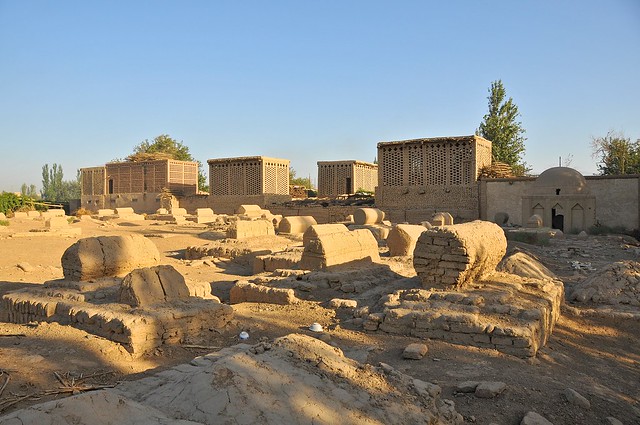
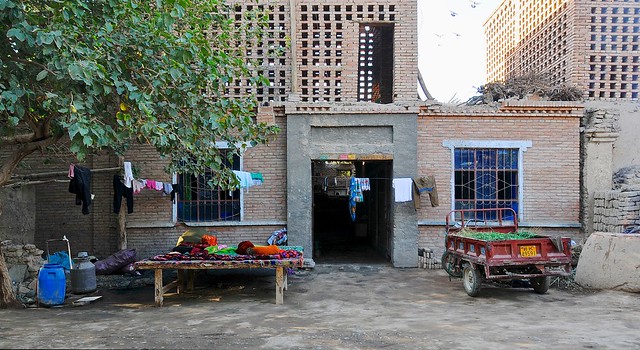
Muslim cemetery near Emin Ta, with typical Turpan lattice-brick grape-drying houses in background.

_DSC8141
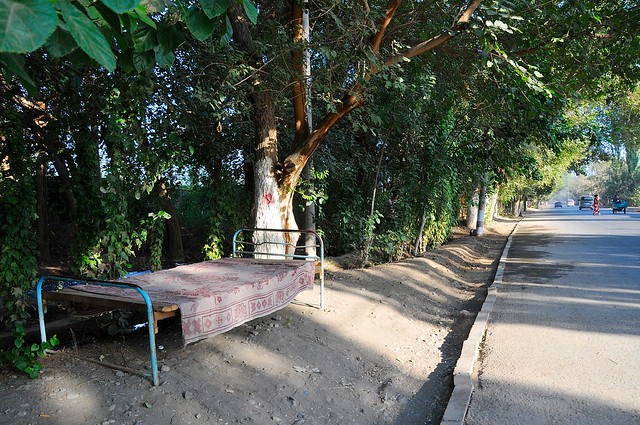
Beds in front of houses and in the streets are a common sight in scorching-hot Turpan.

_DSC8142
Living quarters below, grape-drying on top, and sleeping platform out front.

_DSC8144
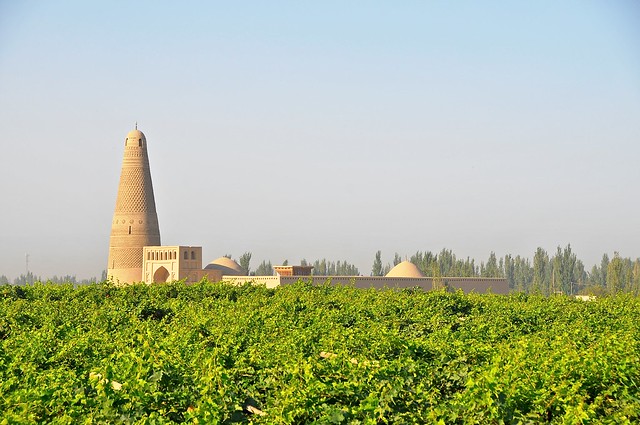
View of Emin Ta over grape vines.

_DSC8149
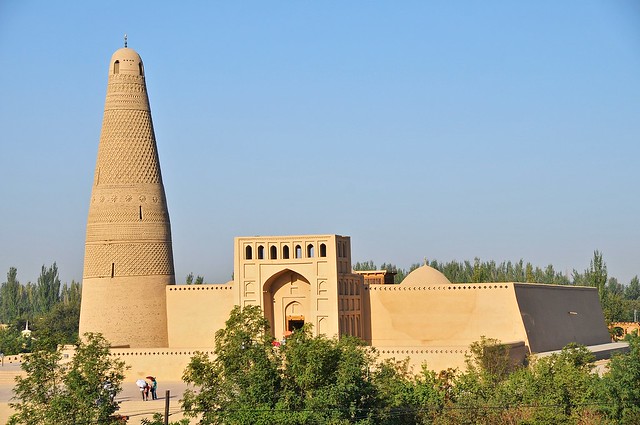
The minaret is 44 meters high and richly ornamented with decorative brickwork.

_DSC8151
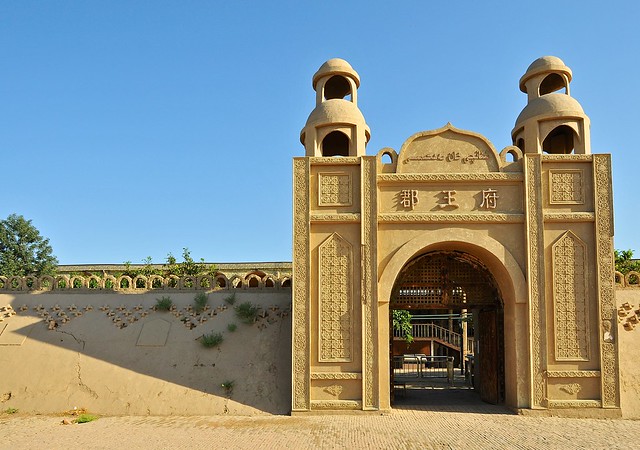
Modern admission gate to the mosque complex.

_DSC8152
Below the mosque's main entrance.