Showing posts with label Beijing. Show all posts

Tuesday, 10 July 2012

The Trans-Mongolian from Beijing to Ulaanbaatar

Mongolia was one of the major reasons why I chose to travel to Asia, and the trans-Mongolian was a definite must-do on my visit to Mongolia. Although the train isn't cheap, it is significantly cheaper to buy the tickets yourself than to go through an agency—and it's not like the limited flights into Ulaanbaatar are exactly cheap, either. While you can cut costs even further by taking local trains to Erlian/Erenhot on the Chinese border, crossing the border by car, and then taking local trains from Zamyn-Uud on the Mongolian border to UB, this is a real hassle and not a great introduction to Mongolia (I did this on my return to China, and I can confirm that it's not much fun and would have sucked even more if it was my introduction to Mongolia).

Ticket classes and buying them in Beijing

Chinese, Russian, and Mongolian trains operate the trans-Mongolian. The Russian trains are part of the Moscow-Beijing network, while the Chinese and Mongolian trains run exclusively between Beijing and Ulaanbaatar. Mongolians run the same rolling stock as the Russians, while Chinese run a different set of carriages.

Ticket classes

Russian-made Mongolian trains have two classes on the Trans-Mongolian:
  • Spalny Vagon (SV): two-berth compartments. No showers, and toilets and hot water at end of carriage.
  • Kupe: four-berth compartments. No showers, and toilets and hot water at end of carriage.
Chinese trains have three classes:

  • Deluxe: two-berth compartments with a shower shared with the neighbouring compartment. Toilets and hot-water dispensers are at the end of the carriage.
  • Soft sleeper: four-berth compartments that are slightly nicer versions of the four-berth hard sleepers, at a much higher price. No showers, and toilets at the ends of each car. Hot water boiler at one end.
  • Hard sleeper: four-berth compartments with doors that close and lock (i.e., not your typical Chinese hard sleeper). The cheapest type of ticket, and the best value. No showers, and shared toilets at the end of each carriage. Hot water dispenser at one end.
Hard sleeper/kupe is the best value, and the Chinese-only soft sleeper would be the worst value.

All compartments have doors that close and lock. Safety is unlikely to be a problem as almost all passengers are tourists and/or relatively wealthy, as the train is much more expensive than local trains. Only passengers who are crossing the border are allowed on the train, so you do not get local traffic; locals will cross the border by bus/jeep and take the much cheaper local trains.

The second-class compartments do not appear to have air conditioning (at least my Russian/Mongolian rolling stock didn't), but this was not a problem despite it being the height of summer.

I bought my tickets in Beijing. Despite it being the height of the tourist season and despite taking the train scheduled to arrive on the first day of Naadam, I had no problems booking my ticket only a few days before departure, and there only ended up being one other person in my compartment. You probably don't have to worry about booking your tickets in advance, and you can save money by booking in Beijing.

Schedules

The Russian trains, running between Beijing and Moscow, leave Beijing every Wednesday at 11:22 am and arrive in UB at 2:20 pm the next day. heading towards Beijing, they leave UB at 7:15 am on Sunday and arrive in Beijing at 11:40 am on Monday. Because UB is an intermediate stop on this train, it is more difficult to book a ticket leaving UB on this train, and you may not be able to book it more than 24 hours in advance.

The Chinese and Mongolian trains are more complicated, and for two reasons: first, they run one weekly UB-Beijing service year round, and add another weekly service in the summer; and second, they switch who runs the year-round and seasonal service every May, and also switch the days on which they run them!
  • Until May 2015
    • Year round service: operated by Mongolians. Leaves Beijing on Saturdays at 8:05 am and arrives in UB at 1:20 pm the next day. Leaves UB on Thursdays at 7:15 am and arrives in Beijing at 2:33 pm the next day.
    • Summer service (late June-early September): operated by Chinese. Leaves Beijing on Tuesdays at 8:05 am and arrives in UB at 1:20 pm the next day. Leaves UB on Fridays at 7:15 am and arrives in Beijing at 2:33 pm the next day.
  • May 2015-May 2016
    • Year round service: operated by Chinese. Leaves Beijing on Tuesdays at 8:05 am and arrives in UB at 1:20 pm the next day. Leaves UB on Thursdays at 7:15 am and arrives in Beijing at 2:33 pm the next day.
    • Summer service (late June-early September): operated by Mongolians. Leaves Beijing on Mondays at 8:05 am and arrives in UB at 1:20 pm the next day. Leaves UB on Saturdays at 7:15 am and arrives in Beijing at 2:33 pm the next day.
As always, seat61.com has comprehensive coverage.

Where and how to buy in Beijing

Tickets are sold not at the train station, but at the CITS (China International Travel Service) office in the Beijing International Hotel, which is a few hundred meters north of Beijing Station (where the trains actually leave from).


Prices are as follows, and only cash is accepted (there is an ATM in the hotel).
  • Deluxe/SV: 2241/2202 yuan
  • Soft sleeper: 2056 yuan
  • Hard sleeper/kupe: 1430/1472 yuan
It's pretty painless to buy your tickets. Simply go into the Beijing International Hotel, and look for the CITS office on the ground floor. Show them your passport and purchase your ticket. It takes maybe 10 or 15 minutes, and they speak English.

Scenes from a train

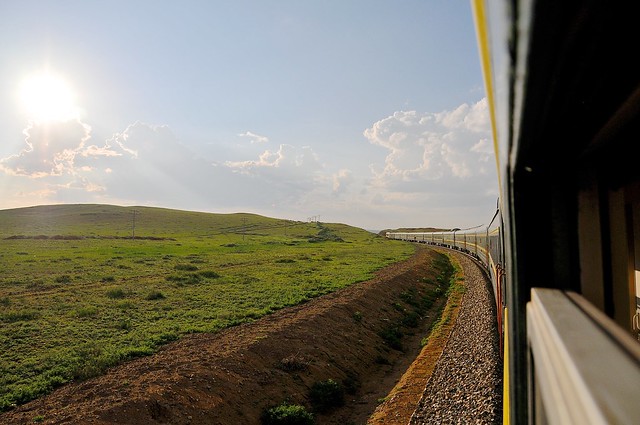
Between Beijing and Datong the scenery is peppered with small, rocky, and arid mountains. After Datong the train heads north, and soon you're on the Inner Mongolian plains.
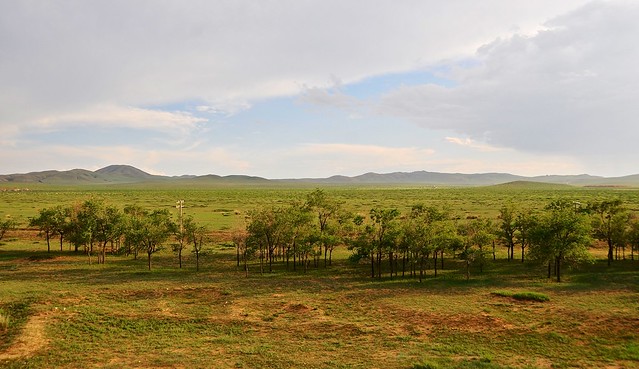
_DSC4179
Entering the Inner-Mongolian steppes.

_DSC4183
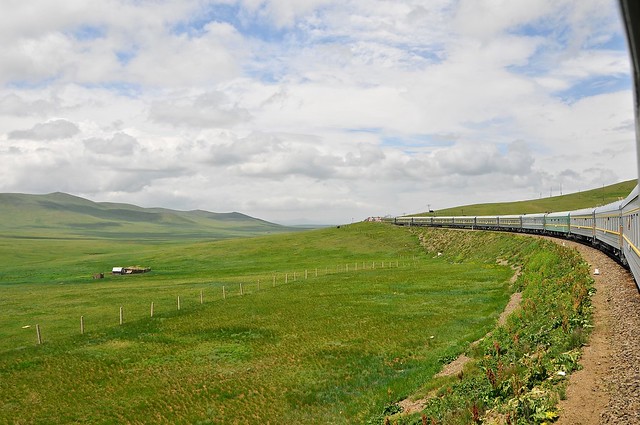
Taking a curve.

_DSC4184
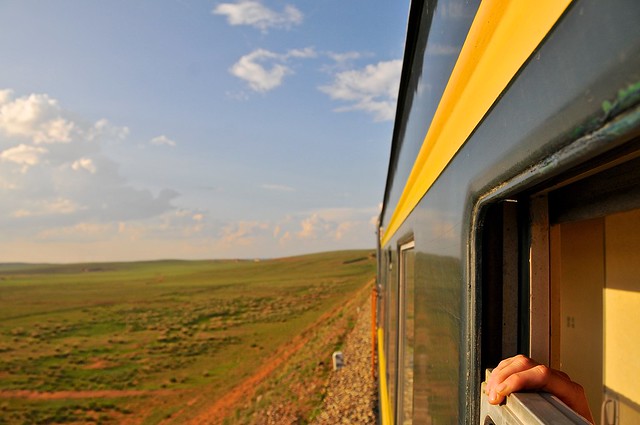
There's no air conditioning, but it gives you an excuse to stand by the windows.

_DSC4212
A dusty sunset as we near the Gobi. For much of it's territory, the Gobi isn't so much a desert as an arid grassland, and only 3% is covered by sand dunes. It didn't feel that dusty, but after this I had to clean lots of dust from my lens.

_DSC4216
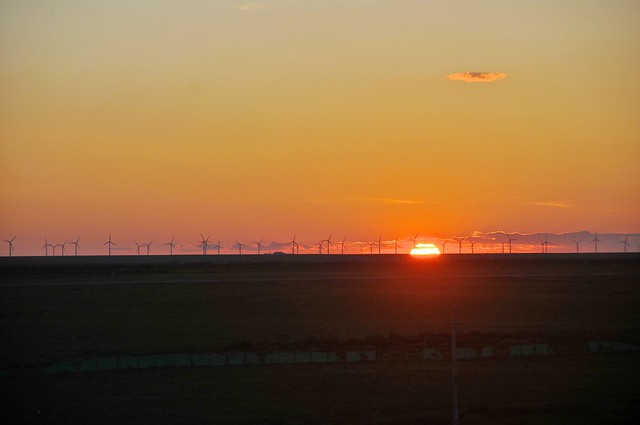
Sunset over wind farm.

_DSC4218
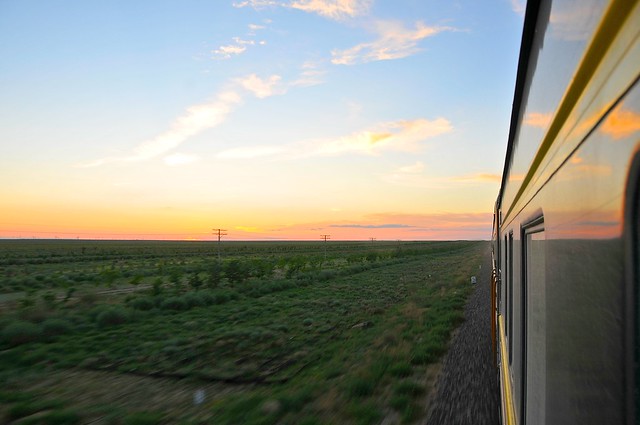
Even after the sun goes down the light lingers, as we speed on.

Erlian (aka Erenhot)

The final stop in China is Erlian. Actually, the city is known as Erenhot, even though the name of the station is Erlian—search for Erlian on maps, and you'll find nothing, but search on train schedules for Erenhot and you'll also find nothing.

Anyway, there's a long stop in Erenhot/Erlian. Your passports will be collected for customs, and then you'll have the opportunity to get off the train while the change the bogies (wheel sets) from the Chinese gauge to the Russian gauge. This takes a few hours, and while you can stay on the train durting this process, almost no one does. There's a supermarket-style shop in the station where they sell lots of snacks at low prices (sometimes even cheaper than in normal Chinese and Mongolian shops), but make sure to save some yuan if you're returning to China as you may need some to pay customs fees if you re-enter China via car.

You can get out and walk around the station, and I spent some time walking a few blacks away to see a bit of the city.
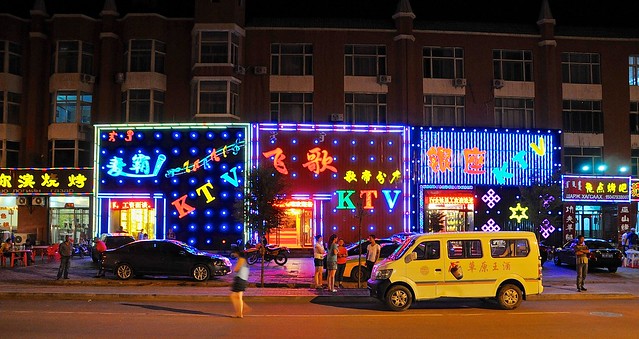
_DSC4225
KTV: everyone loves karaoke.

Mongolia

It's well after midnight by the time the bogies are changed and you can get back on the train in Erlian. Get settled in and wait to get your passports back, and it will be after 1:00 in the morning before you get to sleep. I need my eight hours, so it had been light for a while by the time I was up and about. And while the Mongolian plains may be pretty featureless, I love prairie and steppe.
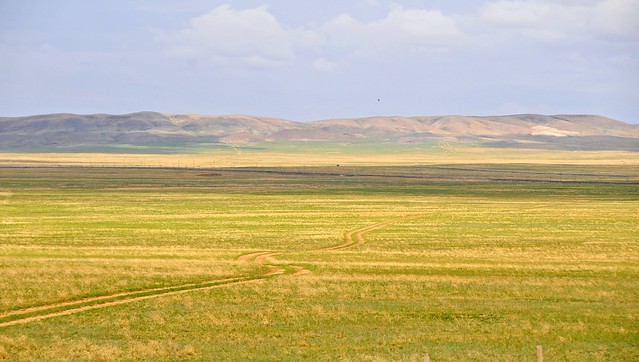
_DSC4236
Road along the Mongolian steppe. Almost none of Mongolia's roads are paved, and the first paved road from UB to China wasn't completed until 2013!

_DSC4240
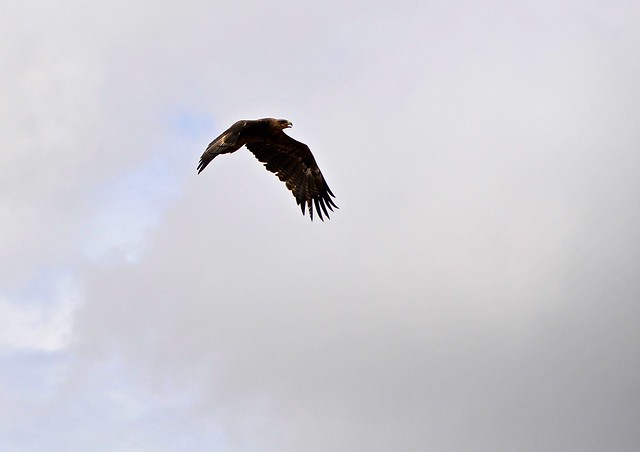
A Golden Eagle, or just a hawk? I don't know, but it kept the train company for a while.

_DSC4244
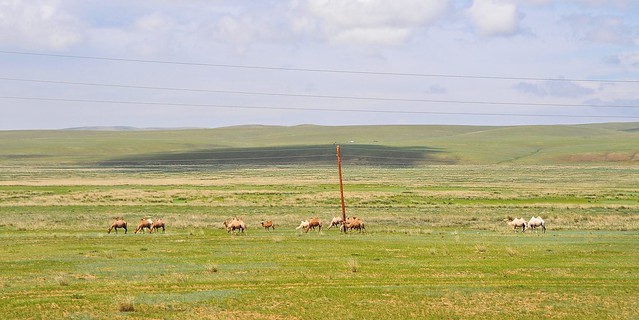
Two-humped Bactrian camels.

_DSC4250
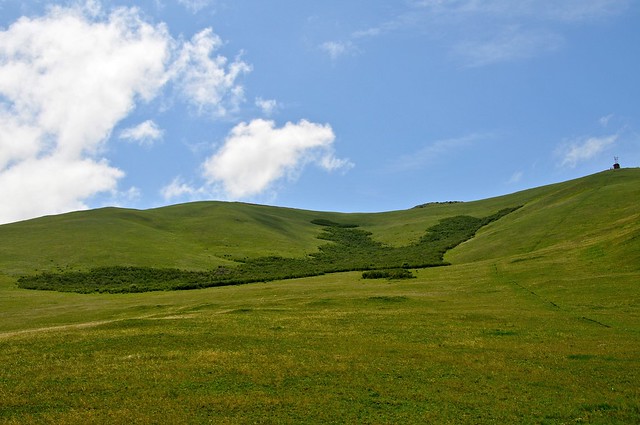
Closer to Ulaanbaatar the landscape is greener and lusher than I expected.

I was surprised to find that Mongolia was very similar to China in one unexpected way: the amount of garbage strewn next to the train tracks. This was unexpected not only because of the relative paucity of train traffic, but also because I had imagined that the Mongolians, who are deeply connected to nature and the environment, would be better environmental stewards than the urbanized Chinese. Not so.
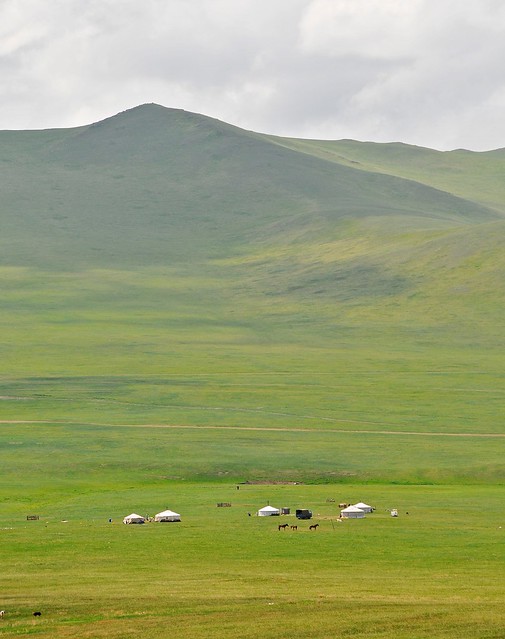
_DSC4251
Gers, horses, and a truck... but no sheep or goats in the vicinity.

_DSC4248
Green hills and bush. The grass everywhere is short, but I didn't see any herds of mammalian lawn-mowers along the way.

Ulaanbaatar's train station isn't in the greatest location, as it's a fair ways west of the city center and south of the major east-west commercial thoroughfare of Peace avenue. I had booked into the nearby Idre Guesthouse, mainly based on its location, as it is a short 10-minute walk away; I was off the train, checked in, and ready to start exploring the city within an hour.

Saturday, 7 July 2012

The Great Wall at Mutianyu by public bus


There are a few places near Beijing where you can see the Great Wall, all with their pluses and minuses. The closest, most famous, most heavily restored, and busiest of them is Badaling. You can get cheap tours that go here, but many of them spend little time at the wall and lots of time at souvenir shops where you're pressured to buy stuff. The second most popular and restored place is Mutianyu, which is supposed to be a decent compromise between accessibility, authenticity, and popularity. While there are less restored and more secluded areas of the wall, they are also much harder to access as a solo traveler.

When I went to Mutianyu, it was possible to go all the way there by public bus, via bus 867. Although it did not run during the winter, it was possible to go from the terminal outside Donzhimen station all the way to the base of Mutianyu. Sadly, that service seems to have been eliminated in July 2014.

What remains is the express bus 916, which is faster and runs all year round, but doesn't go all the way to Mutianyu. Instead, it drops you off at Huairou, which is about 20 minutes away from Mutianyu. From Huairou you can share a car or minivan to Mutianyu for about 20 yuan per person, or you can take bus 936 and get off after the 8th stop (but be careful because it's not the final stop). Bus 916 runs every half hour or so from Dongzhimen's Public Transfer hub, which is a covered indoor terminal accessible from inside Dongzhimen station, and costs 12 yuan.

In all honesty, the need to transfer to a minibus or private car would change the calculus on where I would go: it was so much simpler with the 867 direct bus. Now, I would probably consider going to Simatai or Jinshaling, both of which are as easy as the new 916 + car route. It takes longer to get there, and you can't really make them a half-day trip, but they are said to be more interesting and photogenic than Mutianyu.

The Great Wall Experience at Mutianyu

Once you're at Mutianyu, you really have to wonder just how bad Badaling is, if this is considered the less-touristed location: there's a cable car you can take to the top of the mountain where the wall is located, and a toboggan ride you can take down from the summit. It's not a particularly long or hard walk up to the wall—stretches of the wall are actually steeper—and once you reach the wall you find lots of vendors selling souvenirs but mainly things like beer and soft drinks, as well as chocolate bars and snacks. It's hot and humid, and unless you want to pay multiples of what you should pay, be sure to bring your own water and drinks from Beijing.

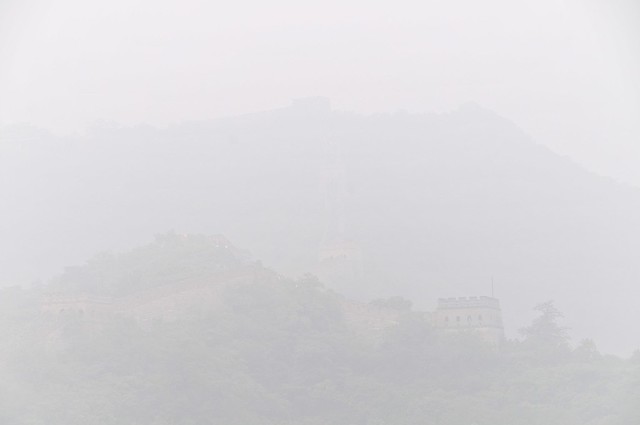
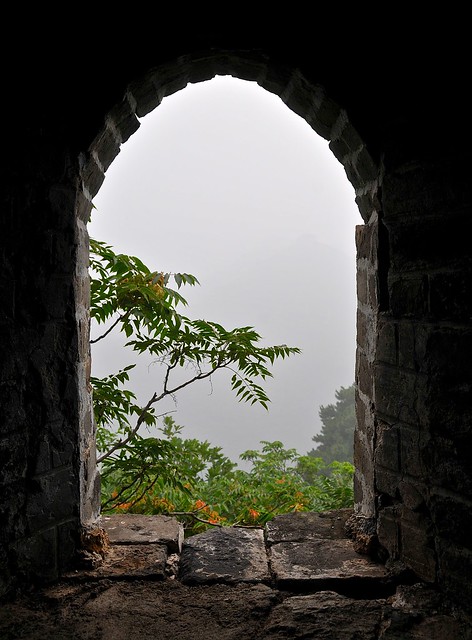
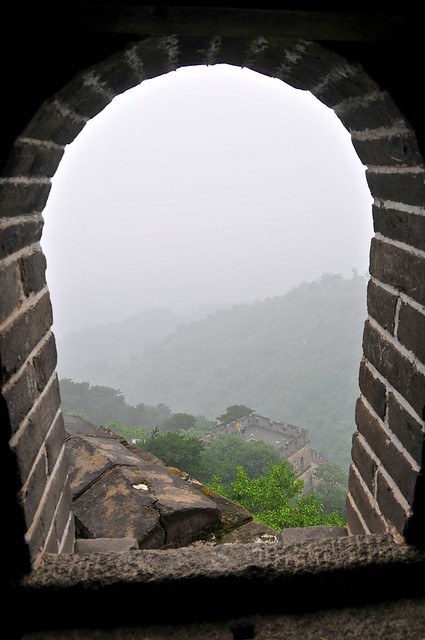
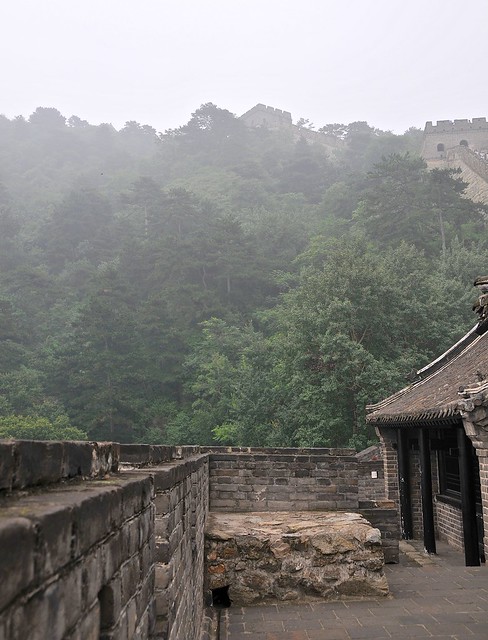
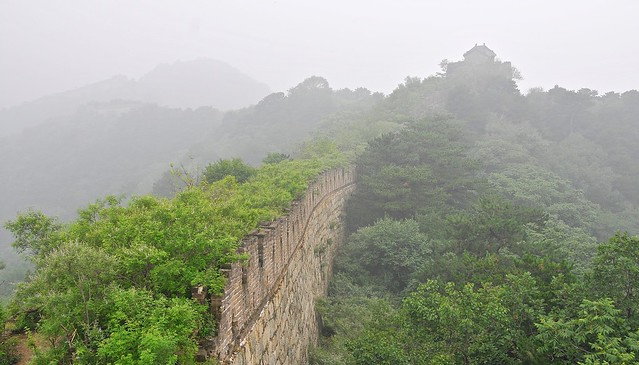
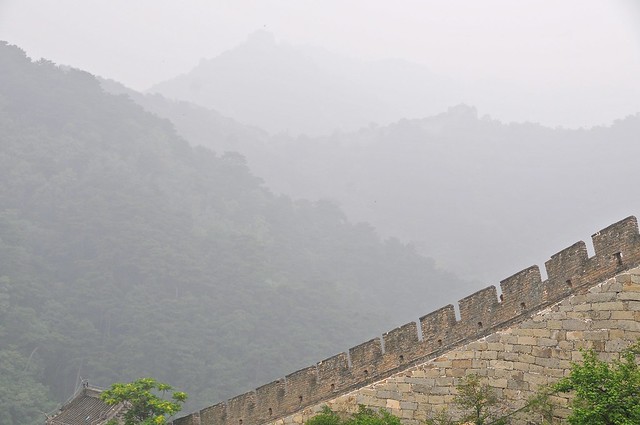
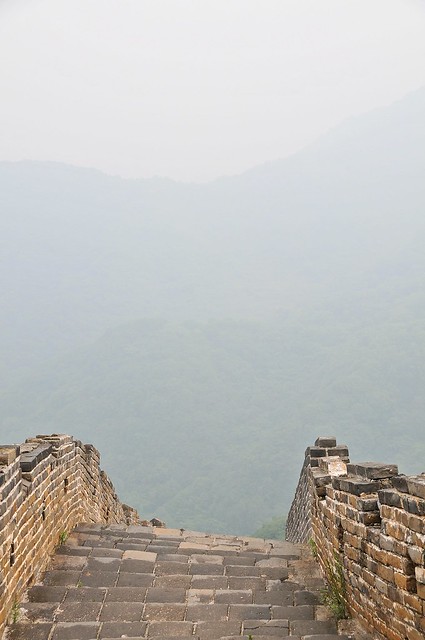
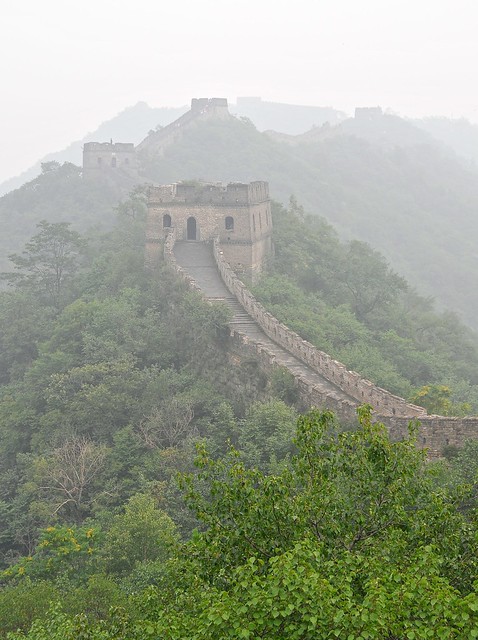
The smog that plagued Beijing was no better at Mutianyu, where visibility and contrast were in short supply. While light smog might be atmospheric, the conditions were pretty ridiculous.

_DSC3948
A dog relaxes at the base of Mutianyu.

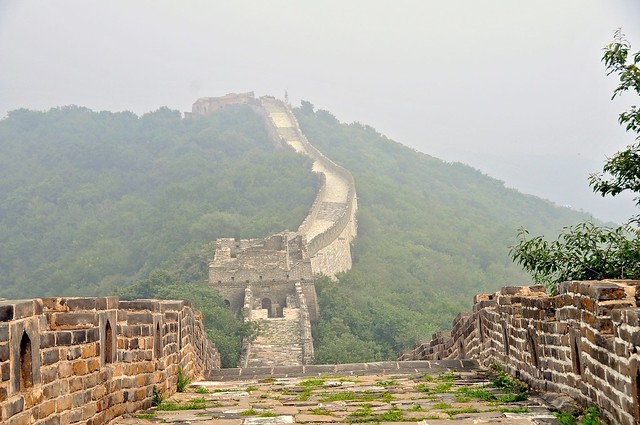
_DSC4005
I wonder what it looks like on a clear day—believe it or not, but there are actual towers in this picture.

_DSC3959
And a landscape in the fuzzy white background.

_DSC3958
At least you can see something more than 5 meters away in this one.

_DSC3955
Looking up towards the eastern terminus of the restored wall.

_DSC3970
The eastern limit of the wall, overlooking the unrestored and overgrown sections of the wall.

The eastern section of the wall is by far the busiest section. There were a lot of obnoxious young Western tourists there, doing their best to perpetuate the stereotype of the Ugly American. Shirtless guys, everyone talking really loudly and obliviously; the usual lack of consideration. In all honesty I was kind of happy to see them, as a reminder that Westerners can be every bit as inconsiderate and grating as the Chinese are.

It also gave me some insight as to what sorts of things the loquacious Chinese might be talking about with the strangers they chat with: if they're anything like these Americans who had been thrown together on this sightseeing expedition, they talk about nothing more consequential than the Chinese equivalent of college sports and their favourite TV programs (very topical when climbing the Great Wall, I'm sure).

_DSC3991
The cable car and pathway deposit you at the bottom of this section of the wall.

_DSC4030
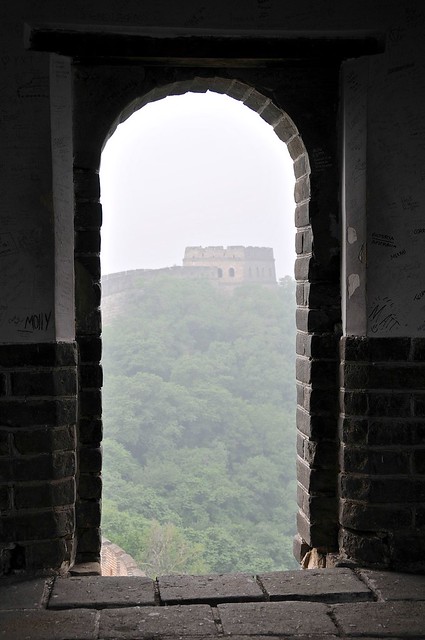
Looking out from a guard tower.

_DSC4073
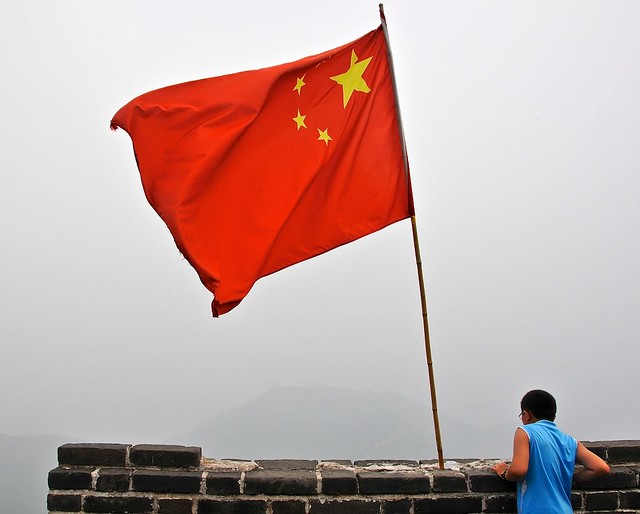
 One of the vendors at the top of a steep section had a Chinese flag, and would offer to take your picture for free. It was a good ice-breaker and goodwill generator.

_DSC4070
Top of the hill gives you a good view of the haze.

_DSC4084
This was the other end of the restored section. No one was here because it was the top of a long climb and most people don't have enough time to go that far.

_DSC4093
On the way back.

Thursday, 5 July 2012

Fear and Loathing in Beijing

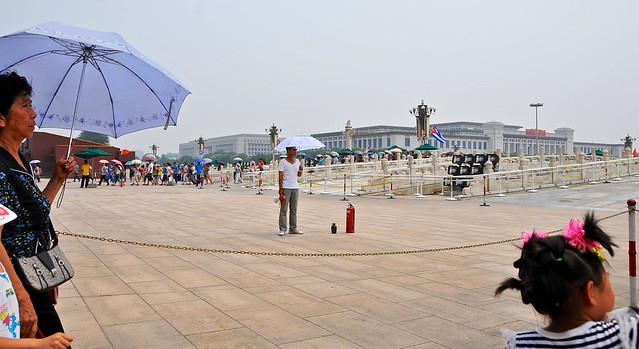
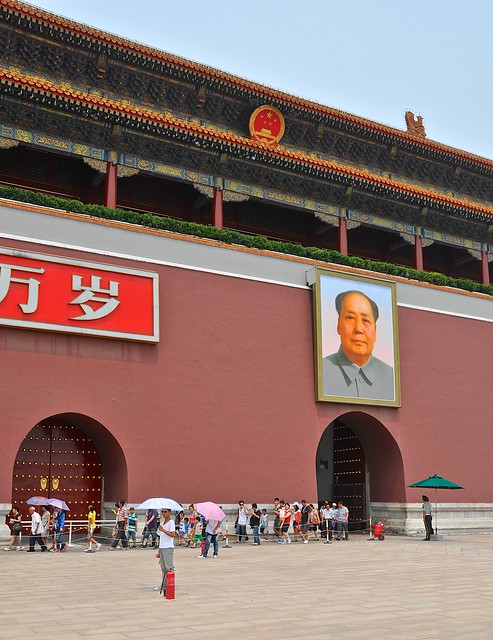
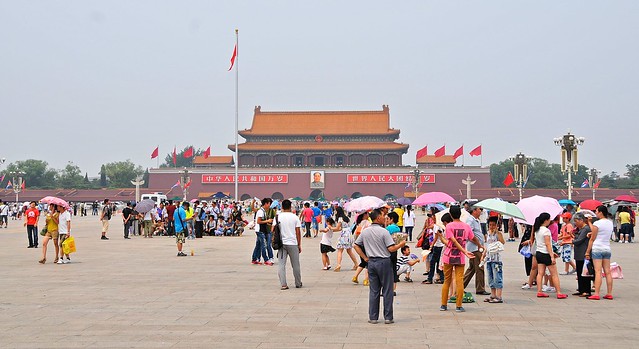
Fear, paranoia, and suspicion are everywhere in Beijing. X-ray machines in subway stations. Scores of plainclothes policemen in Tiananmen square, which contains numerous official police security stations but no place for people to sit or congregate comfortably. Security officers with fire extinguishers next to the Tiananmen Gate and it's monumental portrait of Mao, in anticipation of Tibetan self-immolators. It's clear the government is worried, fearful of internal dissent from Tibet and Xinjiang, fearful of any organized uprisings against the government for any reason whatsoever—be it lax responses to earthquakes, as in 2008; train crashes as in 2011; or any of the scores of cases of local corruption that occur every year. The government lives in fear of its citizens, and this fear is as palpable as the US fear of terrorism. But unlike the US fears, which manifest themselves mainly when flying, reminders of Beijing's fears are omnipresent.

_DSC3432
Making sure no one sets themselves on fire.

_DSC3433
Because it would look bad for this to happen before Chairman Mao. In order to minimize the chances of this happening, most of the area is roped off and the throng of people means you have to keep moving.

_DSC3435
It's difficult to imagine a less inviting public space than Tiananmen square. No respite from the sun, no place to sit, and plenty of plainclothes minders to keep an eye on you. There's definitely no lounging, dancing, or Tai Chi that goes on here, as it does in most other public spaces in China.

_DSC3442 - _DSC3444 equi
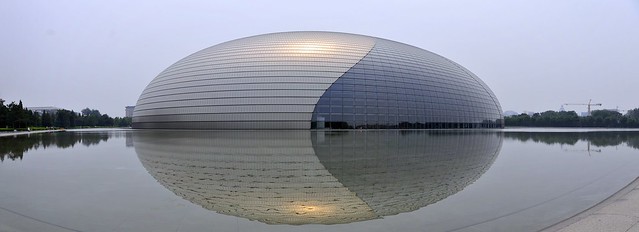
Paul Andreu's nearby National Center for the Performing Arts is just as sterile and non-functional as a public space, but at least people are allowed to gather if they so desire.

_DSC4155
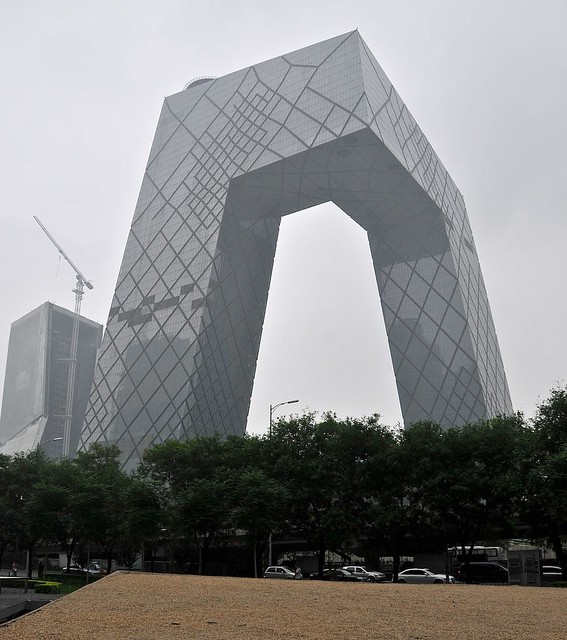
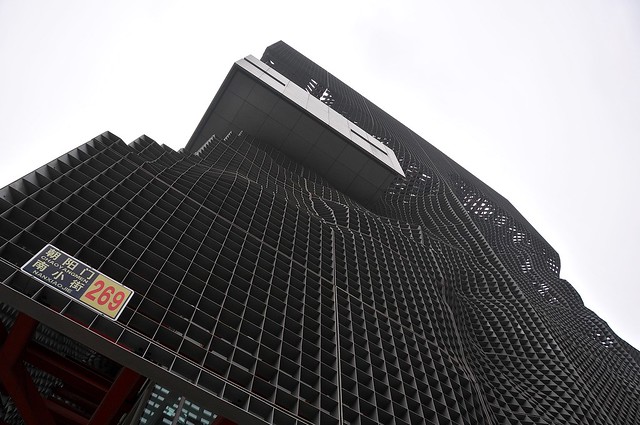
At the iconic CCTV building, by Rem Koolhaas, you can't even get near the building as there is strict security and fencing around the perimeter. This is definitely not architectural tourism like Gehhry's Guggenheim Bilbao or Disney Center. China may be the source of great commissions, but it must be disappointing to have an amazing building get built yet not have people fully enjoy it.

_DSC4128
The most accessible interesting architecture may be commercial buildings like this shopping mall west of the Forbidden City.

_DSC4158
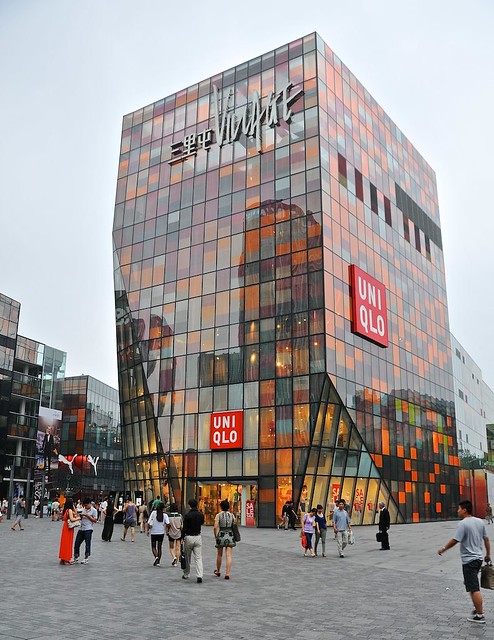
Or in the trendy students' area of Sanlitun. I love Uniqlo and this building was pretty cool, but the inside of the glass-curtain wall was black with streaks of dirty rain pollution.

Saturday, 23 June 2012

Gimpo to Beijing to Hong Kong on Air China

I flew Air China in 2004, when I was living in Japan. An Air China flight through Beijing was, by far, the cheapest ticket from Kansai back to Canada. After taking the flight, I understood why: the armrest on my seat was duct-taped to the frame, they played movies that had been pirated from cinema by handi-cam, and they used the overhead speakers instead of headphones. The food was really bad, even for airline food. And that's without even talking about the Chinese passengers who spit into their cups throughout the eight-hour flight to Vancouver.

Fast-forward to 2012 and Air China has improved to the point it's essentially indistinguishable from any other generic international carrier. Sure, it doesn't offer the service or amenities of a non-budget Asian or SE Asian carrier, but it gets the job done.

My flight from Gimpo to Hong Kong, booked 3 days in advance, cost $270. That seems kind of steep, but keep in mind that it involved over 5-and-a-half hours of flight time. Of course, this involved a stopover in Beijing, whereas a direct flight would clock in at almost exactly four hours. Even so, it still  seems pretty steep for the region, but that was the cheapest I could find at the time.

Gimpo is the smaller airport for Seoul, used mainly for shorter flights, while Incheon is used for long-haul international flights. Gimpo is connected by subway, while Incheon is connected by express and commuter trains, making them both pretty darn convenient, although Gimpo is closer to the city and very convenient if staying in Hongdae.

Gimpo feels a little quiet and lacks the bustle and (duty free) shopping outlets one expects in international airports, but it was perfectly functional and modern.

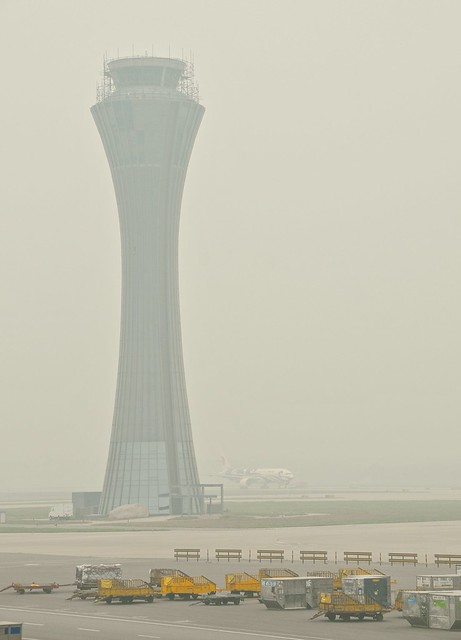
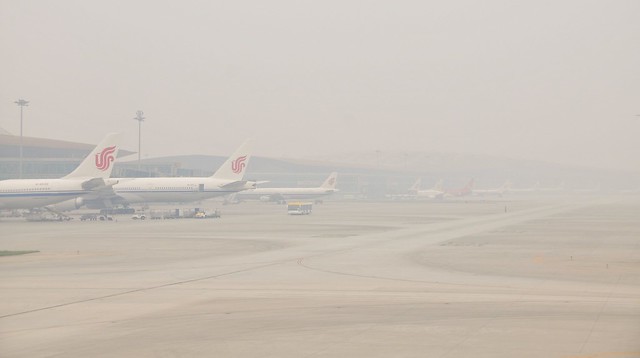
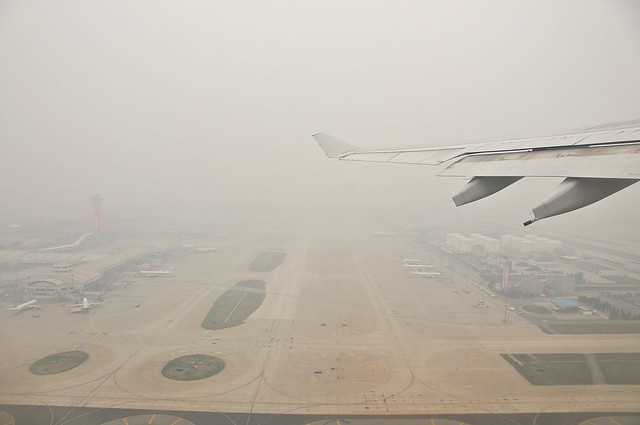
The smog at Beijing International seemed familiar from when I flew through there in 2004, but this time I have photographic evidence. It's pretty incredible, and I seriously doubt that the air-traffic controllers in their tower can always see planes that are on the runways or at the far ends of the terminal.

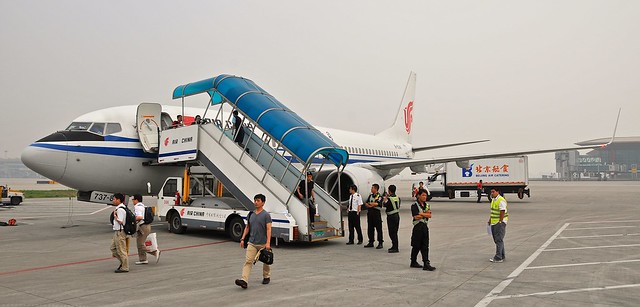
Deplaning in Beijing
Deplaning in Beijing.

Tower smog
The control tower is close, but already obscured by smog.

It's pretty ironic that I connected through Beijing on a flight booked so that I can receive a Chinese visa, especially since most nationalities can obtain a visa-free 72-hour stopover in Beijing so long as they have a connecting flight through the airport. So I ended up being stamped into China by immigration at the Beijing airport, while on my way to an embassy that would give me a visa so that I could be stamped into China.

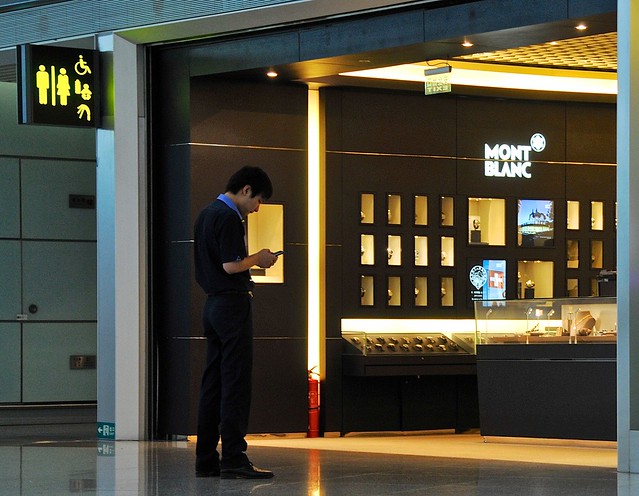
The terminal was virtually empty when I was there around noon, but the callow youth staffing the expensive luxury boutiques were doing their best to send text messages to their friends while ignoring the few people who did venture into their stores.

Montblanc attendant
Western brand, Chinese service.

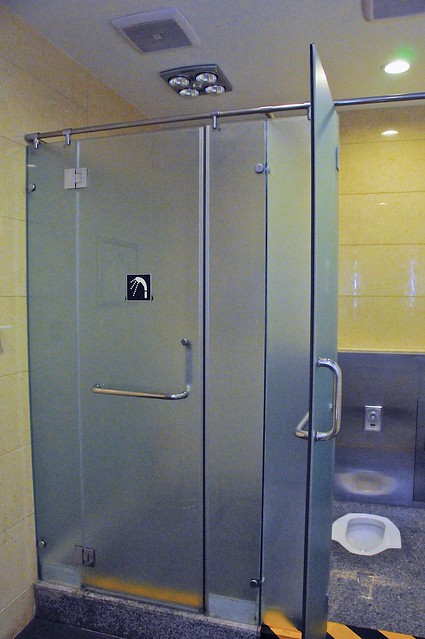
Showers in the airport
Free showers in the bathrooms, with heating lamps above! You've got to like that... but for some reason the bathrooms look much older than then airport.

Atmospheric perspective at Beijing airport
This is called atmospheric perspective, where things farther away are fuzzier and less well defined. It's usually seen between mountain ranges or hills that are farther and farther away, and not between airplanes at terminal gates.

Visibility on takeoff
Visibility on takeoff. Where does the terminal end?

Visibility in HK is slightly better...
Hmmm.... visibility is just slightly better in Hong Kong.

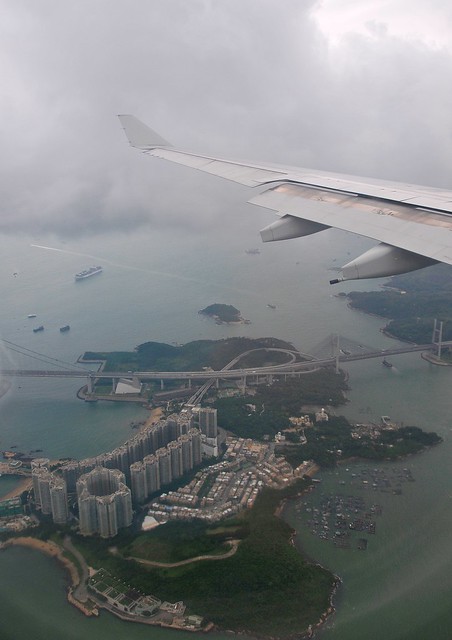
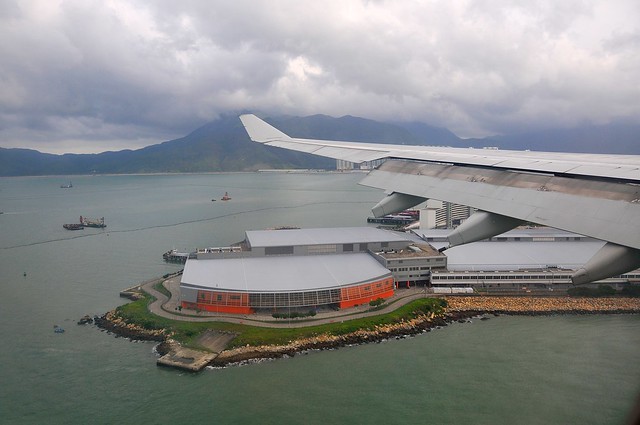
About to land
About to land on the airport's artificial island.

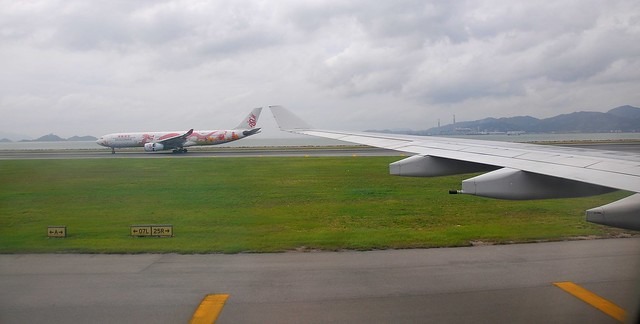
Touchdown.
The symmetry between our winglet and the other plane's tail is completely accidental.