Sunday, 19 August 2012

Turpan & Jiaohe

The Turpan depression is the lowest point in China, and the second lowest in the world after the Deadd Sea, at 155 meters below sea level. It's also the hottest place in China, with a recorded high of 48°C.
Turpan was also my first exposure to Xinjiang, even if it was almost 800 km from the border with Gansu. As the bus from Dunhuang was ultimately headed for Urumqi, I was dropped off at the northern end of town, where the highway clips the edge of town.
I had no idea where I was but started walking south along a major road. I eventually reached town, but even at 8:00 in the morning I had to stop a few times to cool down. After walking around the center of town for a bit, I headed to the Turpan Hotel—which was supposed to have dorms—hoping that they still accepted foreigners. It took a while for the English-speaking attendant to show up, but she said I would be able to check in later—I think they accepted foreigners because they were a large three-star hotel that also hosted tour groups in their main hotel operations.
When I checked in that afternoon, I discovered that the dorms were actually located in the basement of a side building whose entrance was to the right of the main hotel entrance steps. Lots of people seem to complain about these dorms, but in my mind they were actually pretty good: 3 beds in an air-conditioned room with a TV and attached bathroom featuring a western toilet, and daily cleaning from hotel staff, all for the typical hostel price 50 yuan per night. Given that hostels usually lack AC and are much dirtier, being in a fairly dark and humid room (there was window high up on the wall, but always closed since people tend to use AC instead) was fine with me, especially since I didn't plan on being there that much.

Emin Ta Minaret aka Sugong Ta

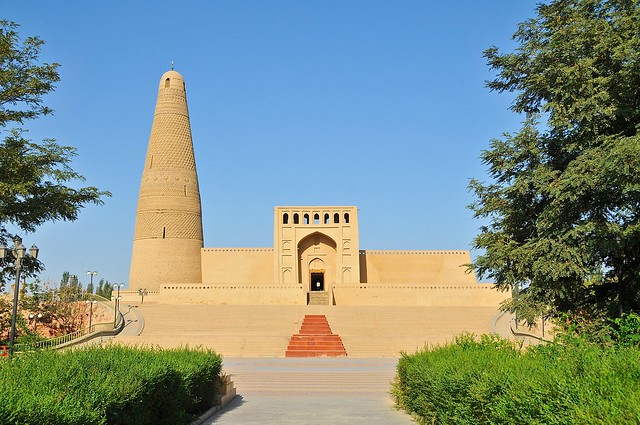
After dropping my bag at the hotel, I decided to see one of the major attractions in Turpan: the Emin Ta Minaret.

You can take bus 1, 6, or 102 to get there. I took bus 6, which takes back streets and drops you off near the rear entrance to the mosque. I ended up walking all the way around to the front entrance because I couldn't read the signs pointing out the shortcut access, which seemed to indicate it was an exit only. It was a pleasant walk through empty backstreets bordering on grape fields, and much more interesting than simply being dropped off directly at the entrance.

Anyway, a bigger problem is that Lonely Planet calls it Emin Ta—and only gives the Chinese characters for Emin Ta—when everybody local calls it Sugong Ta and the signs and buses only use this name (苏公塔). This makes it kind of tough to tell if you're getting on the right bus, not least since the buses don't all seem to have numbers on them.

The back roads that bus 6 takes you over is a nice introduction to Xinjiang, however, as you pass through dusty streets lined with mud-brick houses—all very monochrome and Central-Asian looking. Between this kind of architecture and the poplar trees, this is the sort of landscape I was expecting, and hoping, to see in Central Asia. Dunhuang may have offered a taste of it, but this is where it really felt like the Silk Road was beginning.
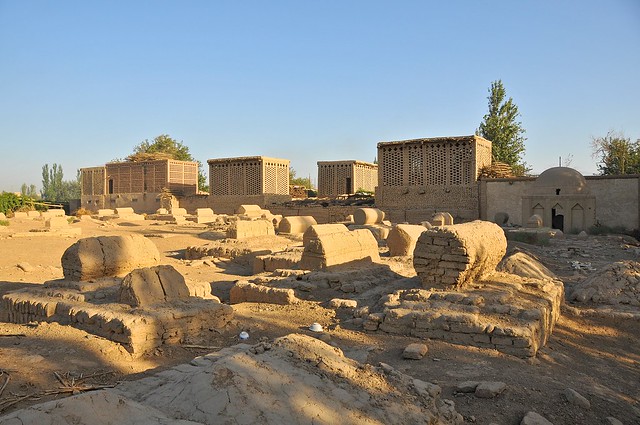
_DSC8139
Muslim cemetery near Emin Ta, with typical Turpan lattice-brick grape-drying houses in background.

_DSC8141
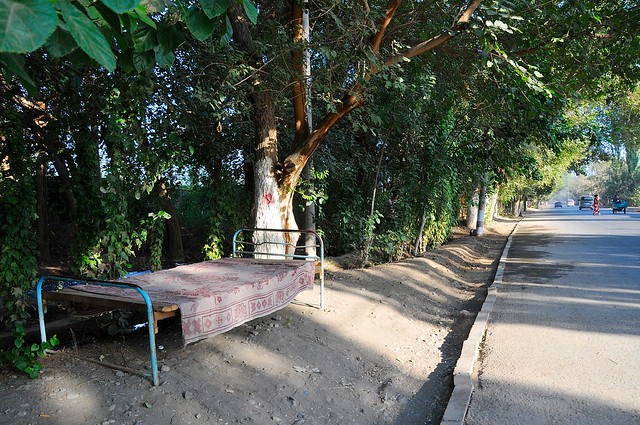
Beds in front of houses and in the streets are a common sight in scorching-hot Turpan.

_DSC8142
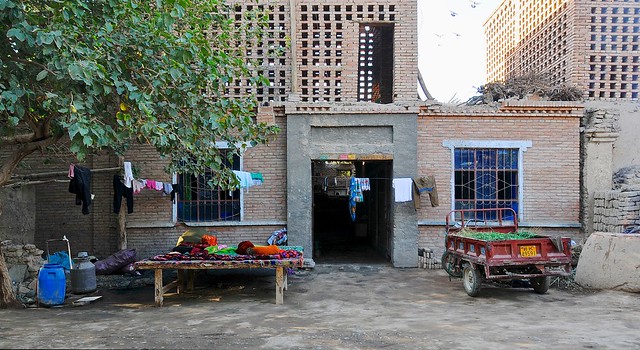
Living quarters below, grape-drying on top, and sleeping platform out front.

_DSC8144
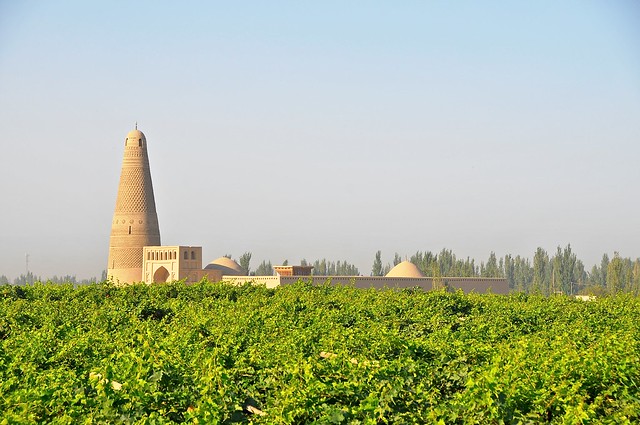
View of Emin Ta over grape vines.

_DSC8149
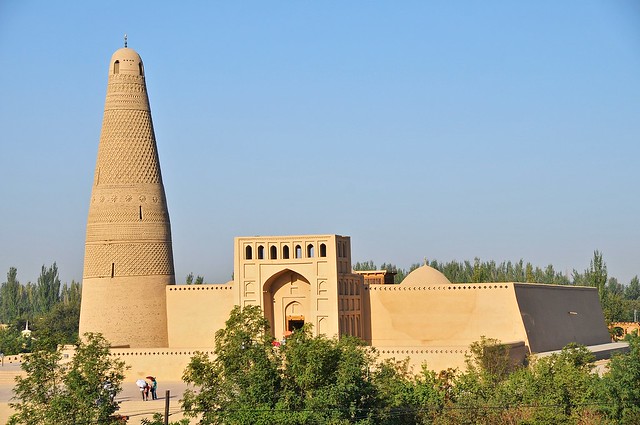
The minaret is 44 meters high and richly ornamented with decorative brickwork.

_DSC8151
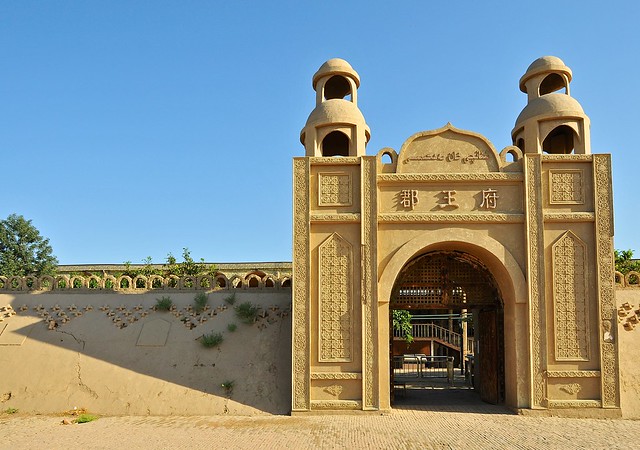
Modern admission gate to the mosque complex.

_DSC8152
Below the mosque's main entrance.

Friday, 17 August 2012

Unwinding in Dunhuang & Mogao

From Jiayuguan to Charley Johng's Dune Guesthouse

Standing-room tickets—which let you get on the train but don't assure you of a seat—are never fun, and are probably least fun when on a train leaving at three in the morning.

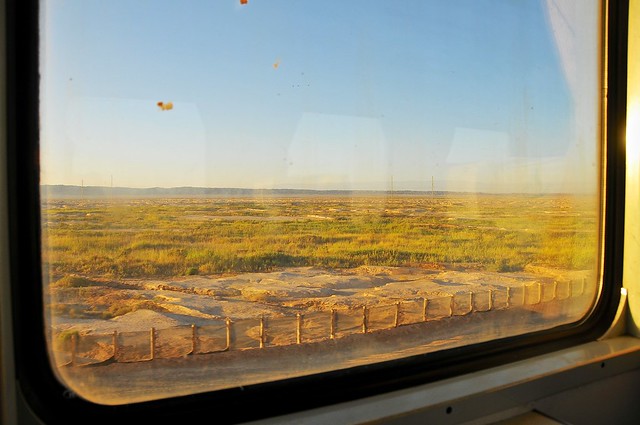
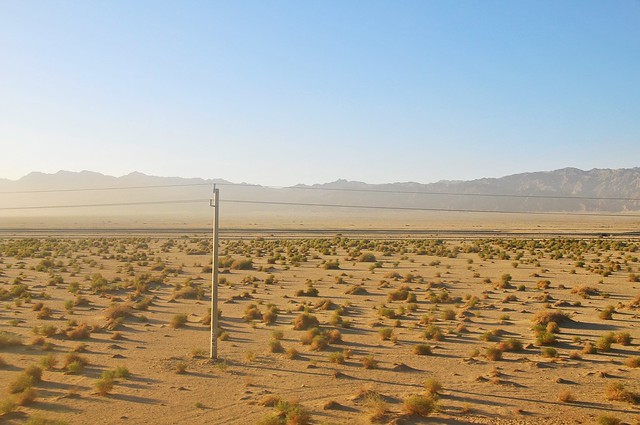
I was lucky enough to find a seat, but the car was full of people trying desperately to sleep on uncomfortable hard seats arranged facing each other, with garbage and spilled drinks littering the tables and floor. I managed to get a couple hours sleep, and when I awoke was able to enjoy the rising sun over the desert.

_DSC7701
Early morning on the night train.

_DSC7702
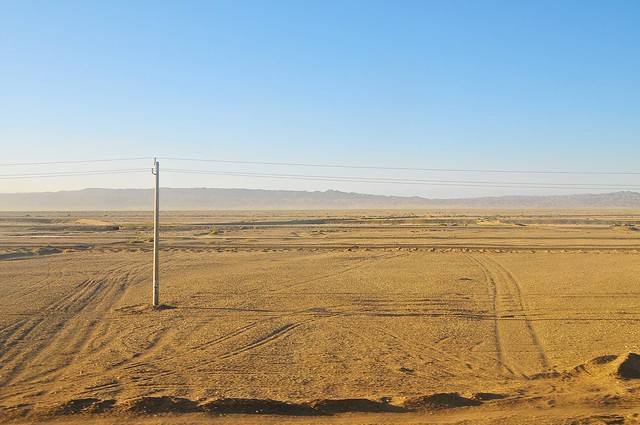
This is still part of the Gobi, just like it was way back in Shainsand, Mongolia.

_DSC7703
It makes you wonder what else you miss by traveling at night.

The train station in Dunhuang is some way east of the town, and when the train arrives there is a big rush and excited taxi drivers and touts. You can ignore them, as you can take a bus into town for about 5 yuan. Any of the green minibuses in front of the station will be going into town.

I decided to stay at one of the hostels by the sand dunes, and at the time Charley Johng's was the only one of the dune hostels listed in Lonely Planet. I went to the cafe of the same name in town to ask about both this dune guesthouse and his hostel in town, but the lady there said only the dune hostel had room. It turned out that this was basically a lie, and that in reality the hostel in town had been sold and was under different ownership, so all guests were directed to the dune hostel. You can take a green minibus to the dunes for about 3 yuan.

_DSC7705
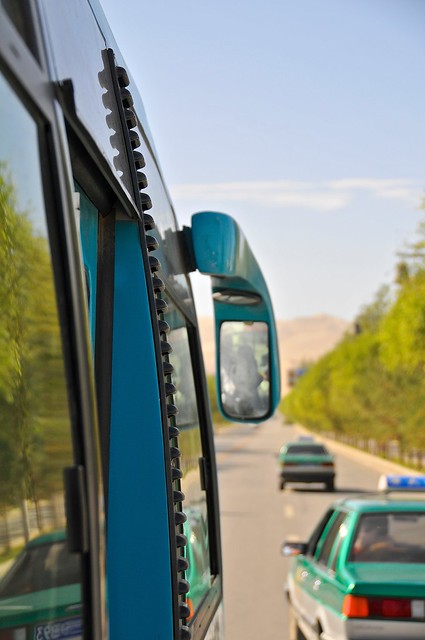
On the bus to the sand dunes.

_DSC7708
You take a few turns off the main road to get to Charley Johng's, but there are signs along the way.

_DSC7709
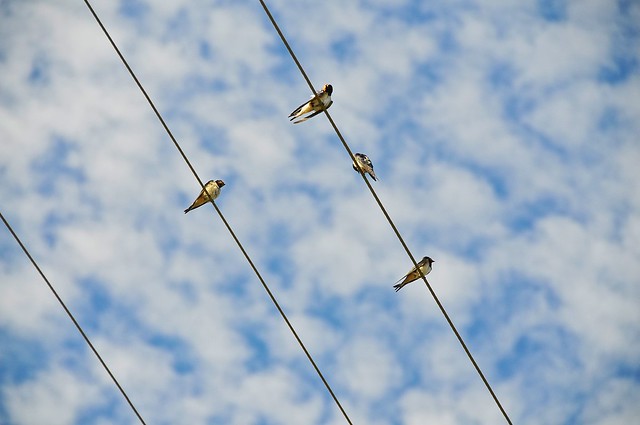
Birds on a wire.

_DSC7715
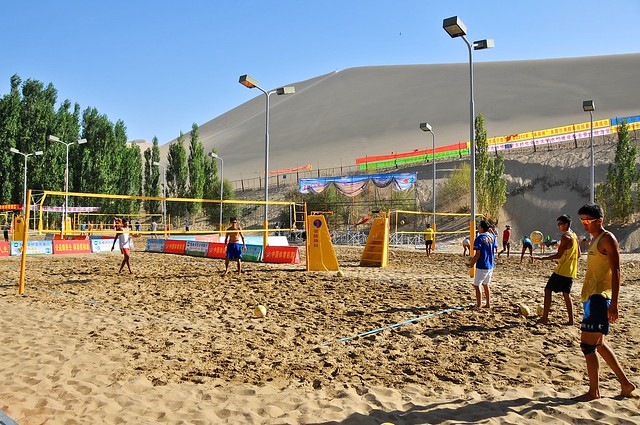
There's a volleyball court right next to the guesthouse.

The main thing going for Charley Johng's is the location. Other than that, it's not the greatest. The toilets are smelly and fly-infested, and the toilet-paper baskets are usually full and smelly. There are flies in the common areas, and not much hot water for showering. I was pretty unimpressed, but the location makes it convenient for seeing the dunes (especially if you're going to sneak into the park to see the sunrise)—if inconvenient for seeing the town.

Monday, 13 August 2012

Jiayuguan and the western end of the Great Wall

Xiahe to Lanzhou to Jiayuguan

There aren't any direct buses from Langmusi to Lanzhou, so you have to transfer in Hezuo. Some reports suggest that there are two different stations in Hezuo and that you might have to take a taxi between them, but I was able to transfer at the same station.

Arriving in Lanzhou, I thought I would probably have to transfer stations in order to get a train to Jiayuguan, but one of the drivers in the bus-station courtyard, before I could even make it into the station, said they could take me there. They weren't leaving for a few hours, and it was a night bus, so I left my bag with them and went out to explore the city for a few hours.

Lanzhou didn't make a huge impression on me. I saw an interesting mosque, but like most Chinese cities it seemed to be a temple to capitalism, with modern shopping malls quickly replacing anything that might have looked traditional. And although Lanzhou supposedly has the most polluted air in China, the air there was a lot clearer on both the times I was there than it was when I was in Beijing.

Although I returned about a half hour before the bus was scheduled to leave, apparently I was later than they wanted; when they saw me coming the rushed me onto the bus and we quickly left. This was my first sleeper bus. These buses have three rows of bunks, but you can't lie flat on them, as they have an inclined back and head area, with your feet going into a compartment below the head of the person in front of you. Although they're actually pretty good for sleeping, by the same token they're definitely not designed for people more than 6 feet/180 cm tall.

Typical sleeper bus configuration.

We arrived in Jiayuguan before dawn, which is to say sometime before 6:30 am, and since the bus didn't terminate in Jiayuguan we were dumped on the edge of town where the highway passed by. A taxi delivered us to the center early in the morning, and I wandered around looking for a place to stay. Like Lanzhou, however, nowhere would accept foreigners except for those that charged more than 160 yuan per night. That's too rich for my blood, so I decided to stay the day and take a train that night to Dunhuang. It's both frustrating and unsurprising that China appears not to want many foreigners to see the west of the country, with their crackdowns especially affecting budget tourists who are more likely to interact with locals and less likely to be taking tours.

In order to figure out what I was going to do I again had to rely on a friendly internet cafe to help me get online, and suss out train schedules and how to get to the station by bus. I made my way to the train station, bought the only kind of ticket they had left—standing room on a 3:00 am train—dropped my bag at the left-luggage room, and headed back into town to see if I could rent a bike at the Jiayuguan Binguan. After locating the hotel (there are multiple buildings in the same compound, so finding the right person to talk to was slightly difficult) and finding the right person, I was able to rent a bike. This was great, as biking to the sights was really a great way to see the sights and enjoy the landscape. It's too bad that more places don't rent bicycles in China, as it's a great way to explore and I used to rent bikes in SE Asia all the time. Step up your game, China! Oh wait, I forgot that they don't care about foreigners and no self-respecting, loaded Chinese tourist would ride a bicycle anywhere.


Fort Jiayuguan

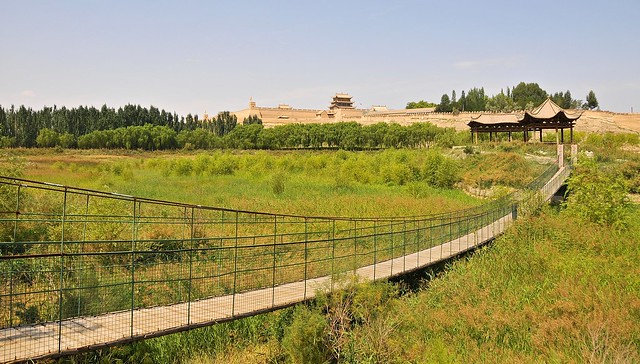
Fort Jiayuguan basically marked the farthest western extent of Ming China, strategically located at the narrowest point of the Hexi Corridor, and it's where the Great Wall ended. There are some pretty amazing pictures out there of the fort with snowy mountains in the background, and it's a pretty impressive sight at any time of the year.

_DSC7298
There's a park and pond just southeast of the fort. It's surprisingly unkempt for a Chinese park.

_DSC7303
As in Dunhuang, tourists can get rides in ultralight gliders to fly over the fort.

_DSC7309
Poppies at the base of the wall, from the south.

Jiayuguan Fort is surrounded by an outer wall and an inner wall. The outer wall, which you can see above, is fairly small, but encloses a much larger space than the inner wall. The inner wall is much more massive and encloses a much smaller area.

The inner wall and fort is the small box on the left. The outer wall encloses it, and then all of the green area is the modern park surrounding it, which includes a museum.

_DSC7315
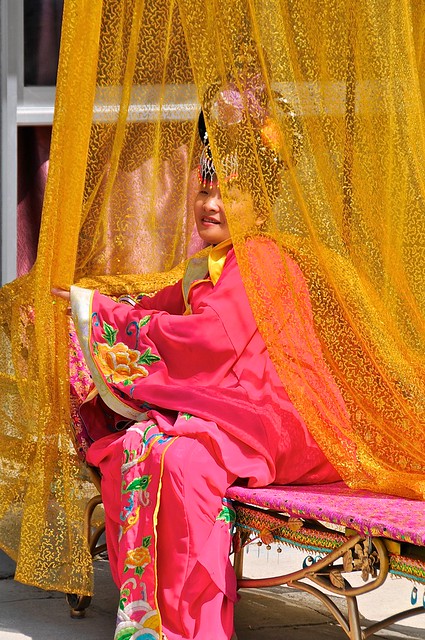
Tourists can play dress-up inside the inner wall.


_DSC7317
Looking north over the fort and inner wall, which is much more substantial. The restored stretches of the Great Wall are in the mountains back there.

Saturday, 11 August 2012

Langmusi: Tibetan Amdo on the border of Gansu and Sichuan

There's a direct bus from Xiahe to Langmusi, but it leaves early in the morning, and often sells out; if you miss it, you have to connect in Hezuo, which is midway between the two. The bus takes about four hours, or slightly longer with stops. You can find a nice list of your bus options to Langmusi here.

Helit and I met a Spanish schoolteacher on the bus, and we ended up sticking together for the bus ride and our time in Langmusi. Other than us, almost all the rest of the passengers were excitable Chinese tourists. We stopped a couple of times on the way: once by a lake, where all the Chinese jumped out and rapidly snapped pictures and ran for the bathroom; and once on a plain near some Tibetan herders who were waiting for the bus and sold the Chinese tourists short horse rides.

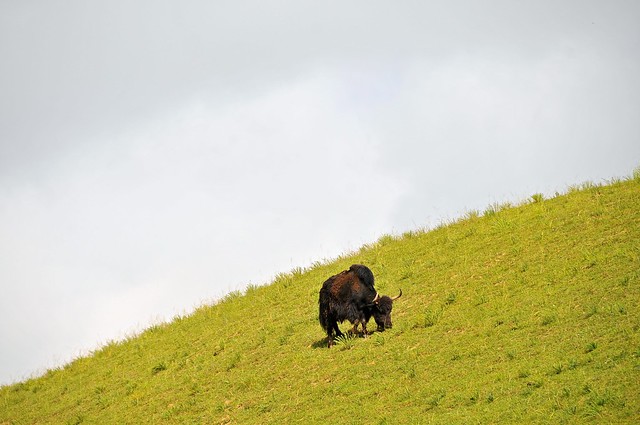
_DSC6979
A yak at the second stop.

_DSC6981
I took pictures while the Chinese took short horse rides. I'm sure the bus driver got kickbacks from the herders cum horse-wranglers.

_DSC6982

_DSC6984
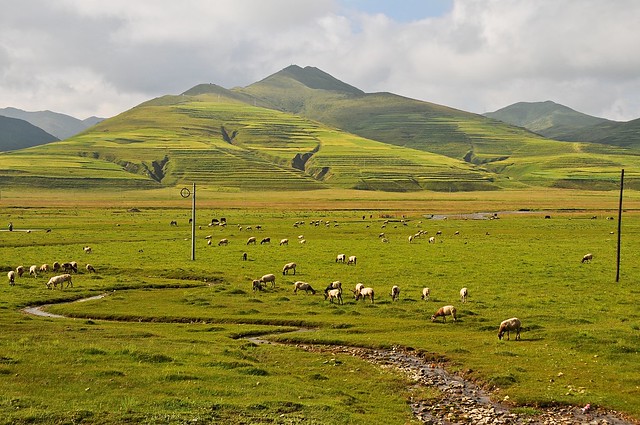
The sheep have horns. Unlike the sheep I would see in Central Asia, these are not fat-tail sheep.

Unlike the trip from Langmusi to Xiahe, it's not really that noticeable that you're going uphill, but the elevation changes from the 2,900 meters in Xiahe to about 3,300 meters in Langmusi.

We arrived around noon, and then searched for somewhere to stay. The Chinese construction boom had reached Langmusi, with both roadworks and hotel construction was in full swing, and tourism seemed to be booming. A symptom of this was that beds were in short supply, and it took a while to find a place to stay. We found a place in the Muslim quarter, and run by Tibetans. It had a nice front patio perched over the stream, and although the rooms were nice the bathroom facilities were even worse than the Overseas Tibetan Hotel: they positively reeked of ammonia. Thankfully, they were so ill-lit that you couldn't fully grasp how dirty they were.

I saw a couple of other hostel bathrooms in Langmusi, and they were no nicer, with with squat toilets that visibly flushed into ditches, and things like that. The Chinese very much take these sorts of setups in stride, which is hardly surprising given that even in major cities you can find bus-station toilets that are just tiled trenches a couple of feet deep, and everyone just lines up over them and squats, with "flushing" happening when water is periodically run down the ditch to wash the shit away. Bathrooms are dirty places where dirty things happen, and that's an accepted fact of life.

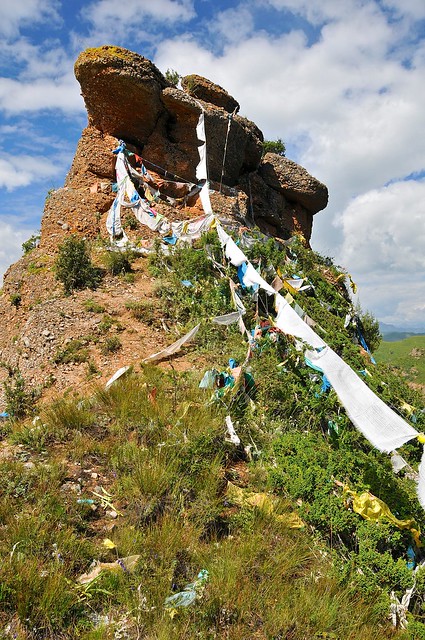
Anyway, after finding a place to stay, we set out on a hike to the Red Rock Mountain just west of town, which you pass on your way into town. We had seen some maps made by a tour outfit, and it looked like it would be fairly straightforward to circle around to the far side of the mountain and ascend it from there. Unfortunately, the map was wildly misleading and the road that was supposed to be the beginning of the path quickly deteriorated into an empty, unmarked field with no discernible path to the top, but lots of thick bushes. Stubborn as I am, I wasn't going to give up, so I pushed onwards up ever steeper and more hostile slopes while the girls turned back. I ended up having to scramble and crawl my way up through a steep section to summit one part of the mountain, only to have to retreat and re-ascend to get to the main mountaintop, as I was on a secondary peak.

_DSC6985
The view from midway up the mountain, before things got tough.

_DSC6986
If this is the view you get when you're climbing Red Rock Mountain, you're doing it wrong. I had just scrambled up and through a thicket of trees like you see on the left and bottom of the screen.

_DSC6996
It wasn't that difficult, as Tibetans obviously make it here with some frequency.

_DSC6997 - _DSC7005
The view of the town from the secondary summit.

Wednesday, 8 August 2012

Lanzhou & Xiahe: paranoia as you leave China proper

Lanzhou: welcome to the west

I had no idea where I would go from Lanzhou: on the one hand, I thought I might want to take a trip up the Yellow River to the Buddhas and caves of Bingling Si, and/or make the sidetrip up to the town of Xiahe and the Tibetan Labrang monastery there. I thought I would figure it out in Lanzhou.

I arrived at the train station in the morning, and headed to the the Lanzhou Huar (Flower) Hostel. They weren't in any guidebooks, but I had picked up a pamphlet in Shanghai (I think), and found instructions to them. It took about an hour to get there by bus because the directions weren't the greatest, and when I arrived I was curtly told they don't accept foreigners. This was really strange, especially since they had the English-language pamphlets on their reception desk! They said it was because of government regulations, and they weren't very helpful about telling me if there were any other cheap places in Lanzhou. I asked if I could use their bathroom, and they said it would cost 10 yuan to do so! Not very impressive (especially since it seems they had lacked the necessary permit to accept foreigners since at least 2011, yet were advertising themselves to foreigners during this time); I really don't understand the inability of people in hospitality industries to be helpful when they have to turn people away.

I backtracked to the station, and looked for the cheap hotels listed in LP. No luck, as they were either closed or not accepting foreigners. I figured that since I wouldn't be able to stay in Lanzhou that Binling Si was out, and that I would head to Xiahe. Unfortunately, the bus station listed in LP had been torn down. Well, at least the LP was still right about where the train station was.

I then tried to go to an internet cafe and see if I could figure out where to catch the bus to Xiahe and how to get there. Except the government requires you to swipe your RFID-chipped ID card in order to get online, effectively shutting out foreigners from using the internet. Thankfully, the owner over-ruled the attendant and swiped me in with her own ID card, letting me go online.

I managed to find the location of the new Bus Station as well as the South Bus Station, and determined that there should be buses running to Xiahe into the afternoon. I went the the new Bus Station (a couple of blocks east on the road in front of the station), only to find that the buses to Xiahe only run from the South Bus Station. I hopped a city bus to the vicinity of the South Bus Station, then got off and wandered around until I eventually found it, and got a ticket to Xiahe in the early afternoon—about 7 hours after arriving in Lanzhou.

_DSC6628
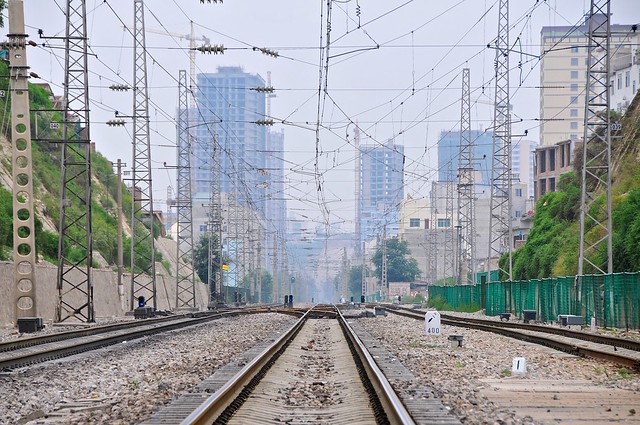
Crossing the train tracks on my way to Lanzhou's South Bus Station (which is actually well west of the main train station, and near the Lamnzhou West Train Station).

Although Lanzhou is already at an elevation of 1500 meters, the road steadily climbs to Xiahe, which is at 2900 meters. The road starts out running through dusty, dry mountains, completely devoid of vegetation except for small fields and trees planted by farmers. Then the road begins to climb in earnest, and the scenery turns decidedly green as it does. Lush fields and trees become the rule in the valleys between the increasingly-high mountains, but the biggest surprise being the abundance of new and impressive mosques that seem to pop up every few kilometers.

As we push higher and higher, the valleys narrow but the scenery remains quite green if not as lush. We stop seeing mosques, and before we know it we're pulling into Xiahe. The bus station is in the Chinese section of town, and the Tibetan quarter doesn't begin until a little further up the valley, so the introduction to the town is familiar. The closer you get to Labrang, the more Tibetan the town becomes.

As I arrived late—at around 5:00—all of the hostels were full. The Redrock Hostel said I could sleep on the floor (albeit at full price), so I ended up doing that. I thought their bathrooms—although appearing clean—were a little smelly, but it would turn out that by regional standards they were actually quite good.

Xiahe

Xiahe is home to the renowned Labrang monastery, which is said to be the third-largest Tibetan Buddhist monastery in the world. It once housed 4,000 monks, and although that number has dropped to an official 1,500, some claim that there are actually about 2,000 monks studying there. Regardless, it's big and there are lots of monks, and even more pilgrims.

A kora is a circuit that the devout walk around religious site, and you typically do it in a clockwise direction. Labrang has two koras: an inner kora that simply surround the monastery itself, and is lines with prayer wheels; and an outer kora that runs along the mountain behind the monastery.

After leaving my stuff at the Redrock Hostel, I went out to explore Labrang for a couple of hours before it got dark.

_DSC6631
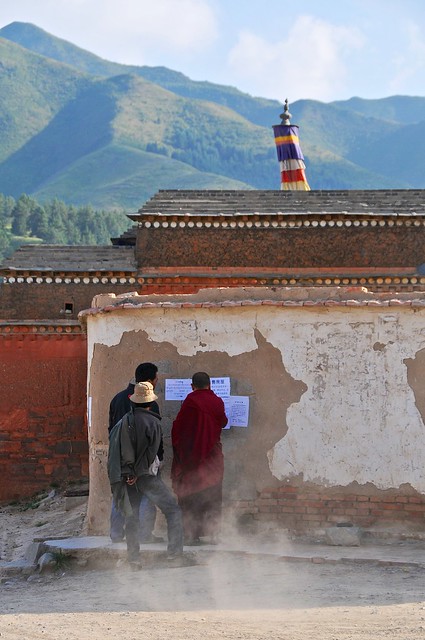
Tibetans reading notices on a dusty street at the edge of Labrang. While the Chinese section of town is all paved streets and newer buildings, the Tibetan sections are (or were) in a much greater state of disrepair.

_DSC6635
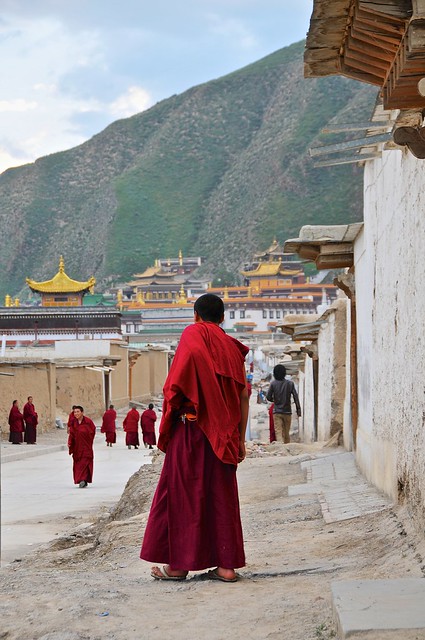
Along the main street from town to the assembly hall.

Sunday, 5 August 2012

Xian & the Terracotta Warriors

Arrival & Han Tang Hostel

I arrived in Xian and found my hostel pickup with a bit of trouble: it's a huge station and thousands of people can be counted on to arrive at any given time, so it took a couple of minutes to find the person sent to meet me. This really isn't a service you expect from a bargain hostel, anyway, but it was a surprising touch. What was even more surprising—shocking even—was that the rooms in this new hostel, the Han Tang Hostel, were about as good and thoughtfully designed as you would expect from a German or Austrian hostel: sturdy and creak-free wooden beds; individual reading lights and electrical outlets for each bunk; large lockers; separate toilet, shower, and sink cubicles in each room (and beautifully designed bathrooms); and rooms that seemed designed to hold four bunks, instead of bunks being haphazardly jammed into rooms too small for them. All this, for the bargain price of 30 yuan, which represented the high value of all the hostels I stayed at in China.

On the other hand, they try to make their money back with overpriced food and tours. The staff are overworked, and while they may try to be helpful, they really don't know much and can't offer advice other than the tours they are taught to sell (and they don't even know too much about them, as they couldn't answer some questions I had about their Three Gorges cruises). They don't know how to get to local places by local bus, and don't know where bus stations are. If you want a tour or want some food, they'll be able to help you, though. The "common area" on the ground floor functions mainly as a cafe, and not as a place for travelers to gather and relax, even though it's the only place you can get wi-fi. If you are comfortable with a hostel as primarily a place to sleep, as I am, it's a great place to base yourself, especially since there's no shortage of online information about Xian.

Xian: the eastern terminus of the Silk Road

I'm already two months into my trip now, but it's only in Xian that I'm really starting the raison d'etre of this trip: to see the Silk Road. Then, as now, Xian was really the introduction to what we popularly think of as big, bustling, populated China—China proper. West of Xian the country is drier and less populated, less prosperous, and more difficult. Mountains rise up and make travel difficult, with Gansu province's Hexi Corridor being the main conduit of travel, sandwiched as it is between the Tibetan plateau and the Gobi desert. The Hexi Corridor's western terminus ends in Xinjiang and the Taklamakan desert, where the Silk Road splits into two: the northern route goes north around the desert while the southern route goes along the southern route, below the Tibetan plateau. The northern and southern routes join up again at the western edge of the desert, in Kashgar, and then split up again to take various paths through the Central Asian mountain ranges.

Despite being the eastern terminus of the route, Xian remains decidedly Chinese in feel, with fairly scant evidence (aside from its wealth) of western influence. Although it has a noteworthy Muslim quarter, the Muslims are Hui and number only about 50,000.

Xian is where I really got tired of paying to see things. Attractions are quite expensive in China, with cheap sites being 25 yuan, mid-range being 60 yuan, and expensive attractions being 150 yuan or more. In comparison, most temples in Japan (a much more expensive country) were 500 yen, or about 30 yuan. Also keep in mind that my hostel in Xian was 30 yuan per night, and that 150 yuan was basically my daily budget for everything, including long-distance transportation.

If these are expensive for me, they're also expensive for Chinese. Or, expensive for average Chinese. For the most part, though, Chinese who can afford to travel can afford to pay a lot. When you have Chinese investors buying real estate in Manhattan, you begin to understand that if even only 1% of Chinese can afford to travel, that still makes 14 million affluent travelers. China can basically price their attractions at almost any level and still have enough domestic demand, and the somewhat perverse result is that Western prices (or more) are charged for attractions that fall to standards well below what we would expect in the West.

_DSC6391
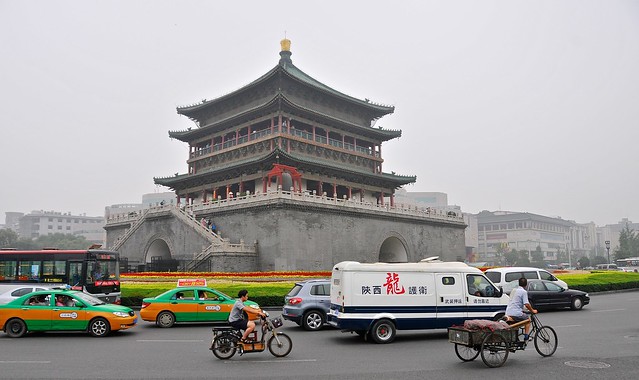
The Bell Tower is surrounded by a traffic circle and is accessed by underground tunnels. The 27 yuan entrance fee ensured I didn't go in.

_DSC6392
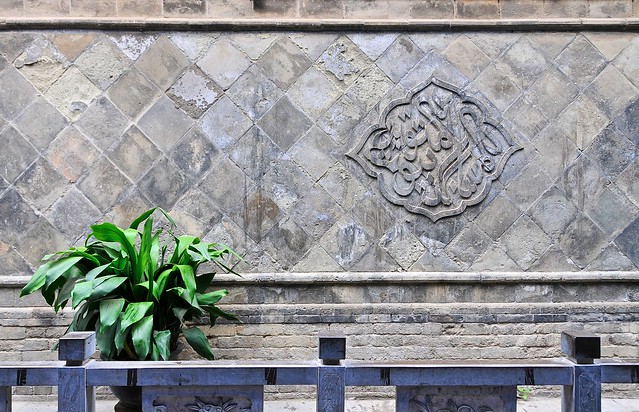
Arabic detail at the Great Mosque. Entry is 25 yuan so I skipped it, too. This is perhaps the one sight I skipped that might have been worth it, even if the Hohhot mosque was similar (but much smaller).

_DSC6397
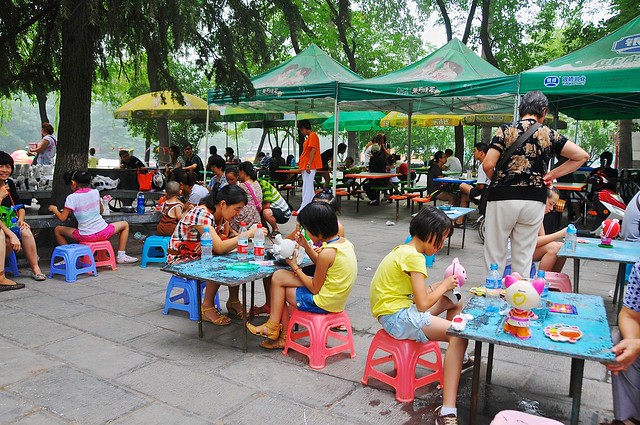
You can buy unpainted ceramics at this park and then paint them and have them fired at this park. Chinese dote on their children—not least because they can only have one—so you'll always see parents and children spending time together.

_DSC6398
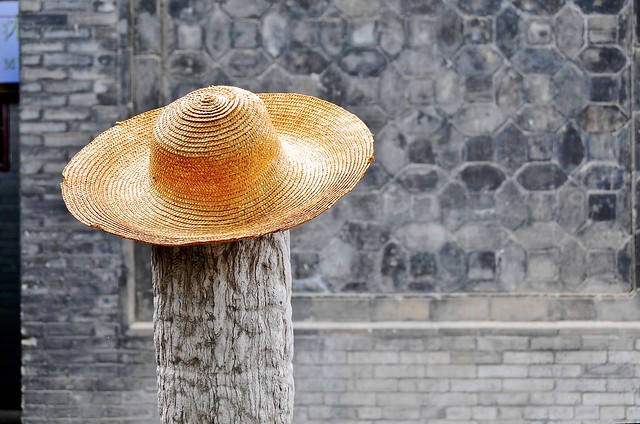
Hat on post at a mosque.

Thursday, 2 August 2012

The walled city of Pingyao

I arrived in Pingyao at around 7:00 am and walked from the station to the city. There were touts in trishaws by the station telling me they could take me to a guesthouse—including the top-rated Harmony Guest House that I was going to try and stay at—for free, but scams by transporters are legion so I declined and took the relatively short and pleasant walk.

_DSC6198
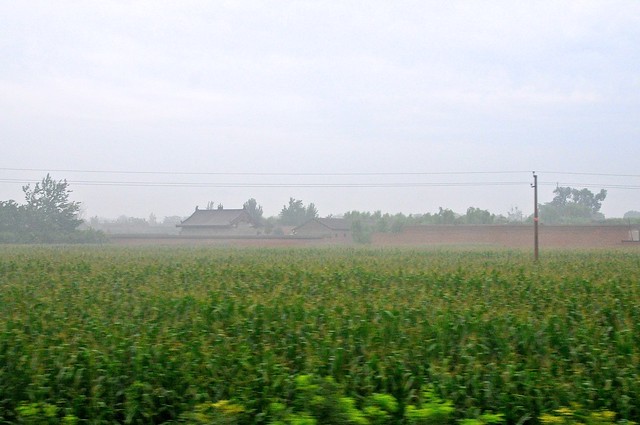
View from the train at 6:30 in the morning. Corn fields are a far cry from the Gobi.

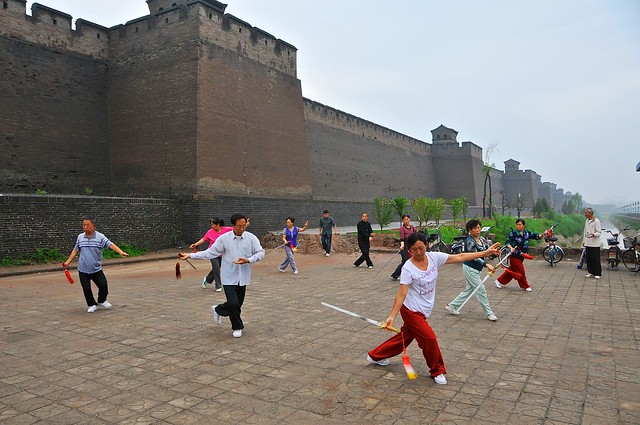
I was a little surprised that the town was just waking up and that there weren't more tourists or locals up and about, but other than some Chinese doing morning Tai Chi there wasn't a lot of action.

_DSC6211
Morning exercises by the old city walls, under the watchful eye of an old master.

I made it the Harmony and they did indeed have space, so I booked a dorm bed, left my bag in the common area, and had a shower in the shared bathroom before leaving to explore.

_DSC6217
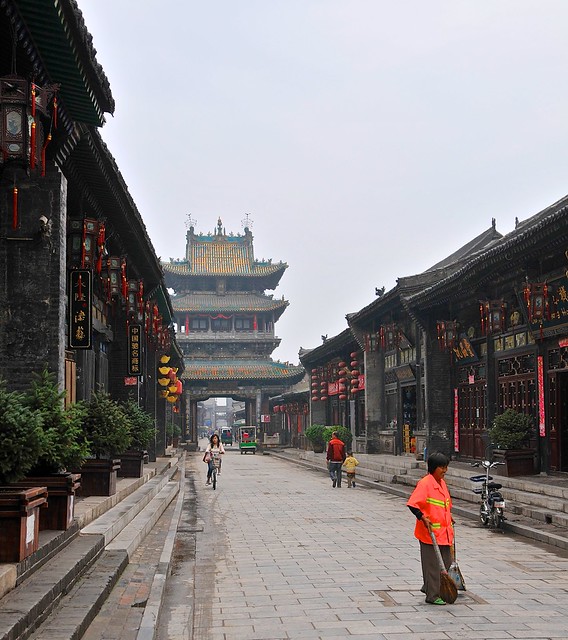
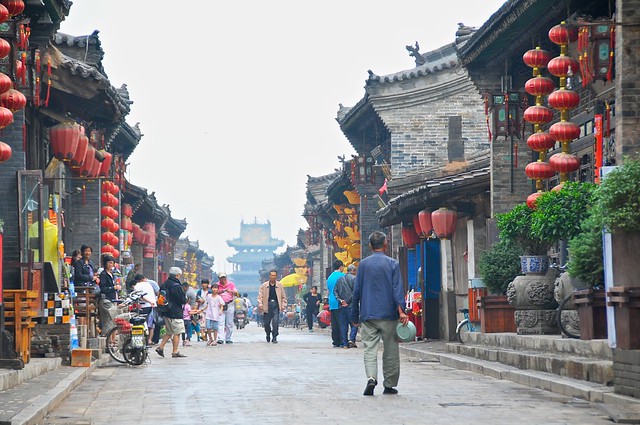
The Harmony is on this street, which isn't so bust at 8:00 in the morning.

_DSC6219
Shop doors are shuttered and the street sweepers are out.

_DSC6224
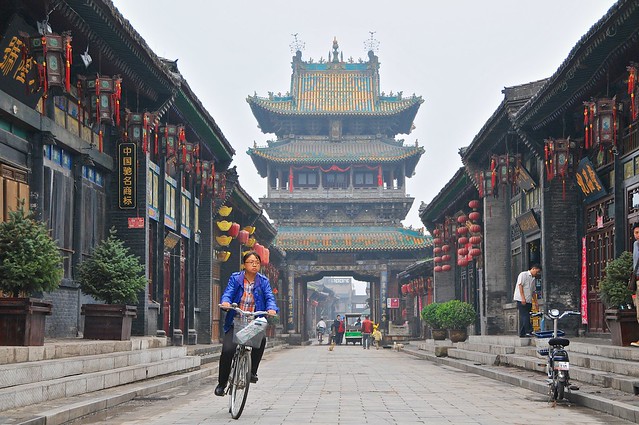
A little later and things start to pick up.

_DSC6229
The busier the main streets get, the further out to the side streets I go.

_DSC6230
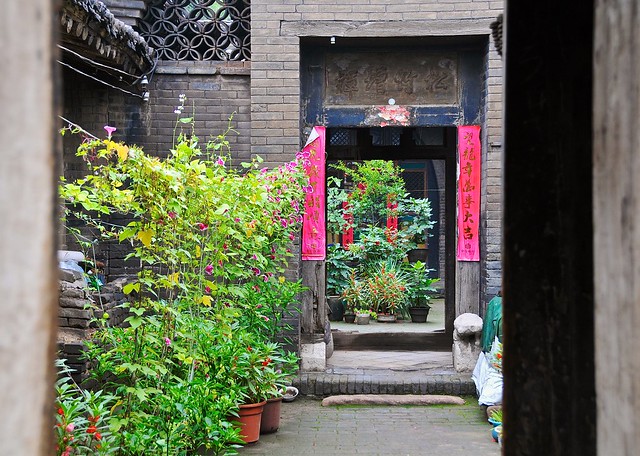
It's a wonder these old houses haven't been razed for new and expensive buildings.

_DSC6233
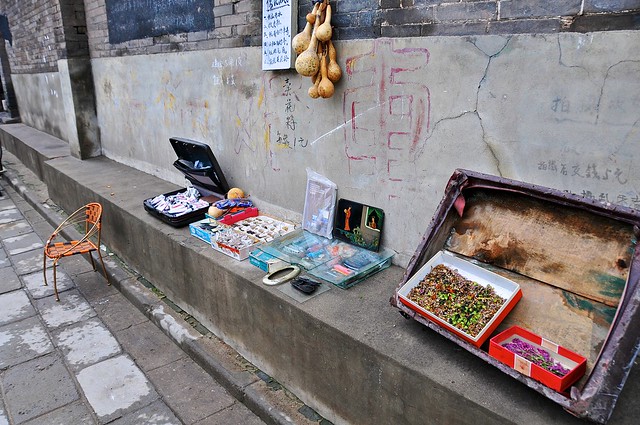
Old people sell knick-knacks in the street.

_DSC6235
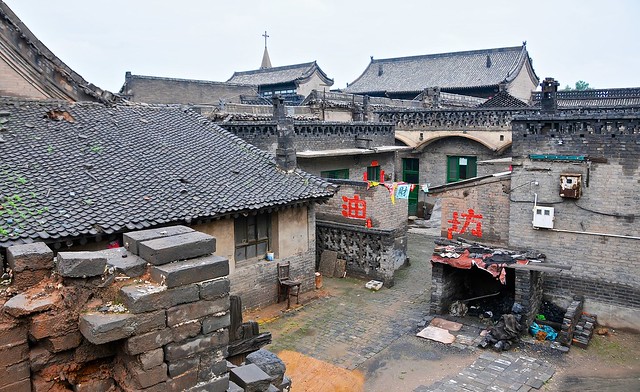
Old houses around communal courtyards, with a church spire in the background.