Wednesday, 17 October 2012

Penjikent, where the journey is more interesting than the destination

As I said in my previous post, share taxis to points north of Dushanbe don't actually leave from the cement factory but from a kilometer or so north of there, where the buses that run along Rudaki turn around (the map below reflects this starting point, which you can see if you zoom in). When I eventually found my way there, I was quickly able to find jeeps going to Penjikent, and negotiated a seat for 90 somoni (almost as much as a seat from Osh to Bishkek, which is about three times longer). Transportation prices in Tajikistan are fairly high, in part because the roads are pretty bad, and in part because fuel is considerably more expensive than in Kyrgyzstan. (You're also more likely to have to bribe a policeman in Tajikistan, too.)


The first stretch of highway as you head north from Dushanbe runs through an increasingly rugged valley that is the backyard for Dushanbe's rich and powerful, who maintain palatial estates along the river. The town of Varzob is possibly the epicenter of ill-gotten wealth, and includes a Presidential retreat complete with imposing fences and security. After Varzob the valley becomes more steep and there are precious few opportunities to build mansions as the road hugs the hills as it wends its way through the Fann Mountains.

_DSC2015
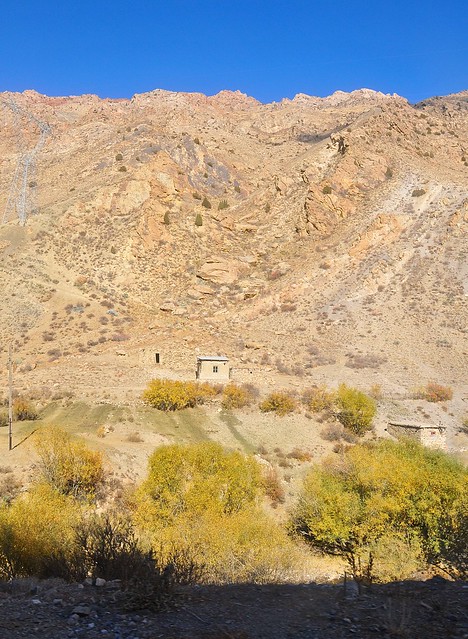
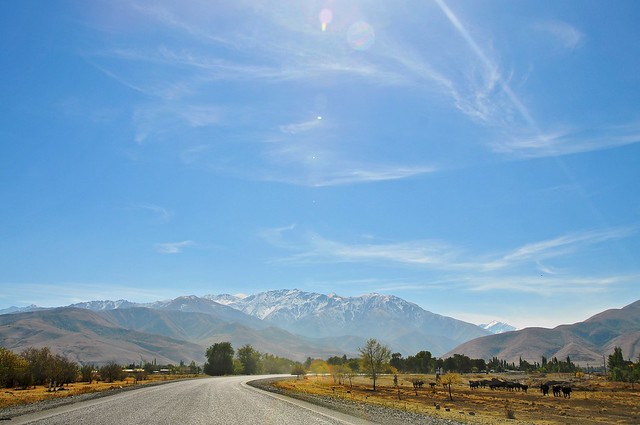
The M34 somewhere past Varzob but before the Anzob tunnel.

_DSC2017
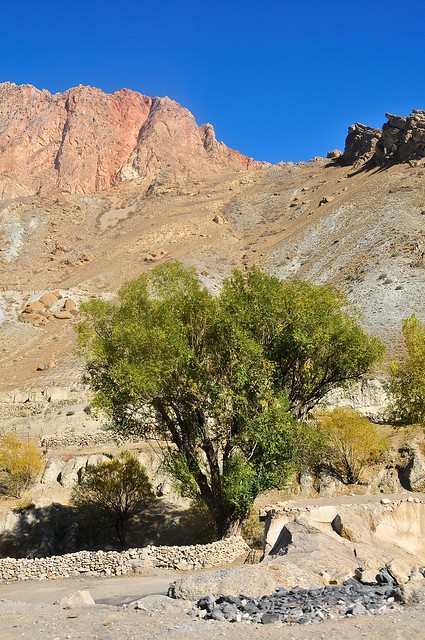
Though not particularly high, the Fann Mountains are rocky and support little vegetation. Or maybe it's more accurate to say that whatever vegetation that may have existed has been long since stripped by the peoples who have lived there.

The M34 between Dushanbe and Khojand is paved from start to finish, with the curious exception of the Iranian-built Anzob tunnel, also known as the tunnel of death. Officially opened in 2006, this 5-km-long tunnel bypasses the Anzob pass to the east, allowing the M34 to remain open—and northern Tajikistan connected to thre rest of the country—all year, regardless of the amount of snow in the Anzob pass. The problem is that this tunnel really isn't finished, as the surface inside the tunnel isn't paved, and is potholed and full of water year round as a result of spring-water that leaks into the tunnel from the ceiling. And despite the notoriety of the tunnel through Kyrgyzstan's Too-Ashuu pass, this tunnel is even more poorly ventilated, as there is only one fan in the middle of the tunnel, and its ineffectual whirling does little to clear exhaust fumes from the road. Supposedly the tunnel was to be completed in 2014, but I have difficulty believing that. (Edit: as of 2018 the tunnel is in good condition, with no potholes or water, and added ventilation, though apparently it can still get pretty polluted in there.)

There are also a number of smaller avalanche sheds along the road leading up to the tunnel, but these kinds of tunnels are much simpler since they are designed simply to protect the road from avalanches by allowing snow to wash over the roof. They're usually pretty short and just cover typical avalanche zones.

_DSC2021
After leaving the Anzob tunnel the road switchbacks and hairpins down and around the side of the the mountain.

Monday, 15 October 2012

Dushanbe: a monument to President Rahmon


Hotel Poytaht is a Dushanbe landmark. It's a huge Soviet-style hotel near the train station, and it's actually a reasonably attractive low-slung building that is four or five stories tall with two long wings angling off the central reception area. It's supposed to have reasonable rooms on the top floor that are charged on a per-person basis (and may or may not involve sharing), but they didn't want to sell me this sort of room, and said the lowest room was something like $30 or $40. The difference was academic to me, as either total was more than I wanted to spend.

I headed to a small supermarket nearby to get something to drink, and to plot out my next plan of attack. I figured out I would try the Farhang hotel, which is supposed to be cheap even if it's not exactly central. I hopped a bus headed in that direction, and found the hotel without too much difficulty (being behind the UFO-shaped circus, which itself was just off the major road the bus traversed, made this pretty easy). Whereas the Poytaht was well-maintained and a clean version of Soviet "hospitality," the Farhang had the dilapidated and scruffy feeling more familiar from Kyrgyzstan. For such a large hotel, I had to wait in the lobby until an attendant showed up, but the rooms were a bargain (for Dushanbe) at 60 somoni.

_DSC1916
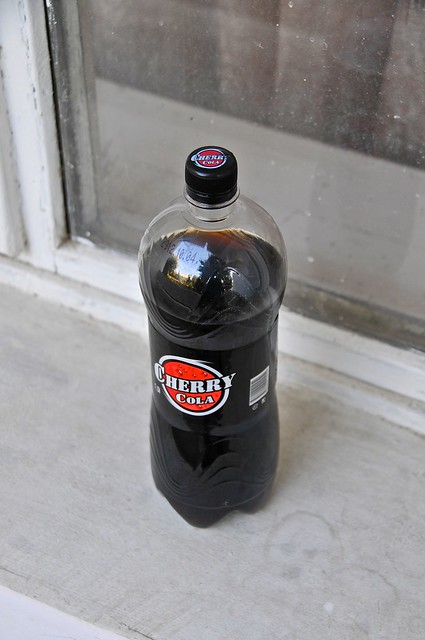
I love Cherry Coke. This is no Cherry Coke.

While Kyrgyzstani supermarkets were surprisingly Russian/Western, most of the things they sold were fairly local, or possibly from Turkey. In Dushanbe, a lot more things were imported from Europe, and a lot of things that would have been locally-produced in Kyrgyzstan were imported. Maybe the best example is Coke and Pepsi. Thomas Friedman's McDonalds theory of war says that no two nations with McDonalds outlets have ever gone to war (which was true until the Russia-Georgia conflict), and to a certain extent I think this really says something about the stability of nations with McDonalds. I think that the existence of foreign brands in a country says a lot about the investment climate and political stability and predictability in that country, and in this context it's interesting to note that Tajikistan is the only country in Central Asia that does not have a domestic Coke or Pepsi bottling facility: these products are officially imported from Kyrgyzstan, and unofficially imported from Afghanistan. The locally-bottled brand is RC Cola, which is more or less extinct in most corners of the world.

This lack of locally-produced goods inevitably means that things tend to be more expensive in Tajikistan than in Kyrgyzstan, which is unfortunate given that Tajikistan is even poorer than Kyrgyzstan. If your only exposure to the country was Dushanbe, however, it certainly wouldn't feel very poor—even if your only basis of comparison was with Kyrgyzstan's most prosperous city, Bishkek. Now, it's no surprise that large, capital cities feel more prosperous than other parts of the country, especially when the capital cities are orders of magnitude larger than any other city in the country. But even given this, it's pretty clear that a disproportionate amount of public funds have been spent beautifying the capital, and that a disproportionate amount of money resides in the capital. The old, Soviet-era public buildings in Dushanbe are better maintained and more attractive than they are in Bishkek. As mentioned earlier, the stores stock more imported goods, at higher prices. You see a lot more late-model luxury cars and European imports in Dushanbe than Kyrgyzstan (although I believe that many of them are stolen), with models like BMW X6 models being not hugely unusual.

What really sets Dushanbe apart from Bishkek, however, is that in Dushanbe you can see new construction and new monuments being built by the government and President Rahmon (who has ruled since 1992). Sure, Nazarbayev is doing the same thing in Astana, but the key difference is that Kazakhstan is riding a wave of resource-based prosperity, while Tajikistan remains dirt poor. Despite this, in Tajikistan the villages remain poor while Dushanbe is beautified.

_DSC1918
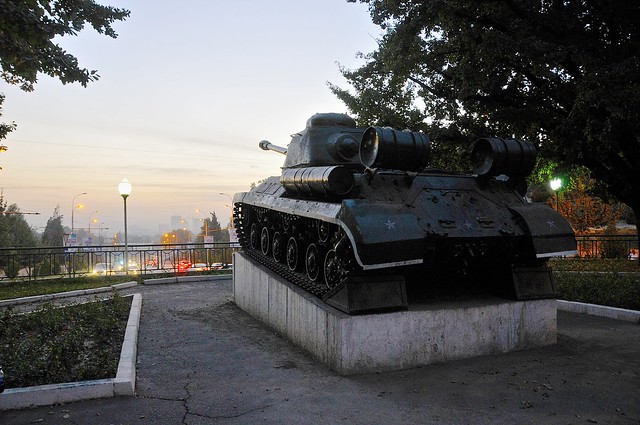
Old Soviet tank in old-style park takes aim at the skyline.

_DSC1922
Imposing monuments (this one to Ismail Samani), empty plazas surrounded by barricades, and armed guards make these public spaces less than inviting. Pedestrians walking by skirted the plaza in front instead of taking the shortcut across, so I had to ask the guard to ask if it was possible to approach the monument and take a picture.

_DSC1923
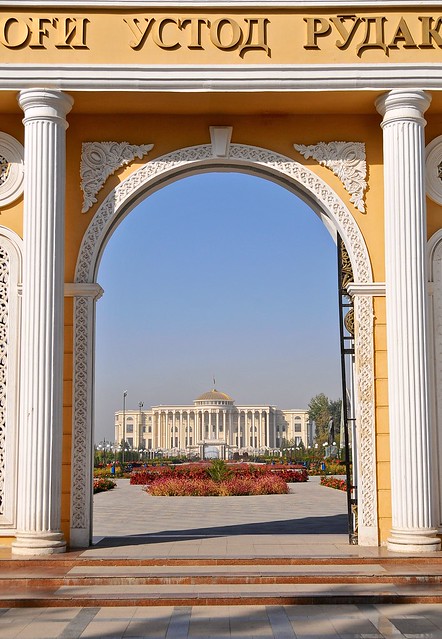
The Presidential Palace.

_DSC1925
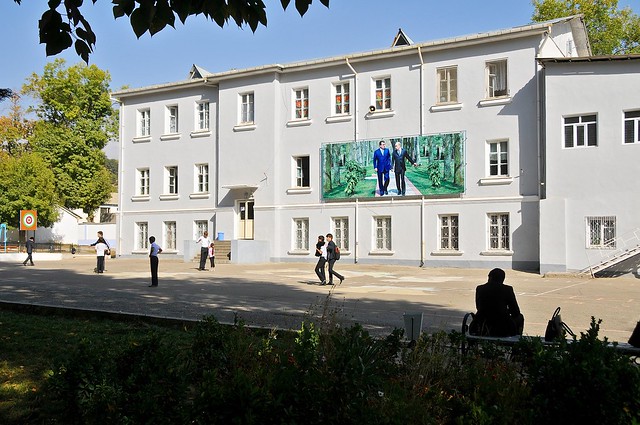
Next to Turkmenistan, Tajikistan is the Central Asian country that most aggressively promotes a personality cult around its leader, Rahmon. Pictures of him heralding his accomplishments and profound statements ("Education is good!") are everywhere. Putin looks like a wimp next to him.

Wednesday, 10 October 2012

Rejected at the Kyzyl Art border, sleeping with border guards, and rerouting through Karamyk on the way to Dushanbe


Border woes and border bliss

Although I was supposed to be picked up early in the morning, the driver rang the hotel to let them know we wouldn't be leaving until closer to noon. As the day dragged on, the time was pushed back, and we didn't actually end up leaving until the middle of the afternoon. This was a disappointment (but about par for the course when trying to travel cheaply in Central Asia), as it meant that it would be dark by the time we arrived at the Tajik border. I figured that I would probably try to get out at Karakol and spend the night there, and then continue on to Murghab the next day, so as to be able to enjoy some of the high Pamir scenery.

And so it was that we arrived in Sary Tash at dusk, where we filled up on cheap Kyrgyz gas before leaving town and heading south towards the Kyzyl-Art border. Although the Trans Alay mountains on the southern side of the Alay valley look close, they are actually some 40km from the northern side of the valley—and the road to the border, unlike the east-west highway that runs through the Alay Valley, is rough and crumbling.

The Kyrgyz border station, Bar Dobo, is in the valley floor, at the start of a sub-valley that cuts its way up the Trans Alays. Getting stamped out of Kyrgyzstan was simplicity itself, as the driver simply grabbed out passports and ran into a nearby building where the border guards were located. By this time it was dark and cold at this altitude, so we were all happy to stay inside the right-hand-drive Pajero.

After being stamped out we started driving up towards the border, switchbacking up the mountain towards the end, before summitting at the the 4,280 meter high Kyzyl-Art border.

A Tajik border guard approached and took our passports from our driver. This is when the problems began: although I had a visa and the required GBAO permit, they were claiming that this border could only be used by tourists leaving Tajikistan, and couldn't be used to enter Tajikistan. Although this should have been true during the period when GBAO was off-limits to tourists, it made no sense now that the territory had reopened for tourists.

Of course, something could be arranged, but only if I paid them $100. This was pretty outrageous, and a price I wasn't willing to pay. My driver really wanted me to pay, as he would have to drive me back if I was rejected, and when I said that I only had $20 on me (this was really the only small currency I had on me), the border guards rejected this amount, and I was denied entry.

The driver thus had to bring me back down the mountain. There was a small building about halfway between the border posts, and although there was supposed to be someone there who would let people stay there, the building was uninhabited and locked up tight when we arrived. We had to go all the way back down to the Kyrgyz border post, and after a brief discussion they let me stay with the customs guards in one of the buildings.

I was kind of surprised by the border post buildings. Although they were in the middle of nowhere, they were much nicer than most houses you see in places like Sary Tash or Sary Moghul, no doubt because they were Soviet-built government buildings. Instead of having stoves for heating, all the buildings had hot-water radiators and were really quite warm. The rooms I was allowed to see were empty, with typical tapchan-style mattresses and bedding being laid out at night. Despite being Soviet built, and originally having a decent shower block in the basement (the showers apparently no longer functioning, however), the toilets remained long-drop outhouses.

One of the younger off-duty guards spoke pretty good English and wanted to know if he could play a video on my netbook. It turns out he wanted to watch a video that had been taken by a visiting TV station that was covering border security patrols (Tajikistan being a smuggling point for Afghan drugs, and this border being one of the borders through which drugs transit). But really he wanted to have a bit of a laugh about his boss, who was narrating one of their night patrols, but who was also so out of shape he had to stop and pant every minute or so as they walked outside.

Racism: one of the top American cultural exports

The next morning, we were joined at breakfast by an older officer who was quite the character. He spoke basically no English, but was an effective mime, and made fun of his partner when he heard him approaching, mimicking a trudging giant. He then said he had a wide nose, and looked African. Uh oh... do we have a Soviet-Kyrgyz racist here? I still don't know what to think, but he was just getting started and it was about to get much more complex. It turns out that—according to him—his partner actually did have some African ancestry, though it's difficult to see.

What's easier to see is that there is a generational and geographic difference in how people view race, and that American media doesn't always translate well or communicate positively; although this older Kyrgyz guy didn't know English, he did know the N-word. I don't think he knew how it is understood in Western—let alone North American—culture, but his younger colleague did and was clearly uncomfortable translating what he was saying. But basically, he started out by saying his partner was "half-nigger" (I'm going to use the language he used, because I think it's the only way to properly communicate the impact of what he said on my ears, and convey the complexity of the situation). Which was shocking for me to hear, and uncomfortable for his translating colleague to hear, but I honestly think he was oblivious to the baggage associated with the word. I say this because he then told me about how much he loved "niggers," saying he loved their lips and asses. He then went on to talk about the type of people he loved, including Halle Berry, Jennifer Lopez, and (somewhat surprisingly) Katherine Zeta Jones, asking me if I had any pictures of them on my computer. He then showed me pictures of himself he had taken with a couple of black American girls at the border, commenting on how beautiful they are.

It was an interesting experience, and as I said I'm still not sure what to make of it. There's certainly something to be said about the corrosive effect of American media in popularizing and even legitimating certain racist phrases and stereotypes, and while there's also some sort of sterotyping going on with the border guard (who also likely harbours anti-Uzbek sentiment, for example), I'm not sure if I should think of his stereotyping as qualitatively worse than North American stereotypes about Russian women, or "Asian" women, or anything along those lines. I mean, this is a guy whose only exposure to black people comes from movies/media and the very odd tourist: to the extent he harbors views about blacks that we would consider racist, to what extent is he or Kyrgyz society to blame, and to what extent is the West?

Anyway, after our interesting breakfast we went outside where they were inspecting a couple of old Soviet-era trucks coming back to Kyrgyzstan. They were largely empty, as I think they were used mainly to carry barrels of cheap Kyrgyz fuel into Tajikistan, but it took about an hour to inspect them. They put me on one of the trucks and we bounced our way down to the junction near Sary Tash, where I got out to hitch a ride west to the border.

_DSC1854
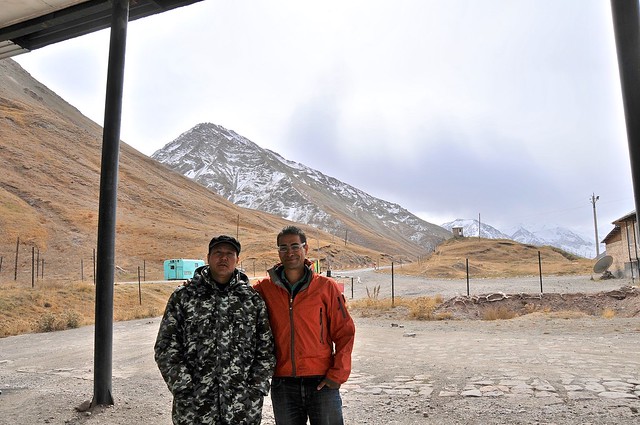
The border guards I stayed with. The guy in the middle is the one who loved Halle Berry, while the one on the left is his partner. The truck on the right is the one they put me on to head back down to Sary Tash.

_DSC1861
Looking north towards Tajikistan, with my Halle Berry-loving friend.

Monday, 8 October 2012

Osh, and lessons in ethnic violence

The return to Osh brought a welcome increase in temperature. Where the daily highs in the Alay valley were about 5°C, down in Osh—some 2,400 meters lower—the daily highs were right around 20°C.

2010  Osh Riots and ethnic tensions

Back at the Taj Mahal hotel I was joined in the dorm by a couple of journalists from Bishkek. One was a French guy who had come to Bishkek to help set up a French-language newspaper, and the other was a Kyrgyz girl who was working with him at the paper. I was surprised there was enough of a market for a French-language paper in Kyrgyzstan, but he said there was.

Anyway, they were in the Osh to write about the 2010 ethnic violence in the area. Lonely Planet had a little bit of information about this—which was somewhat surprising given that the guidebook was published in 2010 and most of their stuff seems to be written a year in advance of actually publishing it—but the journalists told me that the widespread and severe, and that the interim Kyrgystani government had commissioned an independent report on the violence, and then totally disavowed the report once its highly-critical findings were published. Somewhat strangely, the 2014 edition of LP is even less helpful on the issue, merely saying that the issue was controversial.

I downloaded and began to read the Report of the Independent International Commission of Inquiry into the events in Southern Kyrgyzstan in June 2010, and I also spoke with the guys at the Osh Guesthouse while reading the 104-page report. At the beginning, some of the things they told me seemed far-fetched, and I suspected they were exaggerating. It turns out their claims were pretty plausible, and I was more surprised after reading the report that their accounts of what happened in 2010 weren't filled with more rancor.

Pretty much everyone agrees that at least 400 people died, and that over two-thirds of those killed were ethnic Uzbeks (others suggest these total represent only a fraction of the actual deaths, given that those buried quickly in accordance with Muslim beliefs were not counted at all). They also agree that over 100,000 international refugees were created, as Uzbeks crossed the border to Uzbekistan en masse. An additional 300,000 people were internally displaced within Kyrgyzstan—again, almost all of whom were Uzbeks fleeing the violence.

The immediate backdrop for this violence was the overthrow of President Bakiyev in April 2010, but the longstanding tensions between ethnic Kyrgyz and Uzbeks in southern Kyrgyzstan and the Ferghana valley also played a large role: Uzbeks had been marginalized from participation in civil society and employment in governmental positions for a long time, and there was significant resentment of prosperous, urban, Uzbek businessmen from the mountain-dwelling Kyrgyz in southern Kyrgyzstan.

Now in the aftermath of Bakiyev's overthrow, there is widespread belief that Bakiyev and his supporters wanted to foment racial violence in order to demonstrate the need for a strongman-style leader in Kyrgyzstan (as in neighboring CIS countries) who could effectively and ruthlessly control the country. Under this theory, Bakiyev's allies and relatives in the region began to spread rumors about Uzbeks intended to create violence, and Bakiyev thugs may have initiated the violence. We do know that in May, after his April overthrow and exile, Bakiyev supporters took control of government buildings in Osh, Jala-Abad, and Batken, although control of these buildings were quickly recovered.

We once again see that tales of inter-ethnic rape is always a reliable way to incite violence. We saw it in the violence targeting Uyghurs in the Shaoguan Incident in 2009 (which helped spark the Urumqi riots), and it seems to have been the most effective rumor used in June 2010 in southern Kyrgyzstan. After some small skirmishes on June 10, rumors spread of Uzbeks raping Kyrgyz girls at a university dormitory, and it seems that this rumor was spread to Kyrgyz communities in the mountains in an organized manner, prompting numerous Kyrgyz to come down to Osh and Jala-Abad from their mountain communities.

What seems to have happened after this is that Kyrgyz streamed into Osh and Jalal-Abad, and that the Uzbeks largely barricaded themselves into their districts in order to protect themselves. The arriving Kyrgyz then raided police stations and security vehicles that had been deployed by the police, seizing weapons and ammunition from these forces, who did not attempt to prevent them from doing so. Apparently a few Armed Personnel Carriers were also taken from the complicit police, and used to help break into Uzbek areas: direct military involvement seems probable.

Applying its evidentiary standard to the evidence, the KIC considers that there was some military involvement in these attacks. This arises from presence of expertly driven APCs carrying men in military uniform, the apparent readiness with which the military surrendered APCs, weapons and ammunition, the repeated system and order to the attacks and the evidence of planning in the specific targeting of neighbourhoods, people and property. Such discipline and order is not commensurate with the normal actions of spontaneously rioting civilian crowds.

Women were seized and raped, while men were tortured and killed. Police sniper rifles were also used against Uzbeks, though it's not certain if these were from civilians who had seized the weapons or from actual police or army officers. Those Uzbeks who could sought refuge across the border in Uzbekistan, while others fled their homes to seek refuge elsewhere in Kyrgyzstan.

Once the situation stabilized and peace returned to the area, almost all of those who were investigated and charged with violence were Uzbeks, and police failed to protect those Uzbeks from physical assault during their trials. It's clear that ethnic tensions continue to percolate in the region.

This happened only two years before I was in Osh and Jalal-Abad. Although many buildings had been burned out, I had failed to notice any, and if I did notice any I certainly didn't connect them to the violence. For someone coming from a stable and diverse country like Canada, it was really difficult for me to understand this level of ethnic strife, and to understand how people could continue to function as a society in the knowledge that there was so much widespread ethnic hatred which could be re-ignited at any moment. It was difficult to understand why there wasn't more anger from the Uzbeks. I'm sure that part of it is that as a tourist you simply aren't able to access and understand the tensions that simmer beneath the surface in most societies (I'm not sure that most tourists to the US really feel the the tense state of race relations there, even though events continually pop up that hint just how bad they are), but even accounting for this there simply seems to be a greater acceptance of—or resignation to—tremendous injustice, discrimination, and unfairness.

Friday, 5 October 2012

Kyrgyzstan's Alay Valley in autumn: Sary Moghul and Sary Tash


My earlier decision to sleep at the Taj Mahal but use the nearby Osh Guesthouse for information was a good one, as the Taj Mahal is much quieter and allows for better sleep. After waking up refreshed I stopped by the Osh Guesthouse in the morning to see if they had received my boots. Boots? Yes, boots. You see, my Blundstone boots had developed a rip in the leather where it joins the sole— a chronic problem, as this was the second pair to develop the same problem, and I already had the first pair replaced in the US under warranty.

Blundstone: horrible US warranty service, amazing Australian warranty service

Getting warranty service on the first pair was not easy, as I didn't have the receipt and didn't live close to where I bought them. I contacted Blundstone's US distributor, but they never returned my emails. I finally resorted to contacting Blundstone Australia directly, and after sending them a couple of pictures showing the problem, they airmailed a pair of replacement boots from Australia! That's pretty amazing, even if their US distributor is crap.

So when my replacement pair developed the same problem in Mongolia, I was pretty disappointed, especially since it meant my right foot would now get wet in shallow puddles (Blundstones are waterproof for brief periods, and walking through ankle-deep water usually isn't a big problem). Given my prior experience with Blundstone Australia, I figured they would help me out, but being on the road I didn't really have a good place to get them sent. But when i went through Osh the first time, knowing that I would be back there in a few weeks on my way to Tajikistan, I asked at the Osh Guesthouse if they had an address I could get stuff sent to (and how safe it would be to do so). They said it should be pretty safe, as they would just get a note in the mail telling them to come pick something up, but that it could take a while to get there. I asked Blundstone Australia if they could send out a replacement to the Osh Guesthouse, and they readily agreed to.

GBAO permit through the Osh Guesthouse

I had hoped that the boots would have arrived safely by the time I got back to Osh, but they weren't there. While talking to the guys at the guesthouse, however, and talking about the problems of getting a GBAO permit and inquiring as to whether the pamirs were really open for tourists, I was told that not only were the pamirs open and permits being issued, but that I could get a permit from them at the guesthouse. It would take a few days processing and $40, but it was possible. This was great news for me, as it would mean I could take the direct route from Osh to Murghab, instead of first heading to Dushanbe and backtracking to the pamirs and coming back to Osh on my way out of Tajikistan.

I applied for the GBAO permit and decided to spend the processing time in the villages of Sary Mogol and Sary Tash in the Alay Valley near the Tajik border. This was the same valley I had driven through as I entered from China, and from Sary Mogol you apparently have great views of Pik Lenin, a 7,000+ meter peak on the Tajik border.

Osh's CBT office: not helpful

I went to the Alay Hotel, where the regional CBT office is located, to see what sort of options CBT had in the region and to see if I could reserve a spot in the Sary Mogol CBT homestay that night. The CBT office was really quite unhelpful, telling me that they wouldn't call the Sary Mogol homestay and that I could simply arrive and find the home-stay quite easily as everyone knew where it was. It's easy to see why the system isn't working as well as it could, as I described in my Arslanbob post. I suspect that if I wanted a service for which I would have directly paid the guy at the office he would have been more helpful.

I went down to the marshrutka and taxi stations near the market to see if I could get a ride to Sary Mogol, and ended up finding a ride in what Lonely Planet calls the Agromak 4WD stand (which is really just a big parking lot behind some street-front blocks, and most of the vehicles are not 4-wheel-drive. I ended up grossly overpaying, as I apparently agreed to pay 700 som for a ride to Sary Mogol, which Lonely Planet says is twice what I should have paid (though I think their prices for the Osh-Sary Tash route are too low). It seemed reasonable in light of the 1,000 I paid from Irkeshtam, but c'est la vie. I hate haggling, especially since it seems entirely haphazard whether the driver initially quotes you a fair price or a wildly-inflated price.

The M41 between Osh and Sary Tash

The ride up to Sary Tash would be the first time I had done this stretch of the M41 during the day, and it was really quite impressive. The first half hour or so from Osh is relatively flat farmland that is part of the Ferghana valley, but it eventually starts to climb into a mountain valley, culminating in the 2,391 meter Chiyrchyk Pass, some 80 km from Osh. After that pass you drop down into the town of Gulcha (1,546 m) and up the Kurshab valley. Whereas the mountains before the Chiyrchyk pass were grassy and green, the mountains in the Kurshab valley are red and craggy, with a wide and stony riverbed that looks tame and narrow in the fall but must appear very different during the spring melt.

At a couple of places along the road, where the valley was narrower and the highway had more bends, I saw wrecked tractor-trailers. For the most part they had failed to negotiate a corner and had gone straight off the road. I had a difficult time imagining that the government really cares that much about removing wrecked trucks from the sides of roads, so I imagined that they had been there for some time. I was wrong about this, however, as when I returned to Osh a few days later they were gone (maybe they are valuable as scrap?). I suspect that these crashes may have been fatal, as nobody in Central Asia likes to wear a seatbelt, and drivers (and front-seat passengers) only pretend to wear them by slinging them across their bodies when they pass police checkpoint. In fact, wearing your seat belt is likely to be taken as an insult by your driver, who will proceed to tell you how good a driver he is. Such a good driver that not even the argument that you are protecting yourself from the other bad drivers on the road will be satisfactory: he's so good he can avoid those bad drivers.

_DSC1201
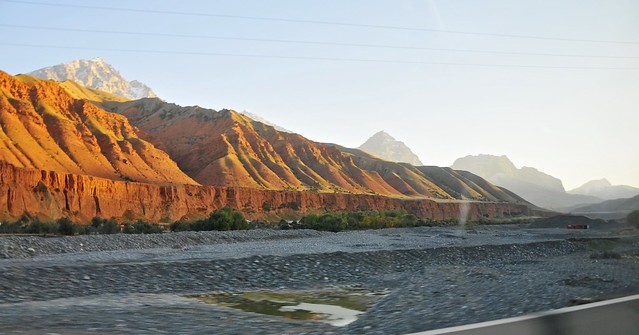
The Kurshab riverbed and mountains after Gulcha.

_DSC1203
The lower mountains are surprisingly grassy.

Tuesday, 2 October 2012

The M41 from Bishkek to Osh

Finding a share taxi to Osh was significantly more difficult than I expected. There weren't any at the place indicated in the 2010 Lonely Planet, and I kind of had to wander around Osh Market until I found a place with randomly-parked cars half-full with people. Although the going rate from Osh was only 1,000 som, I ended up paying 1,300 som for the return trip. It wasn't all bad, though, as I was given the front seat even though I was the last passenger, and because I was the last passenger we left right away. It turned out that this was really just a family returning to their home in Jalal-Abad, and they were picking up a passenger to help pay for gas.

The car was a Japanese-market, right-hand-drive Lexus. It was about 6 years old, had pretty low mileage, and apparently he only paid something like $6,000 for it. Having lived in Japan, this really isn't that surprising: Japan has an aggressive licensing system known as shaken that requires cars to undergo inspections every couple of years, and after a couple of inspections it generally becomes cheaper to sell the cars on the export market than perform the repairs deemed necessary. Of course, because there is a limited market for right-hand-drive vehicles, the resale price is pretty low. Add in the fact that Japanese drive limited distances and take care of their cars pretty well (even if the inspectors feel repairs are warranted), and used Japanese cars are usually a very good deal.

From what I saw on the road, however, it seems that Kyrgyzstan is the only country in the area that allows for the import of right-hand-drive cars (Mongolia also does), which is a good deal for Kyrgyzstanis but a bad deal for others (Kazakhs don't have the same need for cheap cars, Uzbekistan taxes foreign-made cars so heavily that almost all vehicles are made by the domestic Chevrolet factory, and in Tajikistan the market for cheap cars seems to be met by cars stolen from Europe).

Shooting into the sun through a windshield isn't the best way way to take pictures, but it's a heck of a lot better than from the back seat (especially the middle seat, which I had on the way up to Bishkek), and I took advantage of the opportunity on the way south.


_DSC1149
The first 60 km from Bishkek you simply head west on a flat road that passes through numerous small villages and towns in the Chuy valley. At Kara Balta you turn south onto the M41, and head towards the Ala Too mountains to the south.

_DSC1150
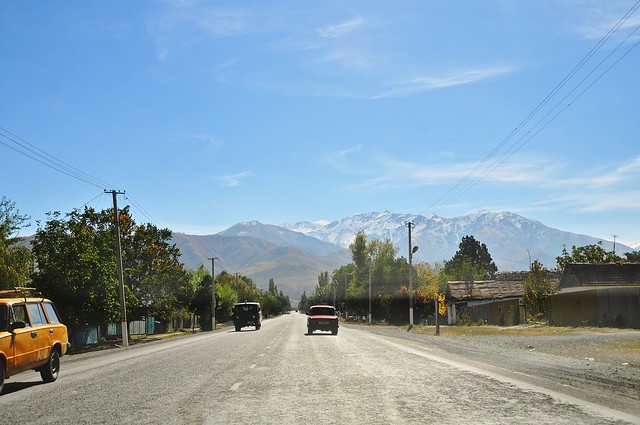
Passing through Sosnovka village, which marks the entrance to the mountain canyons and the exit from the flat and fertile Chuy valley.

_DSC1151
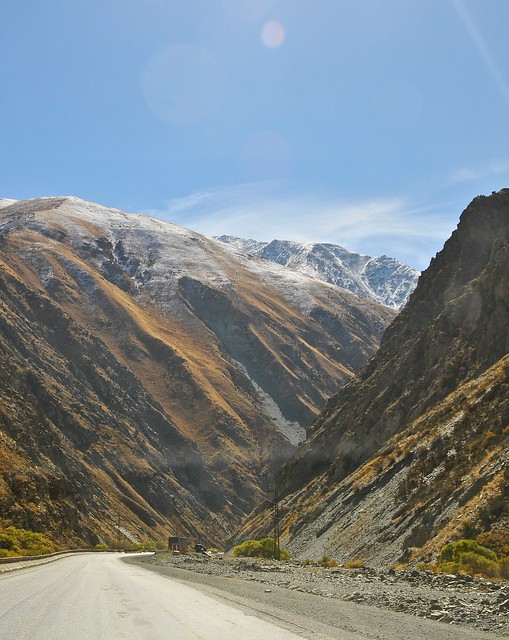
The steep and narrow valley that the M41 runs through.

Monday, 1 October 2012

Bishkek the third: picking up the Tajik visa en route to Osh

Coming back from Jeti Oguz, I was given a ride to the main road by the store owner's nephew, who was a stockbroker from Bishkek and spoke English. Before the did that, though, they downloaded some of my pictures to their USB drive, which was a bit surprising since the guy had no idea about computers (but his children did). In China, you could go into a modest looking shop and find that the shopkeeper had a new flat-screen computer behind their shelves, and that they were amusing themselves playing Mahjong or watching videos on Baidu, but in Central Asia such a scene would be truly shocking.

It was raining at the junction, so the owner's nephew let me stay in his car until a marshrutka passed, and we talked a bit about politics and the nearby gold mines. The Kumtor mine creates something like 10% of Kyrgyzstan's GDP, but it's owned by a Canadian company which keeps more of the profits than protestors like, as they accuse the government of striking a sweetheart deal. In his opinion there wouldn't be a profitable mine at all if you tried to let locals run it, but it's easy to see why people are upset when they see foreigners profiting off of local resources.

Back in Karakol I headed straight to the bus station to catch the marshrutka back to Bishkek. I lucked out in the sense that the marshrutka was almost full, which means little waiting. It still ended up taking me about 10 hours to take the 422 km trip from Jeti Oguz to Bishkek, despite knowing exactly how to get there and what transportation to take. This is a sobering reality about transportation in Kyrgyzstan: it takes a long time, even in the best of circumstances.


I wasn't surprised to find the Sakura full when I arrived there, so it was another night at the cheap hotel. No worries.

The next day I moved over to the Sakura in the morning to secure a bed, and otherwise I had little to do other than pickup my Tajik visa. Compared to the Iranian visa, the Tajik visa was easy-peasy. I just went to the embassy, told them I had applied for a visa a couple of weeks ago, and they picked through the applications sitting in the in-box to find mine, then processed it and gave me my visa. Even though there were rumblings that the GBAO permits were being issued in Dushanbe and that the Pamirs were once again open for tourists, I was told that they still weren't issuing them in Bishkek and that I would have to apply in Dushanbe. That was a major disappointment (as well as an additional expense in Dushanbe), but there's not much you can do about it.

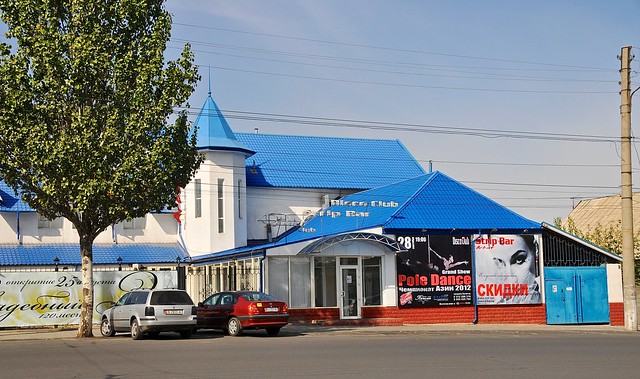
The Tajik Embassy in Dushanbe is now listed on Google Maps and thus pretty easy to find. One of the more interesting things you may encounter on your visit to the embassy is the strip club on the nearest major road: certainly not something I expected to see advertised so openly in what is, after all, still a somewhat conservative Muslim country.

_DSC1141
The strip club near the Tajik Embassy.

_DSC1142
Looking down the entrance park to the Kyrgyz State University, next to the Philharmonic.

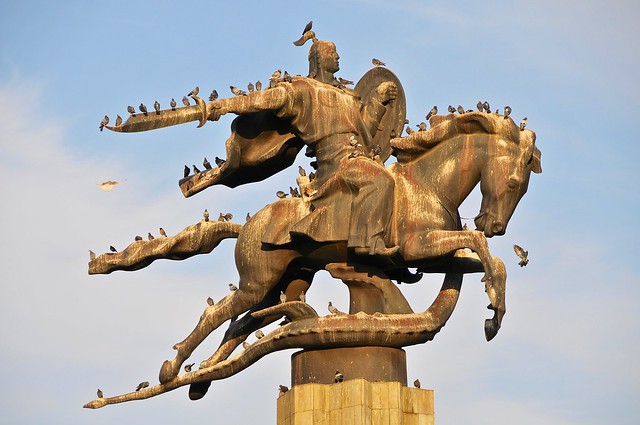
_DSC1145
A statue of Manas in front of the Philharmonic keeps the pigeons happy.

Budget

September 30, 2012, from Jeti Oguz to Bishkek: 958 som
  • Room at cheap hotel: 300 som
  • 2 x super snicker, pic-nic chocolate bar, M&Ms: 121
  • Van to Karakol: 30 som
  • Marshrutka to Bishkek: 300 som
  • Coke: 40 som
  • Dinner at roadstop (bifsteak): 130 som
  • Coke: 37 som
October 1, Bishkek: $65 + 670 som
  • Bed at Sakura: 350 som
  • Sandwich: 33 som
  • Bus x 2: 16 som
  • Ice cream, lemon soda: 21 som
  • Lozenges, eggs, sandwich, pepsi, tomatoes, coffee packets: 150 som