Border woes and border bliss
Although I was supposed to be picked up early in the morning, the driver rang the hotel to let them know we wouldn't be leaving until closer to noon. As the day dragged on, the time was pushed back, and we didn't actually end up leaving until the middle of the afternoon. This was a disappointment (but about par for the course when trying to travel cheaply in Central Asia), as it meant that it would be dark by the time we arrived at the Tajik border. I figured that I would probably try to get out at Karakol and spend the night there, and then continue on to Murghab the next day, so as to be able to enjoy some of the high Pamir scenery.
And so it was that we arrived in Sary Tash at dusk, where we filled up on cheap Kyrgyz gas before leaving town and heading south towards the Kyzyl-Art border. Although the Trans Alay mountains on the southern side of the Alay valley look close, they are actually some 40km from the northern side of the valley—and the road to the border, unlike the east-west highway that runs through the Alay Valley, is rough and crumbling.
The Kyrgyz border station, Bar Dobo, is in the valley floor, at the start of a sub-valley that cuts its way up the Trans Alays. Getting stamped out of Kyrgyzstan was simplicity itself, as the driver simply grabbed out passports and ran into a nearby building where the border guards were located. By this time it was dark and cold at this altitude, so we were all happy to stay inside the right-hand-drive Pajero.
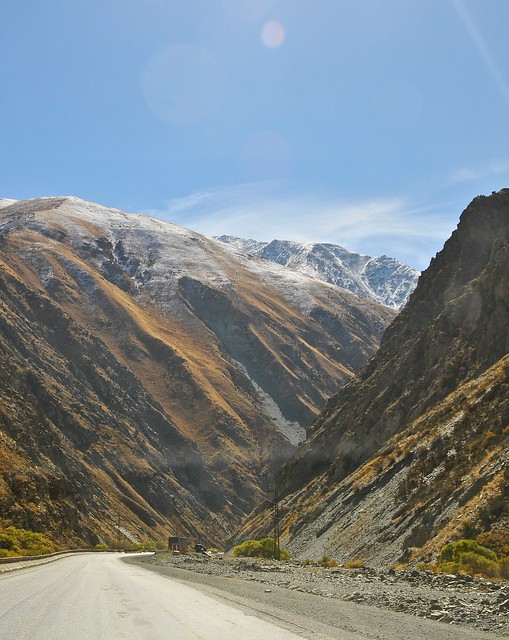
After being stamped out we started driving up towards the border, switchbacking up the mountain towards the end, before summitting at the the 4,280 meter high Kyzyl-Art border.
A Tajik border guard approached and took our passports from our driver. This is when the problems began: although I had a visa and the required GBAO permit, they were claiming that this border could only be used by tourists leaving Tajikistan, and couldn't be used to enter Tajikistan. Although this should have been true during the period when GBAO was off-limits to tourists, it made no sense now that the territory had reopened for tourists.
Of course, something could be arranged, but only if I paid them $100. This was pretty outrageous, and a price I wasn't willing to pay. My driver really wanted me to pay, as he would have to drive me back if I was rejected, and when I said that I only had $20 on me (this was really the only small currency I had on me), the border guards rejected this amount, and I was denied entry.
The driver thus had to bring me back down the mountain. There was a small building about halfway between the border posts, and although there was supposed to be someone there who would let people stay there, the building was uninhabited and locked up tight when we arrived. We had to go all the way back down to the Kyrgyz border post, and after a brief discussion they let me stay with the customs guards in one of the buildings.
I was kind of surprised by the border post buildings. Although they were in the middle of nowhere, they were much nicer than most houses you see in places like Sary Tash or Sary Moghul, no doubt because they were Soviet-built government buildings. Instead of having stoves for heating, all the buildings had hot-water radiators and were really quite warm. The rooms I was allowed to see were empty, with typical tapchan-style mattresses and bedding being laid out at night. Despite being Soviet built, and originally having a decent shower block
in the basement (the showers apparently no longer functioning, however),
the toilets remained long-drop outhouses.
One of the younger off-duty guards spoke pretty good English and wanted to know if he could play a video on my netbook. It turns out he wanted to watch a video that had been taken by a visiting TV station that was covering border security patrols (Tajikistan being a smuggling point for Afghan drugs, and this border being one of the borders through which drugs transit). But really he wanted to have a bit of a laugh about his boss, who was narrating one of their night patrols, but who was also so out of shape he had to stop and pant every minute or so as they walked outside.
Racism: one of the top American cultural exports
The next morning, we were joined at breakfast by an older officer who was quite the character. He spoke basically no English, but was an effective mime, and made fun of his partner when he heard him approaching, mimicking a trudging giant. He then said he had a wide nose, and looked African. Uh oh... do we have a Soviet-Kyrgyz racist here? I still don't know what to think, but he was just getting started and it was about to get much more complex. It turns out that—according to him—his partner actually did have some African ancestry, though it's difficult to see.
What's easier to see is that there is a generational and geographic difference in how people view race, and that American media doesn't always translate well or communicate positively; although this older Kyrgyz guy didn't know English, he did know the N-word. I don't think he knew how it is understood in Western—let alone North American—culture, but his younger colleague did and was clearly uncomfortable translating what he was saying. But basically, he started out by saying his partner was "half-nigger" (I'm going to use the language he used, because I think it's the only way to properly communicate the impact of what he said on my ears, and convey the complexity of the situation). Which was shocking for me to hear, and uncomfortable for his translating colleague to hear, but I honestly think he was oblivious to the baggage associated with the word. I say this because he then told me about how much he loved "niggers," saying he loved their lips and asses. He then went on to talk about the type of people he loved, including Halle Berry, Jennifer Lopez, and (somewhat surprisingly) Katherine Zeta Jones, asking me if I had any pictures of them on my computer. He then showed me pictures of himself he had taken with a couple of black American girls at the border, commenting on how beautiful they are.
It was an interesting experience, and as I said I'm still not sure what to make of it. There's certainly something to be said about the corrosive effect of American media in popularizing and even legitimating certain racist phrases and stereotypes, and while there's also some sort of sterotyping going on with the border guard (who also likely harbours anti-Uzbek sentiment, for example), I'm not sure if I should think of his stereotyping as qualitatively worse than North American stereotypes about Russian women, or "Asian" women, or anything along those lines. I mean, this is a guy whose only exposure to black people comes from movies/media and the very odd tourist: to the extent he harbors views about blacks that we would consider racist, to what extent is he or Kyrgyz society to blame, and to what extent is the West?
Anyway, after our interesting breakfast we went outside where they were inspecting a couple of old Soviet-era trucks coming back to Kyrgyzstan. They were largely empty, as I think they were used mainly to carry barrels of cheap Kyrgyz fuel into Tajikistan, but it took about an hour to inspect them. They put me on one of the trucks and we bounced our way down to the junction near Sary Tash, where I got out to hitch a ride west to the border.
 |
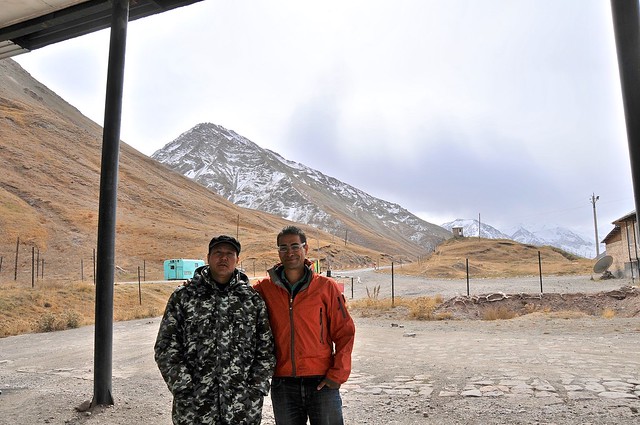
| The border guards I stayed with. The guy in the middle is the one who loved Halle Berry, while the one on the left is his partner. The truck on the right is the one they put me on to head back down to Sary Tash. |